Biology Together · Unit 3: What plants need and how they work
What Do Plants Need?
Rewritten on : new text and film. Your notes and highlights stay, but the text around them may have moved.
Does a plant really need sunlight if it already has water? Four cups and a cupboard give a fair answer.
Three real-life stories behind this activity, about 2 minutes aloud, or read them below.
The film, 4 minutes, and the safety notes, for the grown-up to look at before the activity.
The hands-on part, done with a child: about 30 minutes, then a few quick looks later.
Pause when the reading reaches a film, and offer to play it. Saved on this device.
Watch the film now, or keep listening
That is the end of the reading
This idea at other levels
An activity for ages 5 to 10 about photosynthesis. Next, for an older child: Photosynthesis Feeds the World (grade 7).
See every levelHide the levels
Photosynthesis
Plants use light to turn air and water into sugar, and that sugar feeds almost everything alive.
Taught at four levels: ages 5 to 10, grade 7, high school and upper-level college.
College, upper level · the level you chose
Photosynthesis: The Light Reactions
Two photon-driven lifts carry electrons from water to NADPH, and make ATP.
Biochemistry · about 24 min · film 3:18 · 3 practice questions
The Calvin Cycle: Fixing Carbon from Thin Air
Rubisco fixes carbon dioxide, and the ATP and NADPH bill adds up.
Biochemistry · about 24 min · film 3:08 · 3 practice questions
High school · the level you chose
Track each atom from carbon dioxide and water into sugar and oxygen.
Biology · about 40 min · film 3:19 · Virginia BIO.2e
Grade 7 · the level you chose
Photosynthesis Feeds the World
A tree is built mostly from air: the willow that proved it.
Life Science · about 40 min · film 3:26 · Virginia LS.4 a, LS.4 b
Ages 5 to 10 · the level you chose
What Do Plants Need? · this lesson
Grow seedlings in a cupboard and on a windowsill, then compare.
Biology Together · about 30 min · film 3:38 · Virginia 1.4 a, K.7 a, 4.2 a, 4.2 b
Play the ladder · 5 films, about 16 min, from grade 7 to upper-level college. Each film waits for you to press play.
Next door to photosynthesis
- Cellular respirationRespiration takes the sugar apart again to get the energy out.Nearest lesson: Releasing Energy from Food (grade 7)
- Food webs and energy flowEvery food chain starts with the sugar a producer makes.Nearest lesson: Who Eats Whom? (ages 5 to 10)
Short versions inside this lesson
The grade 7 version · about 1 minute to read
In grade 7 Life Science, children look closer at photosynthesis. They learn that most of a plant's dry mass (what is left once its water is dried out) comes from carbon dioxide in the air, joined with water using light energy, and very little comes from the soil. A willow tree grown in a tub of soil in the 1600s helps show the soil part: the tree gained about 164 pounds while the soil lost about two ounces, though the man who grew it thought the gain came from water alone. They also see how the food plants and algae make feeds nearly every other living thing.
The plainest version · about 1 minute to read
Plants need water, air, light and room to grow. A green plant makes its own food inside its leaves. It uses light from the sun, water, and a gas from the air. A plant in the dark can live for a while on food packed inside its seed. It grows tall and pale. When that food runs out, it gets weak, because it cannot make more without light.
Find an idea: every idea, searchable
Which lessons teach an idea, and the notes on each level, were written by AI models from the lessons and checked by a second model. A person has not yet read every one. How we use AI
About this activity what is in it
Builds on:Wake Up a Seed (read)Why these?
Rewritten on : new text and film. Notes and highlights stay, but the text around them may have moved.
Before you start
- Hands-on time
- About 30 minutes, plus 3 to 10 days for seeds to sprout, then 5-minute checks every day or two for about 2 weeks
- Where
- Indoors
- Ages
- 5 to 10, with an easier and a harder version below
- Grown-up
- An adult pokes the drainage holes and opens the potting mix. Stay nearby while your child plants and waters; the child does the looking, drawing and measuring.
What you need
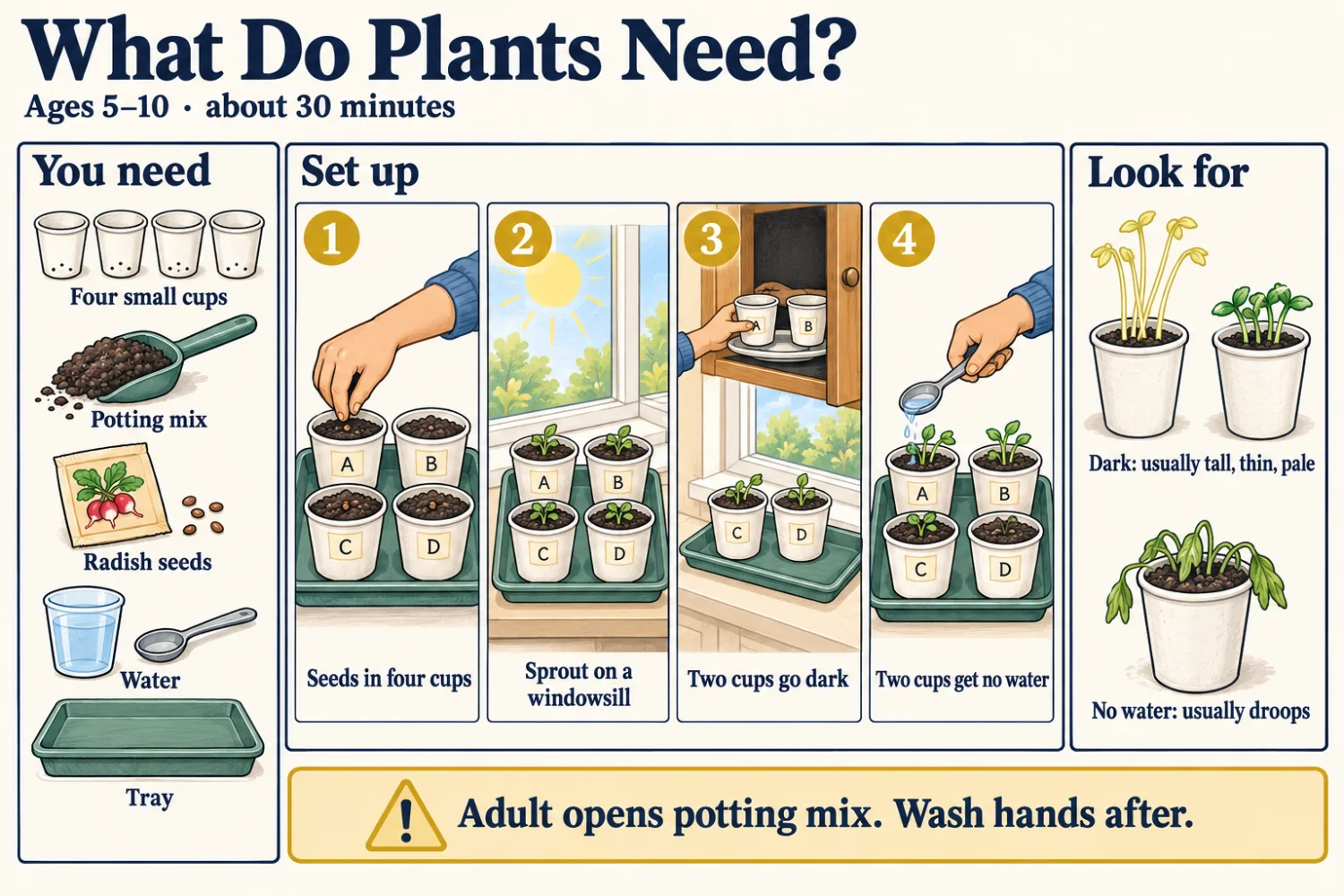
- 4 small cups (paper or clear plastic, about 9 oz), with 3 or 4 holes poked in each bottom by an adult
- A tray or baking dish to stand the cups in
- Potting mix, enough to fill the cups
- A packet of radish seeds (grass seed also works but is slower)
- Water and a tablespoon
- A sunny windowsill, plus a cupboard or a large cardboard box for a dark place
- Masking tape and a marker for labels
- A fifth cup for a seed-in-the-dark test (optional)
- A ruler marked in centimetres (ages 8 to 10)
- Paper and a pencil, or the printed observation sheet below
Virginia science standards SOL 1.4 aSOL K.7 aSOL 4.2 aSOL 4.2 b
In this activity. You and your child grow radish seedlings in four cups, then take away light, water or both and watch for two weeks.
The film
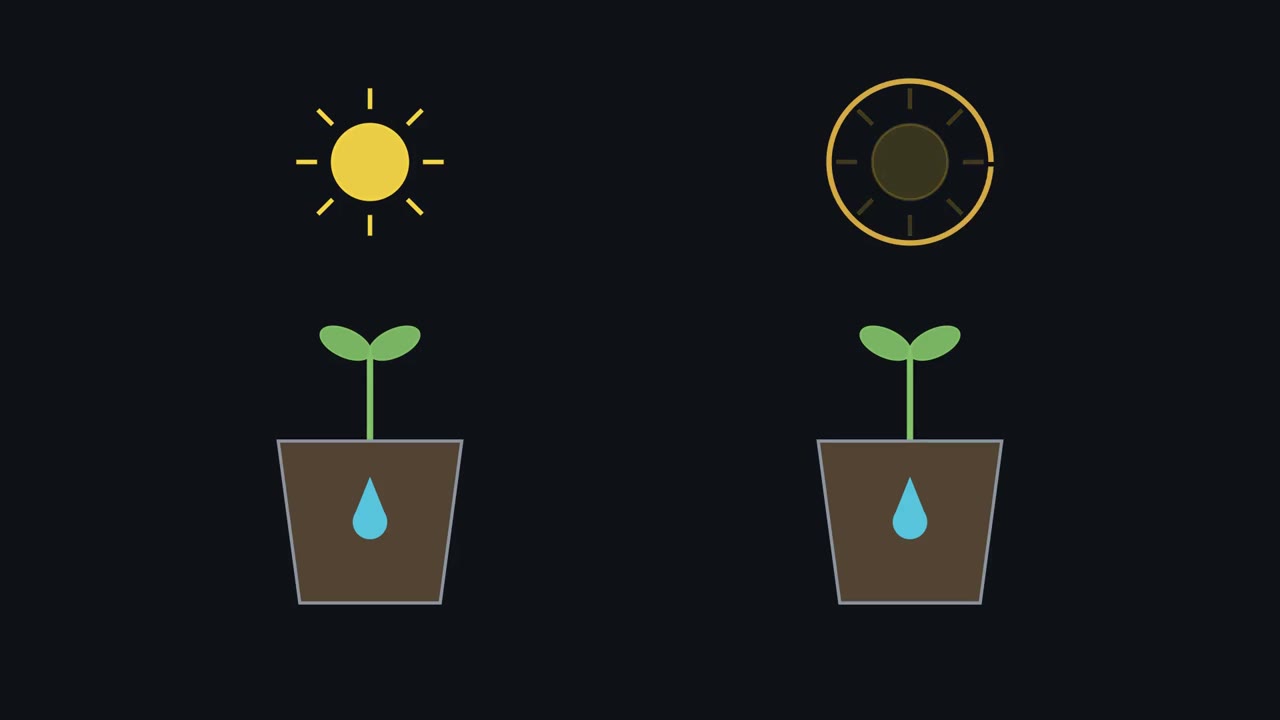 ▶ Watch What Do Plants Need? A Parent Guide · 3:38
Read the transcript of “What Do Plants Need? A Parent Guide”
Film transcript: What Do Plants Need? A Parent Guide
Does a plant really need sunlight if it already has water? Four cups of radish seedlings and a dark cupboard give a fair answer. Setup takes about thirty minutes, then quick checks every day or two for about two weeks. Your child practices running a fair test. They make a guess, change one thing, and check the result over time. You need four small cups, with holes an adult pokes in the bottom. Add a tray, potting mix, and radish seeds. Bring water, a tablespoon, labels, and a cupboard or a big box for a dark place. Have an adult open the potting mix with scissors outdoors or by an open window. Keep your child back and turn your face away. Dampen the mix before scooping to reduce dust.
Read the seed packet and choose untreated seeds. Fill the four cups and label them: light plus water, dark plus water, light no water, dark no water. Your child presses four or five seeds into each cup and covers them. Give each cup two tablespoons of water. Keep all four cups on a sunny windowsill. When the top feels dry, water each cup the same amount. Sprouts usually appear in three to ten days. When most seedlings are about two centimeters tall, have your child predict what will happen to each cup. Write or draw their guesses. Use a cupboard free of cleaners that children cannot climb into. Move both dark cups inside and shut the door. Give each water cup two tablespoons when the top feels dry.
Stop watering the other cups. Compare cups that differ only in light, or only in water. Picture the two cups that still get water. After about a week, how might the dark seedlings compare with the windowsill seedlings? Shorter, the same height, or taller?
The dark seedlings are often taller, thinner, and paler. They may lean or flop as they stretch on stored food. When you compare your cups, ask, 'What do you notice besides height?' Every day or two, take a quick look and return the dark cups. Draw each cup. Note height, color, and drooping. The dry cups usually droop within two to five days. Dark seedlings weaken over one to two weeks. The light and water cup stays green and upright. A green plant makes its own food in its leaves. It uses light, water, and a gas from the air. In the dark, a seedling lives on stored food. When that runs out, it cannot make more. Stay with your child while they plant and water.
Nobody tastes the seeds, soil, or plants. Keep seeds and marker caps away from children under four. If a child is choking, call nine one one. Wash hands with soap and water after planting and after each check. At the end, lay the first guesses beside the cups. Ask, 'What surprised you?' Then ask, 'Where does a green plant get its food?' Let your child point to a cup as they explain.
Before you start
- Hands-on time
- About 30 minutes, plus 3 to 10 days for seeds to sprout, then 5-minute checks every day or two for about 2 weeks
- Where
- Indoors
- Ages
- 5 to 10, with an easier and a harder version below
- Grown-up
- An adult pokes the drainage holes and opens the potting mix. Stay nearby while your child plants and waters; the child does the looking, drawing and measuring.
What you need
- 4 small cups (paper or clear plastic, about 9 oz), with 3 or 4 holes poked in each bottom by an adult
- A tray or baking dish to stand the cups in
- Potting mix, enough to fill the cups
- A packet of radish seeds (grass seed also works but is slower)
- Water and a tablespoon
- A sunny windowsill, plus a cupboard or a large cardboard box for a dark place
- Masking tape and a marker for labels
- A fifth cup for a seed-in-the-dark test (optional)
- A ruler marked in centimetres (ages 8 to 10)
- Paper and a pencil, or the printed observation sheet below
Virginia science standards SOL 1.4 aSOL K.7 aSOL 4.2 aSOL 4.2 b
The big idea
Your child grows radish seedlings in four cups, then takes away light, water or both, and watches for about two weeks. They practise running a fair test: making a guess, changing one thing, and checking the result over time. They find out that a plant in the dark grows tall, thin and pale before it weakens, and that a plant with no water droops first.
Say it together (read aloud): “A green plant makes its own food in its leaves. It needs light and water to do it. In the dark it lives on stored food, then gets weak.”
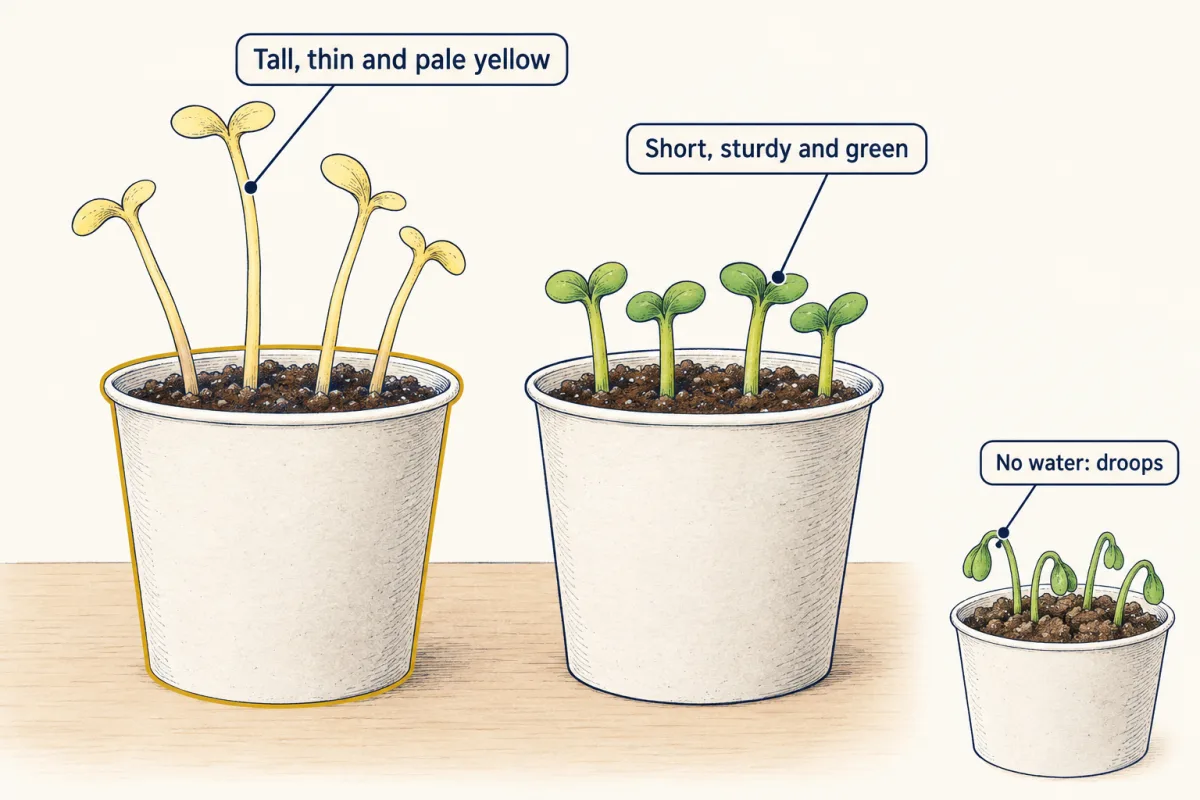
Put one cup of seedlings in a cupboard and leave one on a windowsill. Within a week they often look like different plants. The one in the dark grows tall, thin and pale yellow. The one in the light stays shorter, sturdier and green.
Plants need water, air, light, nutrients and a place with room to grow. This activity tests two of those needs, light and water, with a fair test: a test where only one thing changes and everything else stays the same. Same soil, same cups, same seeds. Each pair of cups you compare differs in just one thing, light or water.
Light matters because a green plant makes its own food. Its leaves use light energy to turn water and carbon dioxide, a gas from the air, into sugar, and they give off oxygen. This is photosynthesis. A seedling in the dark lives on food it has stored, some from its seed and some made earlier in the light. When that runs out it cannot make more. Plants do not get their food from soil. Soil holds the roots, water and small amounts of nutrients.
For teachers
With a class, give each group of four one tray of four cups.
What to do
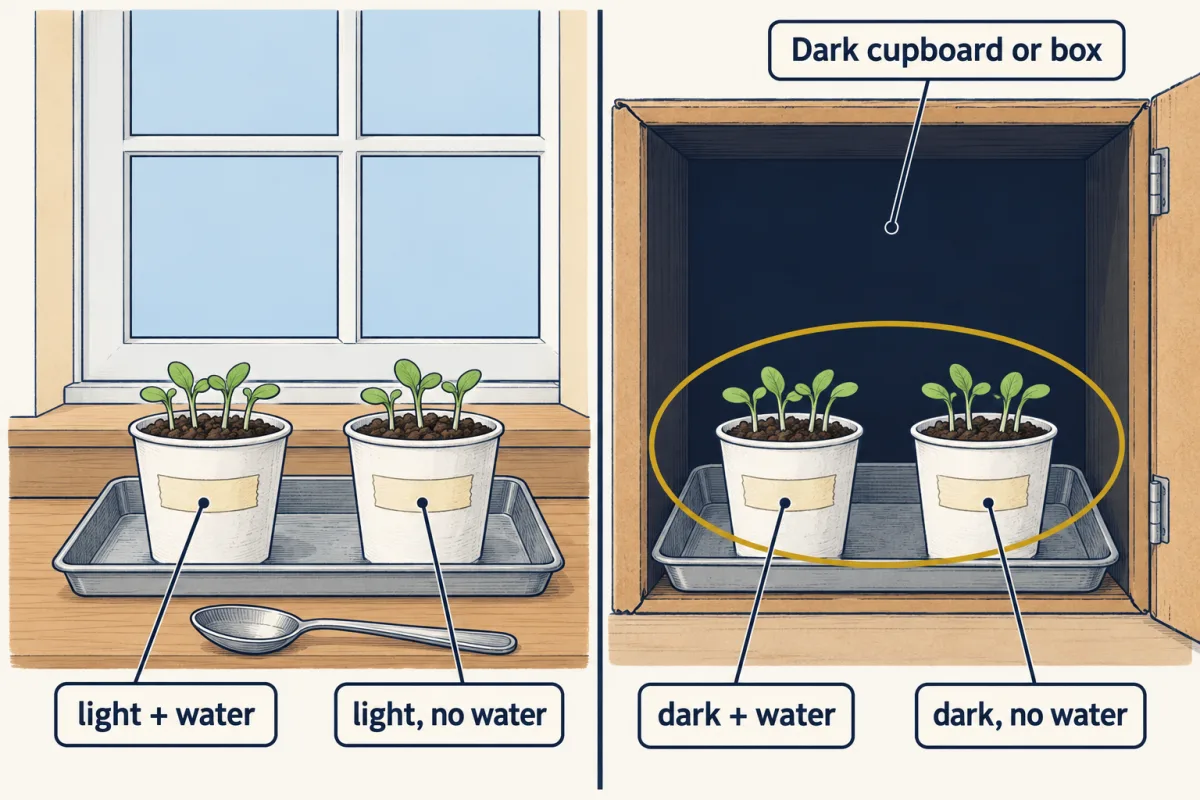
- Set up. An adult opens the bag and dampens the mix first (see the safety box). Then fill four cups with damp potting mix to about 2 cm below the rim. Label them “light + water”, “dark + water”, “light, no water” and “dark, no water”. Stand them on the tray.
- Plant. Have your child press 4 or 5 radish seeds about 1 cm deep into each cup and cover them. Give each cup 2 tablespoons of water.
- Grow them all the same. Keep all four cups on a sunny windowsill. Water each the same amount whenever the top feels dry. Radish sprouts usually appear in 3 to 10 days, faster in a warm room. Wait until most seedlings are about 2 cm tall.
- Predict. Before you change anything, point to each label in turn and ask, “What do you think will happen in this cup? Why?” Write or draw the guesses on the sheet.
- Start the test. Move the two “dark” cups, on a plate or a second tray, into the cupboard or under the box. Keep giving the two “water” cups 2 tablespoons when the top feels dry. Give the two “no water” cups nothing more. Change nothing else. Say, “Compare the two cups that get water. Only the light changes. Now compare the two cups on the windowsill. Only the water changes.” If you have a fifth cup, plant fresh seeds in it, water it, and put it straight into the dark.
- Check every day or two. Open the cupboard, look quickly, and put the cups back. Draw each cup. Ages 8 to 10 measure the tallest seedling in each cup in centimetres. Note the colour, the height, and whether the leaves droop. Ask, “Which cup changed the most since last time?”
- Notice the changes. The dry cups usually droop within 2 to 5 days, sooner in small cups and warm rooms. Within about a week, the dark, watered seedlings are often taller, thinner and paler than the windowsill ones, and they lean or flop. Over 1 to 2 weeks they grow weaker. The “light + water” cup stays green and upright. Ask, “Which plant grew tallest? Which looks strongest? How can we tell?”
- Bring one back (optional). Move a pale “dark + water” cup back to the windowsill. If it is not too weak, its leaves usually turn green over a few days.
- Check the guesses and debrief. Lay the first guesses beside the cups. Ask, “What matched? What surprised you?” Then ask two closing questions:
- “What did the plant in the dark run out of?”
- “Where does a green plant get its food?” Read Say it together aloud again.
Questions to ask while you do it
Ask your child to guess first, then check.
- “What do you think will happen to a plant that gets water but no light?”
- “I wonder which cup will droop first. Why that one?”
- “Which plant grew tallest? Which looks strongest? How could we tell?”
- “I wonder if a seed needs light to sprout. How could we find out?”
- “What do you think will happen if we put the pale plant back in the sun?”
- “Where do you think a plant gets its food?”
What children often think
-
A child might say “Plants eat dirt.”
You could try Ask, "If plants ate soil, what would happen to the soil in the pot?" It hardly goes down as the plant grows. Plants make their own food in their leaves from air, water and light. Soil holds the roots and gives water and small amounts of nutrients.
-
A child might say “More water is always better.”
You could try Ask how they could test it. Have an adult set an extra cup in a shallow dish with just enough water to cover the bottom of the dish. Leave the cup there throughout the test. Have the adult check the dish and add water as needed to keep just the bottom covered. Keep the dish out of reach between checks and stay with your child whenever they are near it. Over a week or two its leaves may yellow or droop. Roots need air as well as water, and soaked soil holds very little air.
-
A child might say “The dark one grew tallest, so it’s the best.”
You could try Ask your child to look at colour and strength as well as height. Is it green? Can it stand up? A seedling in the dark stretches on food it has stored, and it grows weaker once that food runs out.
-
A child might say “Seeds need light to sprout.”
You could try Try the fifth cup, kept in the cupboard from the day you plant. Radish seeds sprout in the dark, using food stored in the seed. Light matters once the seedling has leaves and its stored food runs low.
Why it works
A seed carries stored food. It uses that food to sprout and push up its first leaves. Radish seeds do this in light or in dark, though a few kinds, such as some lettuce, need light to sprout. After that, a green plant makes nearly all of its own food by photosynthesis. Chlorophyll, the green colouring in leaves, captures light energy. The plant uses that energy to join carbon dioxide with water, making sugar and giving off oxygen.
In the dark, seedlings grow in a different way, called etiolation. A seed that sprouts in the dark, like the one in the fifth cup, grows a long pale stem with tiny yellow leaves, because little chlorophyll forms. Green seedlings moved into the dark do something similar: the stem keeps stretching and new growth is pale, while the green leaves slowly turn yellow. In nature this stretching can carry a buried or shaded seedling up to light. In a cupboard there is no light to reach, so the seedling uses up its stored food and then weakens and dies.
Water has several jobs too. It is one of the raw materials for sugar, it keeps the cells firm so stems stand up, and it carries nutrients up from the roots.
Easier and harder
Ages 5 to 7
Use only two cups, both watered: one on the windowsill and one in the dark. That gives one clear difference. Skip measuring. Have your child draw both cups every few days, using crayons that match the real leaf colours. At the end, hold the two plants side by side and ask which one looks stronger and why.
Ages 8 to 10
Let your child plan the test: what will change, what stays the same, and what to measure. Measure the tallest seedling in each cup in centimetres every two days and keep a table. At the end, make a bar graph with one bar per cup. Ask whether one cup for each condition is enough. Two cups of each makes the result more trustworthy.
If it doesn’t go as planned
No sprouts after 10 days usually means a cold room or old seeds; try a fresh packet in a warmer spot. Fuzzy mould on the soil means it is staying too wet. An adult throws that cup away, as the safety box says, and you can start a new one with a little less water. If the “no water” cups do not droop, the mix may hold a lot of water; give it a few more days. If light leaks into the cupboard, use a box with no gaps. If the windowsill seedlings are also tall and floppy, the window is too dim; next time, use your brightest window.
Observation sheet
Here is what one filled-in row can look like, about a week into the test:
| Day | Light + water | Dark + water | Light, no water | Dark, no water |
|---|---|---|---|---|
| Day 7 | Green, upright | Tall, thin, pale, leaning | Drooping | Drooping |
Observation sheet
What do plants need?
NameDate
Each time you check, draw or measure each cup.
| Day | Light + water | Dark + water | Light, no water | Dark, no water |
|---|---|---|---|---|
I think the plant in the dark will:
What really happened:
stemhop.com · Biology Together
The three stories, told aloud Side Hops: three stories that go with this lesson Side Hops
Three playful ways to talk about what plants need
1:36 · Narration: an AI narrator voice (Kokoro, af_heart).
Read the transcript
When your radish cups start to change on the windowsill, a few playful tips can turn the quick checks into the best part of the day.
First, when the dry cups begin to droop, think about a garden hose. Empty, it lies flat and floppy on the grass. Fill it with water and it plumps up firm. Soft green stems stand up in a similar way, with water pushing out inside every tiny cell. Here is a number to share: water makes up about seventy-five to ninety percent of the fresh weight of most lawn grasses.
Next, skip the quiz and ask an open question. Try, "What do you think is packed inside a seed before its leaves come out?" Children guess all sorts of things, from tiny leaves to drops of water to dirt. Enjoy every idea, and ask how you could find out together. Then tell them about the coco de mer palm. It grows the heaviest seeds in the world. A single seed can weigh about forty pounds.
Finally, go looking around the house. Find a houseplant near a window and check which way its leaves point. Plants often lean toward the brightest light. In a dim corner, their stems grow long and thin as they stretch. You can turn the pot once and look again together as the plant grows. See which way the new growth points. Wash your hands if you touch the plant.
Have fun watching together, and let your child's guesses lead the way.
The idea underneath them. You and your child grow radish seedlings in four cups, then take away light, water or both and watch for two weeks.
Your notes
Select any text in the lesson to highlight it or add a note to it. Your highlights and notes are saved in this browser and collected in your notebook.
This browser is not letting the site save anything (a private window or strict privacy settings), so highlights and notes will be lost when you leave the page.
Where this lesson fits
Before thisReview first
- Wake Up a SeedThis course · Lesson 2
Your child has already seen a seed use its stored food to sprout, which this lesson builds on.
After thisStudy next
- Thirsty CeleryThis course · Lesson 9
Your child follows how water climbs a plant, which shows why a plant without water droops.
- Hidden Leaf ColorsThis course · Lesson 27
Your child finds the green colour in leaves, which links to why dark-grown plants turn pale.
Elsewhere on the siteFilms, simulations and method films in other courses
- What Becomes a Tree?Film · Life Science
Shows how light, water and air together let a plant make its own food.
Suggested by an AI model from the lessons themselves, then checked. How we use AI
Those are the stories. The idea under them is the one the lesson builds.
That is the film. The rest of the activity is the fun part.
The rest of the activity is here when you want it.
Finish line
Test yourself
4 questions
Questions to talk over together.
Next · Lesson 8
Plant Parts We Eat
Which part of a plant is a carrot, and what does that part do? A grocery sort onto a drawn plant shows where each food came from and what its part does.
Continue →Rewritten on : new text and film. Notes and highlights stay, but the text around them may have moved.