Biology Together · Unit 8: Virginia and Chesapeake nature
A Watershed in a Pan
Rewritten on : new text and film. Your notes and highlights stay, but the text around them may have moved.
Where does rain go after it lands on our street? A paper landscape and a spray bottle show the way downhill.
Three real-life stories behind this activity, about 2 minutes aloud, or read them below.
The film, 4 minutes, and the safety notes, for the grown-up to look at before the activity.
The hands-on part, done with a child: about 25 minutes.
Pause when the reading reaches a film, and offer to play it. Saved on this device.
Watch the film now, or keep listening
That is the end of the reading
This idea at other levels
An activity for ages 5 to 10 about dead zones. Next, for an older child: Big Changes: Dead Zones, Storms and Climate (grade 7).
See every levelHide the levels
Watersheds and dead zones
Rain carries fertilizer downhill into bays and lakes, where it feeds algae whose decay uses up the oxygen.
Taught at four levels: ages 5 to 10, grade 7, high school and college core.
College, the core · the level you chose
Schindler fertilised whole lakes: Lake 227 stayed eutrophic on phosphorus alone.
Ecology and Evolution · about 20 min · film 3:14 · 3 practice questions
High school · the level you chose
The 2010 Bay TMDL capped nitrogen, phosphorus and sediment; read whether oxygen recovered.
Biology · about 40 min · film 3:29 · Virginia BIO.8d
Grade 7 · the level you chose
Big Changes: Dead Zones, Storms and Climate
Feed a model Bay nitrogen and watch the deep oxygen fall.
Life Science · about 40 min · film 3:21 · Virginia LS.8 c
Ages 5 to 10 · the level you chose
A Watershed in a Pan · this lesson
Crumple paper into hills, spray rain, and see where the colour runs.
Biology Together · about 25 min · film 3:40 · Virginia 4.8 a, 3.8 a, 3.8 b, K.11 c
Play the ladder · 3 films, about 10 min, from grade 7 to college core. Each film waits for you to press play.
Next door to dead zones
- Decomposers and decayThe oxygen goes because decomposers are eating the dead algae.Nearest lesson: Rot Detectives (ages 5 to 10)
- Cellular respirationBacteria use oxygen when they respire, the same as your cells.Nearest lesson: Releasing Energy from Food (grade 7)
Also at grade 7: People Change Habitats
Short versions inside this lesson
The grade 7 version · about 1 minute to read
In grade 7 Life Science, children follow the fertilizer from this activity into the Chesapeake Bay. Too much nitrogen feeds huge blooms of algae. When the algae die, bacteria break them down and use up the oxygen in deep water, leaving "dead zones" where crabs and fish struggle. They also study how people change habitats, such as adding a new kind of fish to Virginia rivers.
The plainest version · about 1 minute to read
When rain falls, it runs downhill. Little streams join bigger streams, and bigger streams join rivers. All the land that drains to the same river or bay is called a watershed. Whatever the rain picks up on the way, like dirt, trash or fertilizer, goes along for the ride. That is why what we do at home can reach a bay far away.
Find an idea: every idea, searchable
Which lessons teach an idea, and the notes on each level, were written by AI models from the lessons and checked by a second model. A person has not yet read every one. How we use AI
About this activity what is in it
Rewritten on : new text and film. Notes and highlights stay, but the text around them may have moved.
Before you start
- Hands-on time
- About 25 minutes
- Where
- Indoors
- Ages
- 5 to 10, with an easier and a harder version below
- Grown-up
- Stay nearby to help with spraying and spills. Keep paper bits and cocoa away from toddlers and pets.
What you need
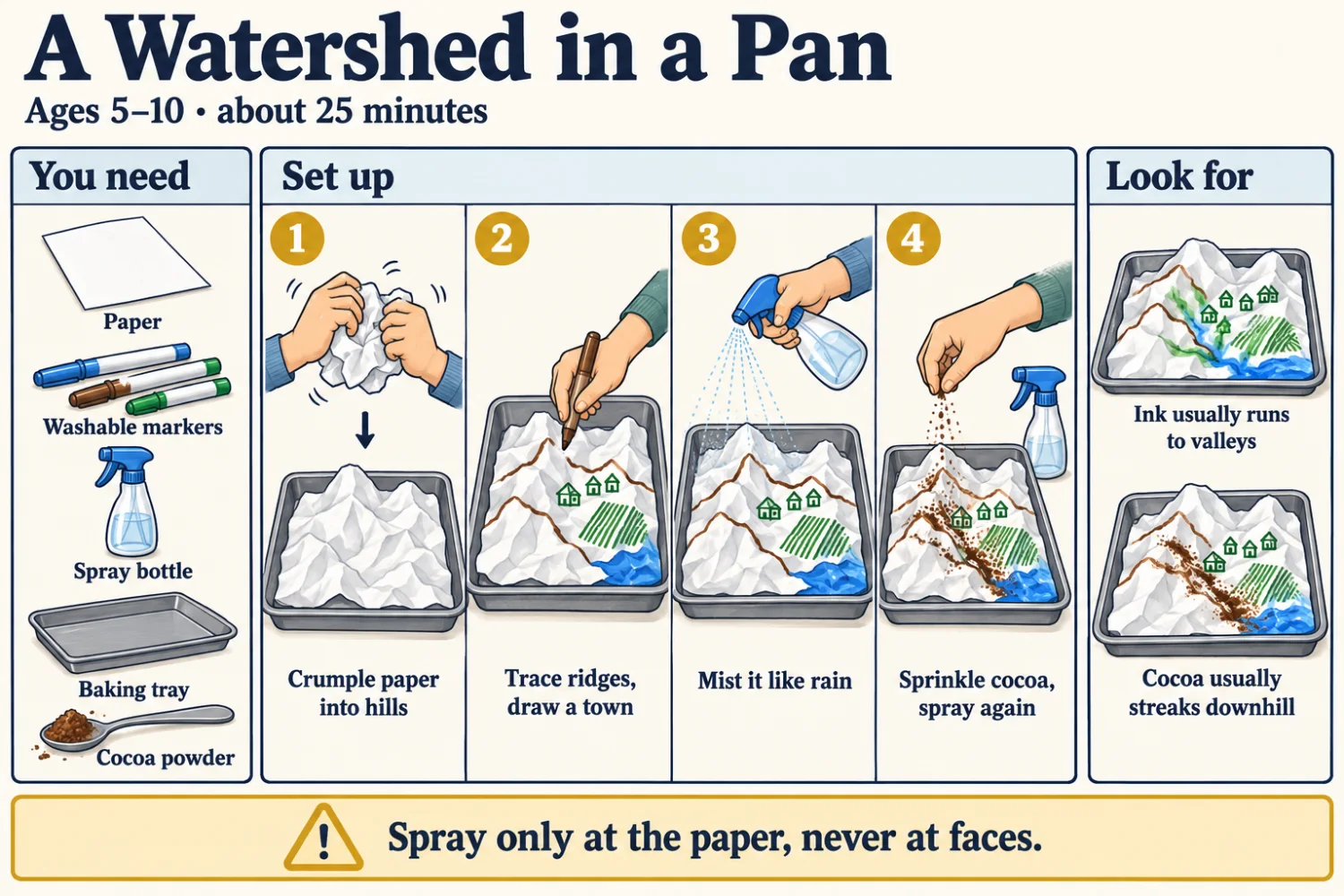
- 1 sheet of white printer paper per landscape
- Washable markers: blue, brown or black, green and one other colour (they must be washable)
- A spray bottle of plain water (new, or one that only ever held water)
- A baking tray, roasting pan or shallow plastic tub
- Paper towels or an old towel
- A pinch of cocoa powder, or a few drops of food colouring in a spoonful of water
- A few hole-punch paper dots or tiny torn paper bits for litter
- A printed or on-screen map of Virginia’s watersheds (optional)
Virginia science standards SOL 4.8 aSOL 3.8 aSOL 3.8 bSOL K.11 c
In this activity. You and your child crumple a sheet of paper into hills and valleys, draw ridges, towns and farms on it, then make it rain with a spray bottle.
The film
 ▶ Watch A Watershed in a Pan: Parent Guide · 3:40
Read the transcript of “A Watershed in a Pan: Parent Guide”
Film transcript: A Watershed in a Pan: Parent Guide
Where does rain go after it lands on your street? It runs downhill. A paper landscape lets your child watch where it flows and collects. It takes about twenty-five minutes. Your child practices guessing where water will go and checking the guess. If you have a watershed map, you can also trace where rain from home drains. Gather white printer paper, washable markers, paper towels, and a shallow metal tray or plastic tub. Use plain water in a new spray bottle or one that has only held water. If you use a hole punch, handle it yourself. Stay beside your child. Spray only at the paper, away from faces and pets. Keep paper dots and small marker caps away from children under four.
Count the dots out and back in. If a child is choking, call nine one one. Keep all supplies out of mouths. Cocoa is toxic to dogs and cats, so keep pets away. Wipe up cocoa and drips right away. Put cocoa-covered paper in a bin pets cannot open. Wash everyone's hands with soap and water when you finish. Crumple the paper into a tight ball. Open it gently, but don't flatten it. You want hills and valleys. Ask your child, 'Where is the highest ground?' Then trace each ridge in brown. Color one low corner blue and call it the bay. Tuck a folded towel under the other end, so the bay sits lowest. Then draw houses, a farm, and a road, some on hilltops and some in valleys.
Now point to three spots, one on each side of a ridge and one by a house. Ask, 'If rain lands here, where will it go?' Your child draws a small arrow for each guess. Here is a question for you. Take two drops that land very close together, but on opposite sides of one ridge. Will they end up in the same place?
Mist the paper from about a foot above, ten to twenty squirts. It can take several squirts before anything moves. Then the marker bleeds and runs down the creases. Drops on each side of a ridge go different ways. Check the arrows together. Ask, 'Did the rain go where you guessed?' Then name it. All the land that drains to the same river or bay is one watershed. The ridges split one watershed from the next. A pinch of cocoa near the farm can stand in for fertilizer. If allergies or asthma rule out cocoa, use colored water with ingredients suitable for your child. You can skip both. Put a few paper dots on the road as litter. Spray again and watch where everything goes.
If you have a map of Virginia's watersheds, find your town and follow the river to where it ends. Have your child pick three things your family can do and draw them. They could put trash in the bin or turn off the tap. Back on your street, rain can carry litter downhill into a storm drain. Your pan shows how water can pick things up and carry them downstream.
Before you start
- Hands-on time
- About 25 minutes
- Where
- Indoors
- Ages
- 5 to 10, with an easier and a harder version below
- Grown-up
- Stay nearby to help with spraying and spills. Keep paper bits and cocoa away from toddlers and pets.
What you need
- 1 sheet of white printer paper per landscape
- Washable markers: blue, brown or black, green and one other colour (they must be washable)
- A spray bottle of plain water (new, or one that only ever held water)
- A baking tray, roasting pan or shallow plastic tub
- Paper towels or an old towel
- A pinch of cocoa powder, or a few drops of food colouring in a spoonful of water
- A few hole-punch paper dots or tiny torn paper bits for litter
- A printed or on-screen map of Virginia’s watersheds (optional)
Virginia science standards SOL 4.8 aSOL 3.8 aSOL 3.8 bSOL K.11 c
The big idea
Your child makes rain on a paper landscape. They practise guessing where the colour will run, then check where it collects. If you use a watershed map, you can also trace where rain from home goes.
Say it together (read aloud): “Rain runs downhill. All the land that drains to the same river or bay is one watershed. What the rain picks up goes along for the ride.”
Watch a puddle after a storm and you will see water moving, always downhill. This activity follows that water.
A watershed is all the land that drains to the same stream, river or bay. High ground called a ridge splits one watershed from the next. Rain on one side of the ridge flows one way, and rain on the other side flows the other way.
As water runs across the land, it picks things up: soil, litter, pet waste and lawn fertilizer. Much of it can end up downstream. More than half of Virginia drains to the Chesapeake Bay. Most of the rest drains south to the sounds of North Carolina or west toward the Gulf of Mexico.
For teachers (Virginia standards)
Virginia’s grade 4 standard asks children to model a watershed, name the one they live in, and explain “we all live downstream.” Younger children only need the idea that what we put on the land can reach the water.
What to do
- Crumple. Crumple a sheet of paper into a tight ball. Open it gently, but don’t flatten it. You want hills and valleys. Set it in the tray.
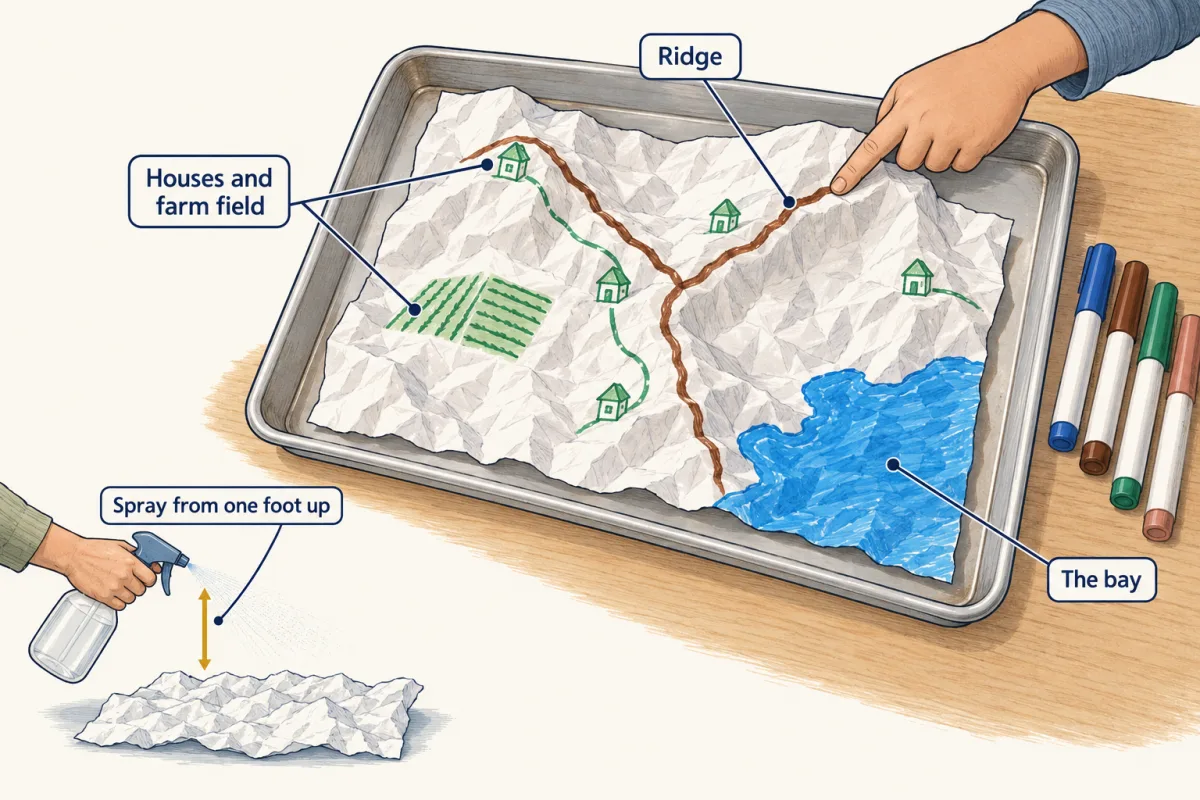
- Find the high ground. Ask your child to run a finger along the tops of the ridges: “Where is the highest ground?” Trace each ridge with a brown or black marker. Colour one low corner blue and call it “the bay.” Slip a folded towel under the opposite end of the tray so the bay corner sits lowest.
- Build a town. Draw small houses, a farm field and a road with green and the other colour. Put some on hilltops and some in valleys.
- Predict. Point to three spots, one on each side of a ridge and one by a house. Ask, “If rain lands here, where will it go?” Have your child draw a little arrow for each guess.
- Make it rain. Mist the paper from about 30 cm (one foot) above, 10 to 20 squirts. It can take several squirts before anything moves. Watch the marker colour bleed and run down the creases. Most of it should collect in the valleys, and some in the bay. Look for other pools, too. Each one catches rain from its own patch of paper. Some pools never reach the bay. Check the arrows: “Did the rain go where you guessed?”
- Add pollution. Sprinkle a pinch of cocoa (“fertilizer” or “soil”) near the farm, or drip a little of your food-colouring water there instead. Drop a few paper dots (“litter”) on the road. Ask, “Where will these go when it rains?” Then spray again. The cocoa usually streaks downhill. The paper dots may need more water before they move.
- Find your watershed. Look at a map of Virginia’s watersheds together and find your town. Follow the river from your area to where it ends. Ask, “Who lives downstream from us?”
- Plan three things. Talk about what your family can do. Keep trash out of storm drains. Plant a tree or garden. Save water by turning off the tap while brushing teeth. Only adults should pick up pet waste. Use a bag and wash your hands with soap and water afterwards. Only adults should sweep spilled fertilizer and grass off the driveway. Sweep it back onto the lawn, keep it out of the street, and wash your hands afterwards. Clean water is limited, and pollution leaves less of it fit to use. Have your child pick three and draw them.
- Debrief. Ask two closing questions:
- “Why did the rain on each side of a ridge go different ways?”
- “What did the rain carry? Where did it end up?” Read Say it together aloud again.
Questions to ask while you do it
Ask your child to guess first, then check.
- “I wonder where this drop will go if it lands right on top of a ridge.”
- “What do you think will happen to the farm if we spray a lot?”
- “Will the bay get more colour or less if we keep spraying?”
- “What do you think will happen if we put the litter on the hilltop instead?”
- “Where does the rain go after it lands on our roof?”
- “If crabs lived in our bay, what would be best to keep out of the water?”
What children often think
-
A child might say “Rain just soaks in where it lands.”
You could try Some does, and that is a good observation. Ask, "Where do puddles go on a sidewalk?" Then spray a little more and watch. When the ground is full or hard, the rest runs downhill. Pavement and roofs let almost none soak in.
-
A child might say “Only factories make water dirty.”
You could try Point to the cocoa near the farm and the dots on the road. Ask, "Was there a factory here?" Factories can pollute, but so can lawns, streets, pet waste and farms. Small amounts from many places add up downstream.
-
A child might say “The water from my house stays at my house.”
You could try Go outside after rain, or think about where the gutter goes. Ask, "Which way does the water go from the end of the downspout?" Follow it with an adult in your own yard or on the sidewalk. Stay away from roads, running water and deep ditches. Get permission before entering anyone else’s property. Pick a day with mild weather, use sun protection, and check for ticks afterward. Leave wild plants, berries and mushrooms untasted, and wash hands after the walk. Some soaks into the yard. The rest joins a ditch, drain or creek, and keeps going.
-
A child might say “One piece of trash can’t matter.”
You could try Ask, "What if every house on our street dropped one?" Drop one paper dot for each house on your paper and spray. One piece is small, but many pieces from many places can reach the same bay.
Why it works
Water flows downhill because of gravity, so the shape of the land sets its path. The crumpled paper is a small copy of real hills and valleys. The washable ink dissolves in the spray and rides along with it, showing the path the way a dye would.
On real land, rain soaks into soil, especially under plants. Water that runs off the surface is called runoff. Runoff carries soil and nutrients, such as nitrogen and phosphorus from fertilizer and animal waste. In the Chesapeake Bay, too many nutrients make algae grow too fast. Thick algae block sunlight from underwater grasses. When the algae die and rot, the rotting uses up oxygen and can leave low-oxygen “dead zones.” Farms, lawns, wastewater and air pollution all add nutrients. In most places, storm drains carry rain straight to a creek without cleaning it, which is why “we all live downstream.”
Easier and harder
Ages 5 to 7
Skip the map and the litter. Draw one house and one farm, trace the ridges with your child, and spray. Ask one question each time: “Where did the colour go?” End with one family action your child can do this week, such as putting trash in the bin. Your child can draw the bay before and after the rain.
Ages 8 to 10
Make two landscapes from the same kind of paper. On one, lay a strip of paper towel (“a strip of plants”) along the stream below the farm. Put the same amount of cocoa or food-colouring water in the same spot near each farm. Use the same ingredient in both trays and follow the allergy guidance above. Spray both trays the same number of times. Compare how much colour from each farm reaches its bay. Skip this comparison if neither ingredient is suitable. The two crumples never match exactly, so look for a big difference. Have your child find their watershed on a map, name the river, and write a short note to a neighbour about one thing everyone can do.
If it doesn’t go as planned
If nothing runs, keep spraying. The paper soaks up water first. If everything turns into one big blur, you sprayed too much at once; try a new sheet and spray in short bursts. If the marker does not move at all, it is probably not washable. Thin printer paper works better than card or construction paper.
Observation sheet
Here is what one filled-in row can look like:
| Where the drop started | My guess | Where it went |
|---|---|---|
| Top of a ridge | Down to the bay | Down the far side, into a valley |
Observation sheet
A watershed in a pan
NameDate
Draw an arrow for where you think the rain will go. Then spray and check.
| Where the drop started | My guess | Where it went |
|---|---|---|
| Top of a ridge | ||
| Next to a house | ||
| On the farm | ||
| On the road |
Our watershed is:
The river near us is:
stemhop.com · Biology Together
The three stories, told aloud Side Hops: three stories that go with this lesson Side Hops
Three playful ways to talk about watersheds with your child
1:43 · Narration: an AI narrator voice (Kokoro, af_heart).
Read the transcript
Once the paper is dry and the markers are capped, the watershed lesson can keep going all week. Here are three easy ways to keep talking about it.
First, after a light shower on a calm day, look for drips from a pointed roof together. Ask your child which way the drops on each side will go, then watch. That roof peak is a little ridge. Virginia's Blue Ridge works like a giant roof peak. In Shenandoah National Park, streams on opposite sides feed different rivers, and those rivers all reach the Chesapeake Bay.
Second, at the sink, drip a little water onto a clean, dry sponge and onto a tilted baking tray. Ask your child which one soaks up the water and which one lets the drops roll downhill. A leafy forest floor acts like the sponge, and a parking lot acts like the tray. In fact, one acre of paved parking makes as much runoff in a year as thirty-six acres of forest.
Third, picture a one-gallon milk jug, and count with your child all the way up to fifty jugs. Under the best conditions, one adult oyster can filter up to fifty gallons of water in a day, eating tiny algae as it goes. Wild oysters usually filter less, but that is still a lot of work for one shellfish. Clearer water helps underwater grasses grow, and those grasses give young blue crabs a place to hide.
When families keep things like lawn fertilizer out of the water that flows to the Bay, it helps keep the water cleaner for grasses, crabs and oysters.
The idea underneath them. You and your child crumple a sheet of paper into hills and valleys, draw ridges, towns and farms on it, then make it rain with a spray bottle.
Your notes
Select any text in the lesson to highlight it or add a note to it. Your highlights and notes are saved in this browser and collected in your notebook.
This browser is not letting the site save anything (a private window or strict privacy settings), so highlights and notes will be lost when you leave the page.
Where this lesson fits
After thisStudy next
- Roots Hold the SoilThis course · Lesson 29
It uses the same downhill runoff and shows how plant roots keep soil from washing into streams.
- Creek CrittersThis course · Lesson 30
It looks at the creek life that lives downstream where this runoff ends up.
Elsewhere on the siteFilms, simulations and method films in other courses
- Extra Nutrients, Less Deep OxygenFilm · Life Science
It shows how fertilizer carried downhill by rain can end up hurting life in the bay.
Suggested by an AI model from the lessons themselves, then checked. How we use AI
Those are the stories. The idea under them is the one the lesson builds.
That is the film. The rest of the activity is the fun part.
The rest of the activity is here when you want it.
Finish line
Test yourself
4 questions
Questions to talk over together.
Next · Lesson 29
Roots Hold the Soil
Why does a muddy stream run brown after a storm? Two trays of soil and a watering can show where the mud comes from.
Continue →Rewritten on : new text and film. Notes and highlights stay, but the text around them may have moved.