Two Halves of One Lake
Read the transcript of “Two Halves of One Lake”
Film transcript: Two Halves of One Lake
Phosphorus has no major gas, so no microbe can fix it from the air. Nitrogen can be fixed by microbes. So when a lake turns green with algae, which input should you cut, nitrogen or phosphorus? Both elements reach a lake as inputs, such as inflowing water, dust and fertiliser. Only nitrogen has a second kind of input, fixation from the air by microbes. Which one sets how much algae a lake can hold? David Schindler was invited to lead whole-lake experiments in northwestern Ontario. Small lakes were set aside, so whole ecosystems could be changed and watched for years. Short tests in bottles can miss slow changes, like a rise in nitrogen fixation.
Lake 226 was divided by a barrier into two basins. Both basins received nitrogen, as nitrate, and carbon, as the sugar sucrose. One basin also received phosphorus. The other got none. So the only difference in what each half was given was that one element. Both halves had plenty of nitrogen and carbon to work with. Only one had phosphorus. Which half turns green?
Only the phosphorus basin. It became highly eutrophic, rich in nutrients and dense with algae. The other basin stayed as it had been. So in that lake, with nitrogen and carbon plentiful, phosphorus limited the algae. A nutrient is limiting when adding it on its own raises production. Lake 227 was fertilised with both nitrogen and phosphorus for years. Then the nitrogen fertiliser stopped. The phosphorus kept coming. With its nitrogen input cut, you might expect the algae to fade. They did not. Cyanobacteria that fix nitrogen took over. They fixed nitrogen from the air, an input that kept coming after the fertiliser stopped. Its rate can still respond to phosphorus supply and other conditions.
The lake stayed highly eutrophic, year after year. Algae stayed as abundant as the phosphorus allowed. Fixation had made up the missing nitrogen. These are small lakes in Ontario, and one lake is not a replicate. Other lakes, and many estuaries, can respond to nitrogen. And production is often co-limited, rising only when both nutrients are added together. So in these lakes, phosphorus supply set how much algae the lake could hold. Fixers can make up missing nitrogen. No microbe can fix phosphorus.
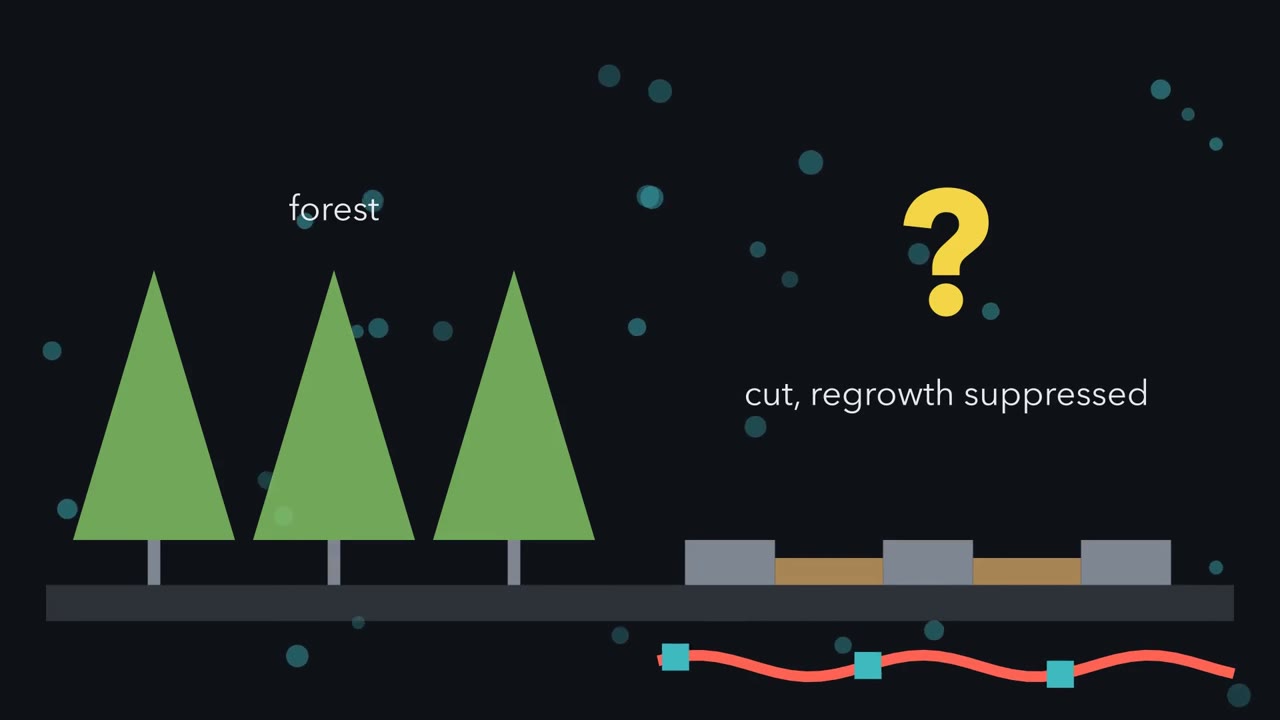
Cut a forest, leave the logs where they fall and keep it from growing back. Nobody adds fertiliser, yet its stream starts carrying far more nitrogen. Where does that nitrogen come from?
Continue in the lesson: Nutrient Cycling →
3:14 · Free, with captions and a transcript. The lesson has the full text, the questions and the sources.
More films from this lesson
How this film was made. Narration: an AI narrator voice (Kokoro, af_heart) reading narration written from this lesson's text. Animation: AI-generated in code (Manim) by Claude, a schematic with no drawn molecular structures. Captions come from the narration script. See something wrong? Report it.