Organismal Biology · Skim version
Tissues, Organs and Homeostasis
Read the full lesson → Skim the whole course →
The guiding idea
In a room heated to about 93 degrees C, close to the boiling point of water, the thermometer under a man’s tongue barely moved. What was holding it there?
For a variable that exchanges passively with its surroundings, such as core temperature, a body holds it steady by pushing back against that leak, and the stronger the push-back compared with the leak, the less the inside follows the outside.
From the film: Leak and Push-Back
- An egg in hot air keeps warming toward the air's temperature; in Blagden's brief trials his body pushed back, and his temperature barely moved.
- A homeostatic loop has five parts: regulated variable, set point, sensor, integrator and effector.
- Leak pulls the variable toward the outside; push-back from the effectors pulls it toward the set point.
- The stronger the push-back compared with the leak, the less the inside follows the outside; in the simple model, equal strengths split a change in half.
- Negative feedback means the push-back points back toward the set point, whether the variable is too high or too low.
From the film: Two Animals on One Plot
- A line's slope is the share of an outside change that reaches the inside: near 1 for a conformer, near 0 for a regulator.
- Over the salinities it tolerates, the blue mussel's blood comes close to the water around it.
- The shore crab conforms near full-strength seawater but holds its blood well above water diluted to roughly half strength.
- Over a tolerable range of air temperatures, an adult human regulates core temperature; a typical lake fish's body temperature largely follows the water.
- Regulator and conformer describe one variable over one range, never a whole animal.
-
The loop, part by part
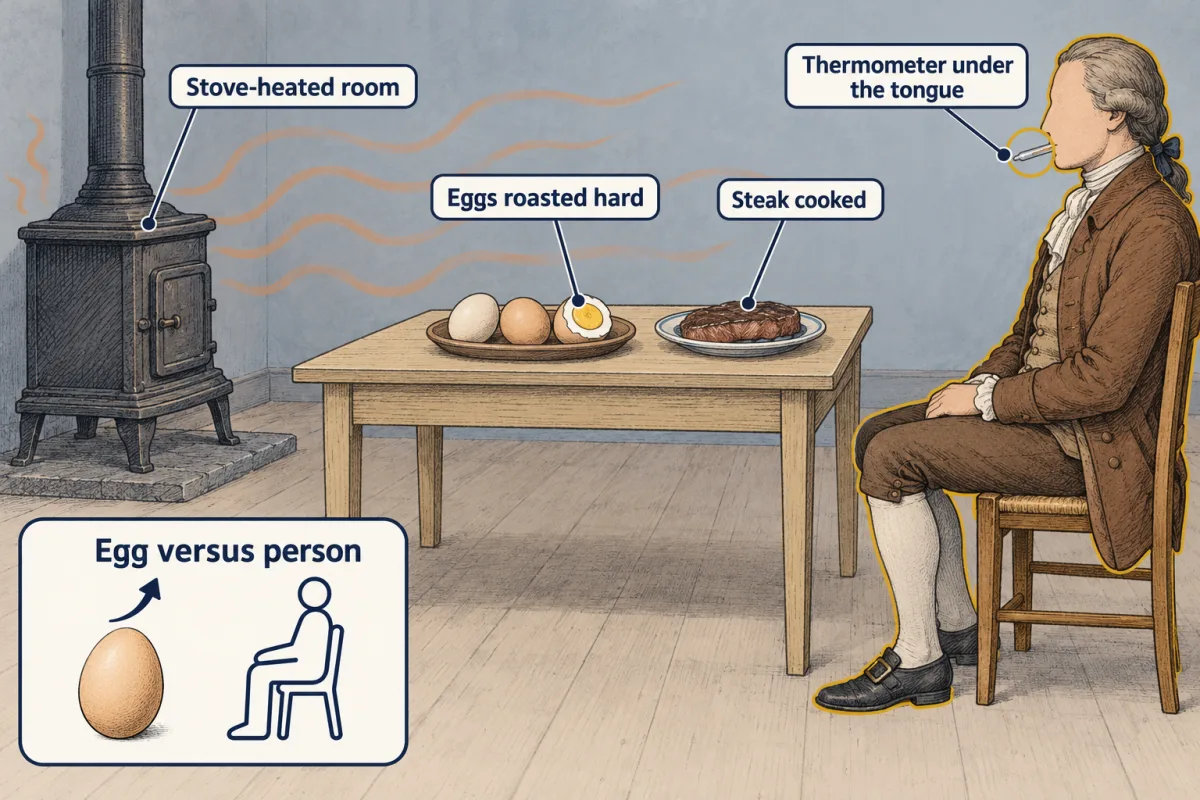
An egg in hot air keeps warming toward the air's temperature; in Blagden's brief trials a living body pushed back, and its temperature barely moved. AI-generated illustration -
Four tissues build the loop and the stomach wall
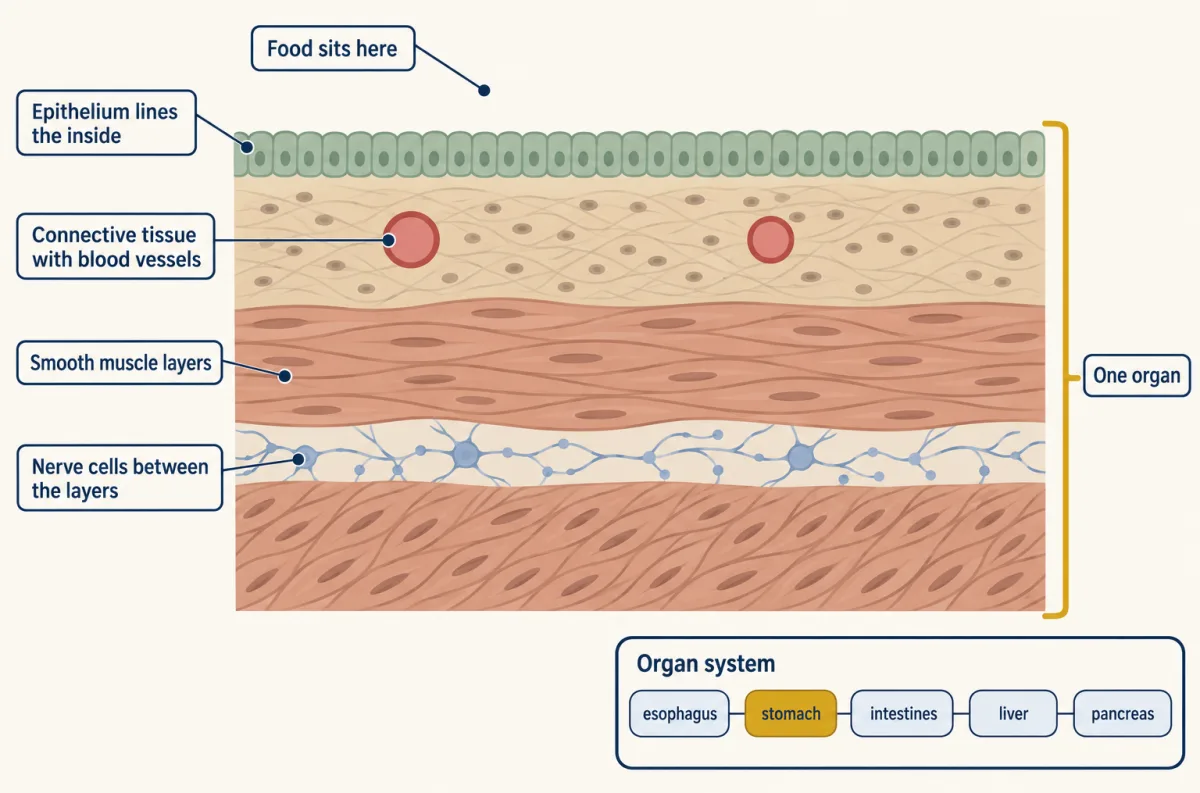
An organ is several tissues working together: in the stomach wall, epithelium lines the inside, connective tissue carries the blood vessels, smooth muscle churns, and a network of nerve cells between the muscle layers helps control it. AI-generated illustration -
Negative and positive feedback, and set points that move
-
Regulators and conformers, and the price of constancy
-
Going deeper
Where this lesson fits
Before thisReview first
- Size, Scale and SurfaceThis course · Lesson 2
You need to know why small bodies lose heat fast for their size to follow the mouse's cost of staying warm.
- What an Organism Has to DoThis course · Lesson 1
It introduces the leak of heat and water to the surroundings that regulation here has to push back against.
After thisStudy next
- Heat Balance and Body TemperatureThis course · Lesson 9
It takes the leak and push-back balance for body temperature and works out the heat budget in detail.
- Osmoregulation and Nitrogenous WasteThis course · Lesson 15
It applies the regulator and conformer idea to blood osmolality, as in the mussel and shore crab.
- Hormones and the Endocrine SystemThis course · Lesson 8
It shows hormones acting as the signals and effectors in feedback loops like those drawn here.
Suggested by an AI model from the lessons themselves, then checked. How we use AI