Neuroscience · Skim version
Integration, Inhibition and Neuromodulation
Read the full lesson → Skim the whole course →
The guiding idea
An inhibitory input can leave a resting cell's voltage unchanged and still stop it from firing. How?
In a passive compact cell, each synaptic input is a conductance that pulls the voltage toward its own reversal potential and adds to the total, so the balance point is a conductance-weighted average.
From the film: One More Rope
- A synapse is one more rope on the balance point: it pulls the voltage toward its own reversal potential.
- It also adds to the total conductance, so every other rope counts for less.
- In a passive compact cell with no injected current, the balance point is the conductance-weighted average of the ropes' ends, so conductances add, not millivolts.
From the film: Adding Inputs in Time and Space
- When conductances change, the voltage moves gradually to the new balance point, with a time constant equal to the capacitance divided by the total open conductance.
- A second EPSP that arrives before the first has gone starts from its tail, so a longer time constant gives more temporal summation.
- A steady voltage change in a long passive dendrite shrinks by the same fraction over each equal stretch, falling to 37% over one length constant.
From the film: Less Than Double
- In the model, two identical excitatory inputs give less than twice the depolarization of one.
- A second input enlarges the total conductance, so it dilutes the first; this is sublinear summation.
- Inputs that are small beside the leak add almost linearly, and the shortfall grows as inputs get larger.
From the film: Inhibition That Moves Nothing at Rest
- A shunting inhibitory input tied at rest moves nothing at rest, because its rope is tied exactly where the voltage already sits.
- It acts through the total conductance: it lowers input resistance, so excitation moves the voltage less and a spike can be stopped.
- A shunt also shortens the time constant, so less of an earlier EPSP is left for the next one to ride on.
From the film: When GABA Pushes Up
- GABA pulls the voltage toward its own reversal potential, so it depolarizes while the voltage is below that level and hyperpolarizes once it is above.
- The direction of GABA current at one moment does not say whether it helps or hinders firing; compare the whole response with and without it.
- With E_GABA below threshold, a steady GABA conductance cannot carry a cell past threshold, but brief inputs can give the opposite answer.
- In the rat cortex slices of Gulledge and Stuart, GABA's effect depended on timing and site, which does not make GABA excitatory in adult cortex in general.
From the film: Branches and Modulators Change the Ropes
- In Polsky, Mel and Schiller's experiment, nearby inputs on one thin branch summed sigmoidally, while widely separated inputs or inputs on different branches summed linearly, so location set the combination rule.
- Thin branches are thought to act as separate integrating subunits, with NMDA receptors thought to take part in the steep phase.
- In the lesson's picture, closing KCNQ channels increases excitability, so the neuron fires more to the same input.
- With dopamine acting on D1 receptors in mouse striatal neurons, firing to the same injected current rose, so the cell's own conductances or active currents changed, though a spike count cannot say which.
-
One more rope: what a synapse does to the voltage
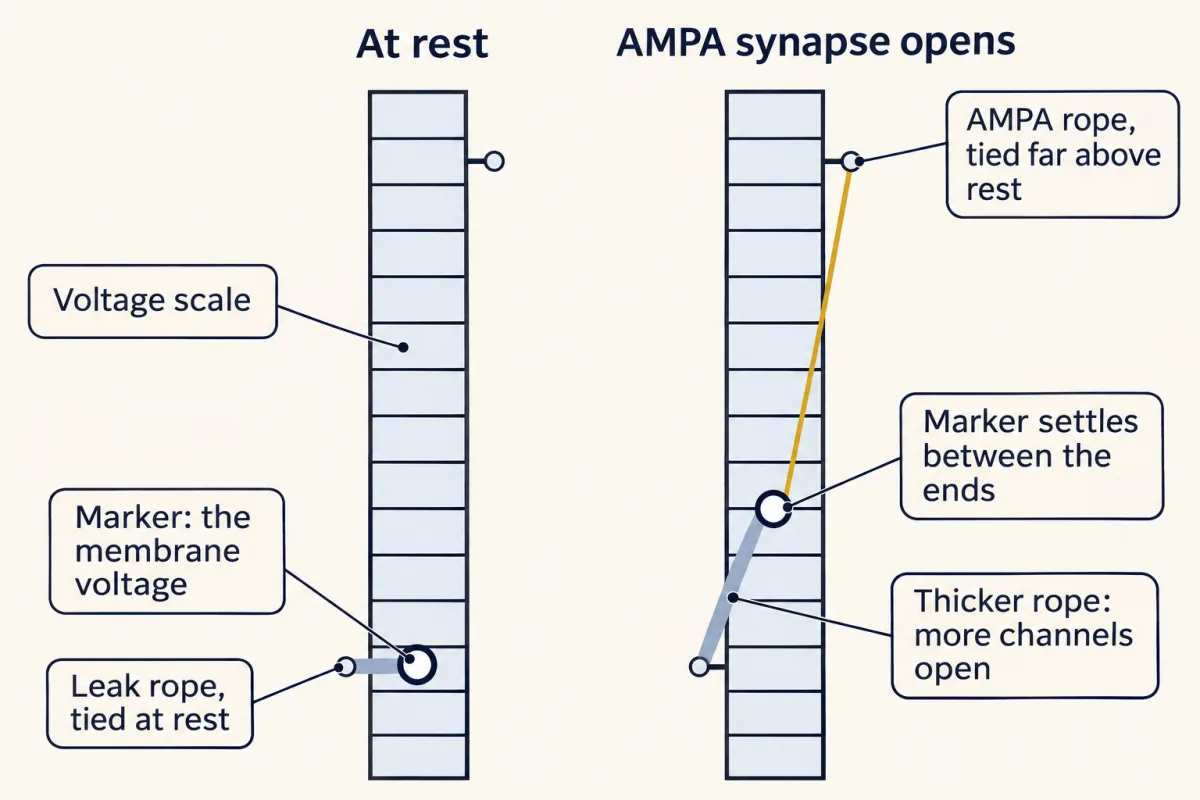
An opening AMPA synapse adds a rope tied far above rest, which pulls the marker partway up while the leak rope holds it back, so the voltage settles between the two ends. AI-generated illustration -
Adding inputs in time and in space
-
Why two inputs make less than double
-
Inhibition that moves nothing at rest: shunting
-
When GABA pushes up: timing and site
-
Dendrites that do not simply add
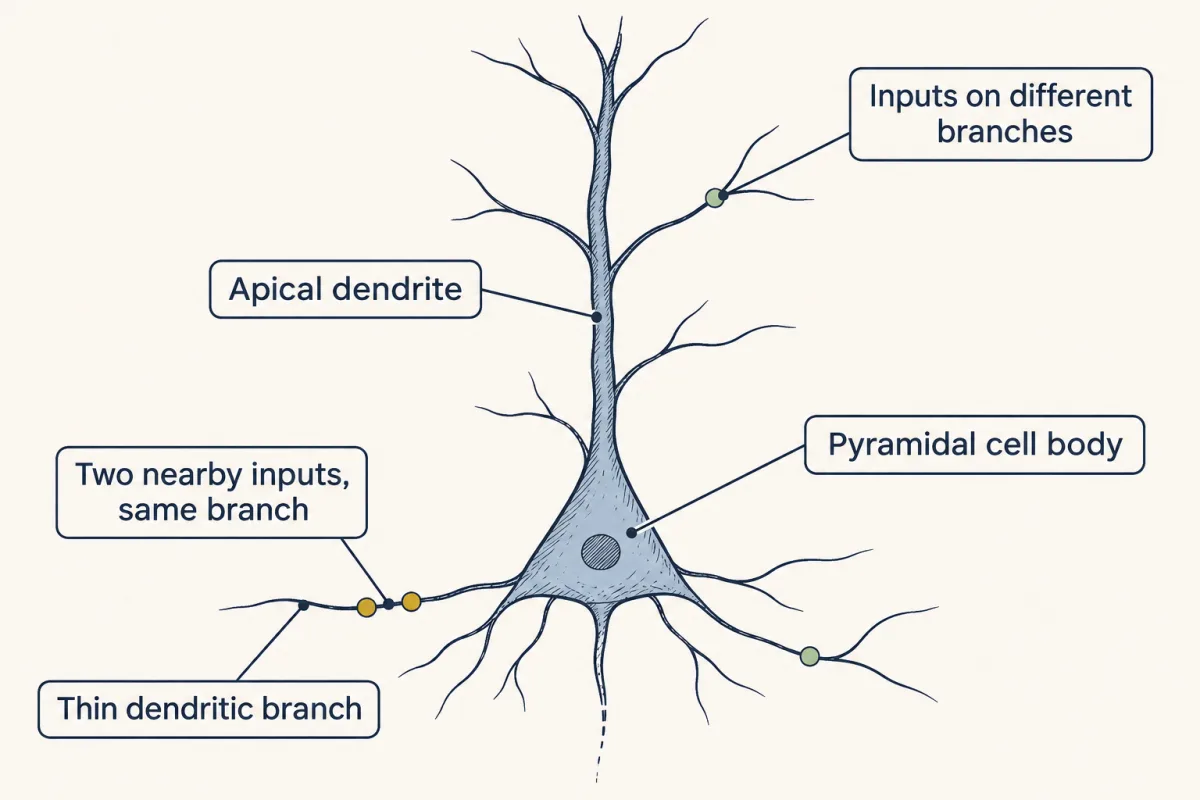
Polsky, Mel and Schiller asked whether location changes how inputs combine by pairing two sites close together on one thin branch against sites on different branches of the same pyramidal neuron. AI-generated illustration -
Modulators change the ropes
-
Going deeper
Where this lesson fits
Before thisReview first
- The Resting Membrane and Passive SignalsThis course · Lesson 3
The time constant, length constant and leak conductance used here for summing inputs are introduced in that lesson.
- The Action Potential and ConductionThis course · Lesson 4
This lesson reuses its balance-point and reversal-potential picture, treating each synapse as one more rope.
- Synaptic Transmission and Quantal ReleaseThis course · Lesson 5
You need to know how transmitter opens receptor channels to give the postsynaptic conductances summed here.
After thisStudy next
- Synaptic PlasticityThis course · Lesson 8
Lasting changes in synaptic strength build on the way inputs sum and how modulators alter the cell's response.
- Feeding, Motivation and RewardThis course · Lesson 19
It returns to dopamine acting on D1 receptors and the change in firing that this lesson explains.
- The RetinaThis course · Lesson 10
Centre-surround inhibition in the retina applies the conductance-based summation of excitation and inhibition.
Elsewhere on the siteFilms, simulations and method films in other courses
- One channel, two numbersSimulation · Cell Biology
Its one-channel simulation shows how an ion's reversal potential sets which way current flows when a channel opens.
Suggested by an AI model from the lessons themselves, then checked. How we use AI