Developmental Neuroscience · Skim version
Synapse Elimination: One Muscle Fiber, One Axon
Read the full lesson → Skim the whole course →
The guiding idea
A newborn rat muscle fiber has two or more motor axons on one synapse, and every one of them works. Within weeks all but one are gone. What decides which one stays?
A synapse is not removed for being quiet; what puts it at risk is being quieter than its neighbours at the same junction.
From the film: Quieter Than Its Neighbour
- A newborn rat muscle fiber is contacted by two or more motor axons, and within weeks all but one are gone.
- Counting the steps in a fiber's response as nerve stimulation rises counts its inputs.
- The lost synapses are branch loss: the motor neurons do not die.
- A synapse is not removed just for being quiet; being quieter than its neighbours at the same junction puts it at risk.
From the film: A Contest at Every Junction
- One motor neuron's branches withdrew at different times and at different junctions, which points to a separate contest at every junction.
- In the mouse time-lapse, the starting territory did not reliably predict the winner.
- Typically one axon withdrew from the receptor sites while the other extended into the sites it left.
From the film: The Focal Block
- Overall activity sets the pace of elimination: blocking impulses slows it, and some patterns of stimulation speed it.
- In mice, a small blocked patch within a working junction was lost, while a fully blocked junction was not, so being quieter than neighbours is what puts a site at risk.
- A difference in activity is a bias, not a verdict, and no candidate molecular signal is yet established as the one that picks the winner.
-
Counting the inputs
-
Did the neurons die?
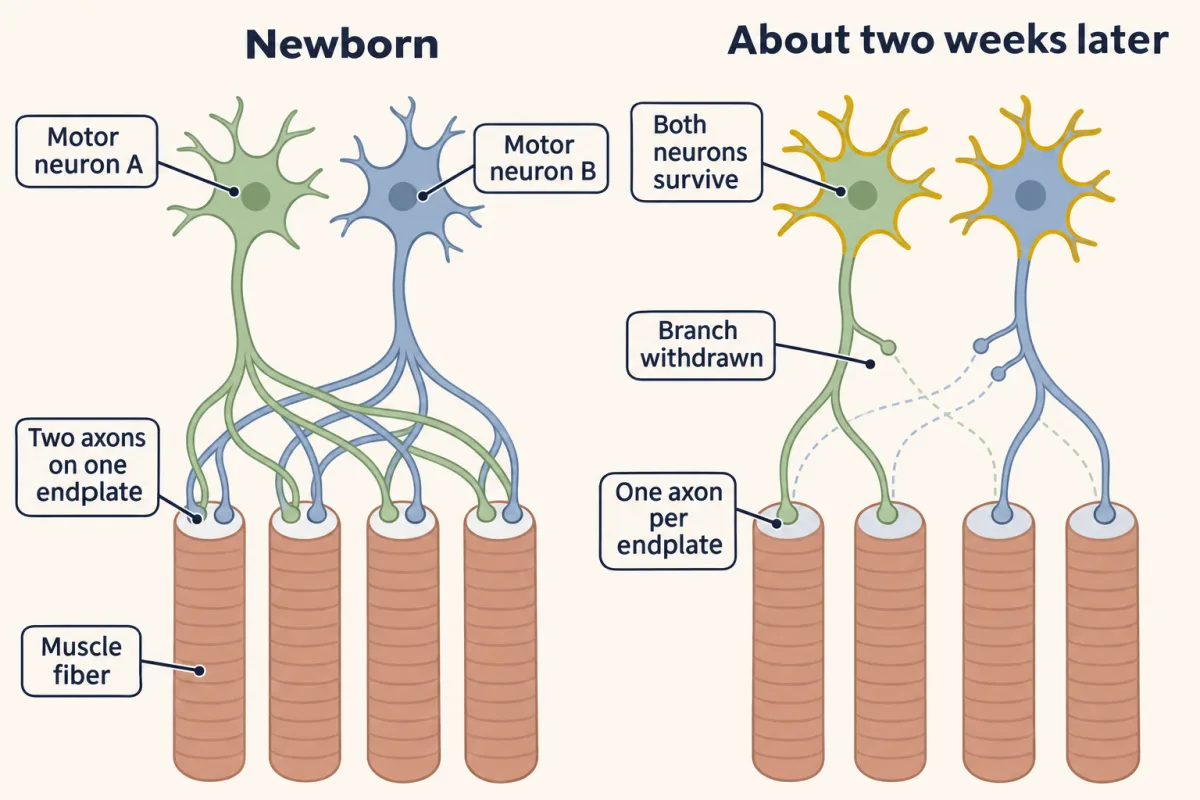
At birth most muscle fibers receive two or more axons; within about two weeks each has one. The motor neurons do not die: each pulls back some of its branches, so it supplies fewer fibers and its share of the twitch falls while the number of neurons stays the same. AI-generated illustration -
A contest at every junction
-
Activity biases the contest
-
What carries the signal
-
A similar contest in the brain
-
Putting it together
-
Going deeper
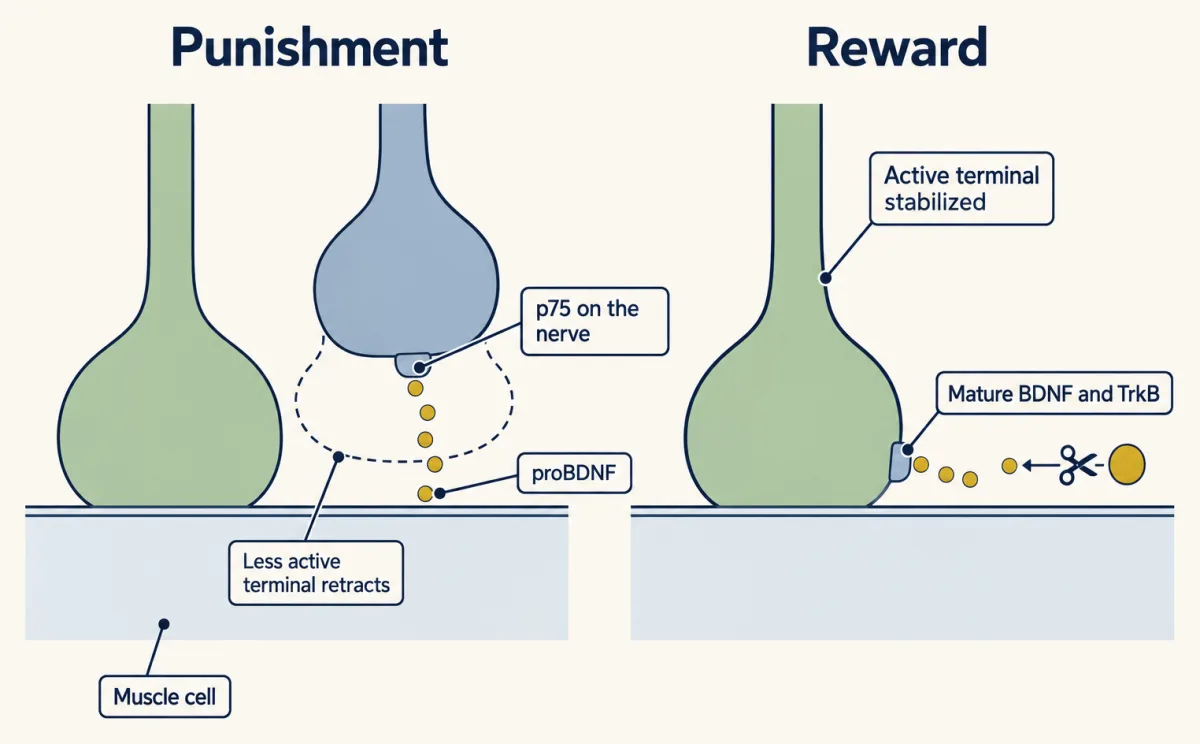
A candidate model for the contest at one muscle cell, from Xenopus nerve-muscle cultures with supporting pharmacology at developing mouse junctions: muscle proBDNF acting through p75 (with sortilin) promotes retraction of the less active terminal (punishment), and mature BDNF acting through TrkB stabilizes the active one (reward). Its necessity in vivo is unresolved. AI-generated illustration
Where this lesson fits
Before thisReview first
- Building the Neuromuscular Junction: Agrin, Lrp4 and MuSKThis course · Lesson 35
You need the endplate and its receptor patch from there, since the contest happens at that junction.
- Neurotrophins, Trk Receptors and p75This course · Lesson 30
You need proBDNF acting through p75 and mature BDNF through TrkB to weigh the candidate signals.
After thisStudy next
- Microglia and Complement Prune SynapsesThis course · Lesson 41
It shows how glia in the brain remove synapses, extending the glial clearance of retreating branches seen here.
- Ocular Dominance and the Critical PeriodThis course · Lesson 39
Competition between inputs from the two eyes, biased by activity, is a similar contest in the cortex.
Suggested by an AI model from the lessons themselves, then checked. How we use AI