Biology · Skim version
Succession in Virginia
Read the full lesson → Skim the whole course →
The guiding idea
If you stopped mowing a field in the Virginia Piedmont and walked away for a hundred years, what would be standing there when you came back?
Organisms change conditions, so suited species can become more common; disturbance can redirect succession, leaving a patchwork of stages.
From the film: How a Field Changes Its Future
- Organisms change conditions, so suited species can become more common.
- Ecological succession is change over years to centuries in the species living in an area.
- Secondary succession starts with soil, while primary succession starts without it.
- The old-field path is a tendency, not one fixed timetable for every place.
From the film: Why Succession Stays Open
- Disturbance can redirect succession, leaving a patchwork of stages.
- A climax community is a model of a fairly stable late stage, not a finish line.
- The result depends on the disturbance, nearby organisms and conditions that remain.
- A regional summary and one dated plot support different strengths of claim.
-
Explore: run a field through the decades
-
What the starting surface changes
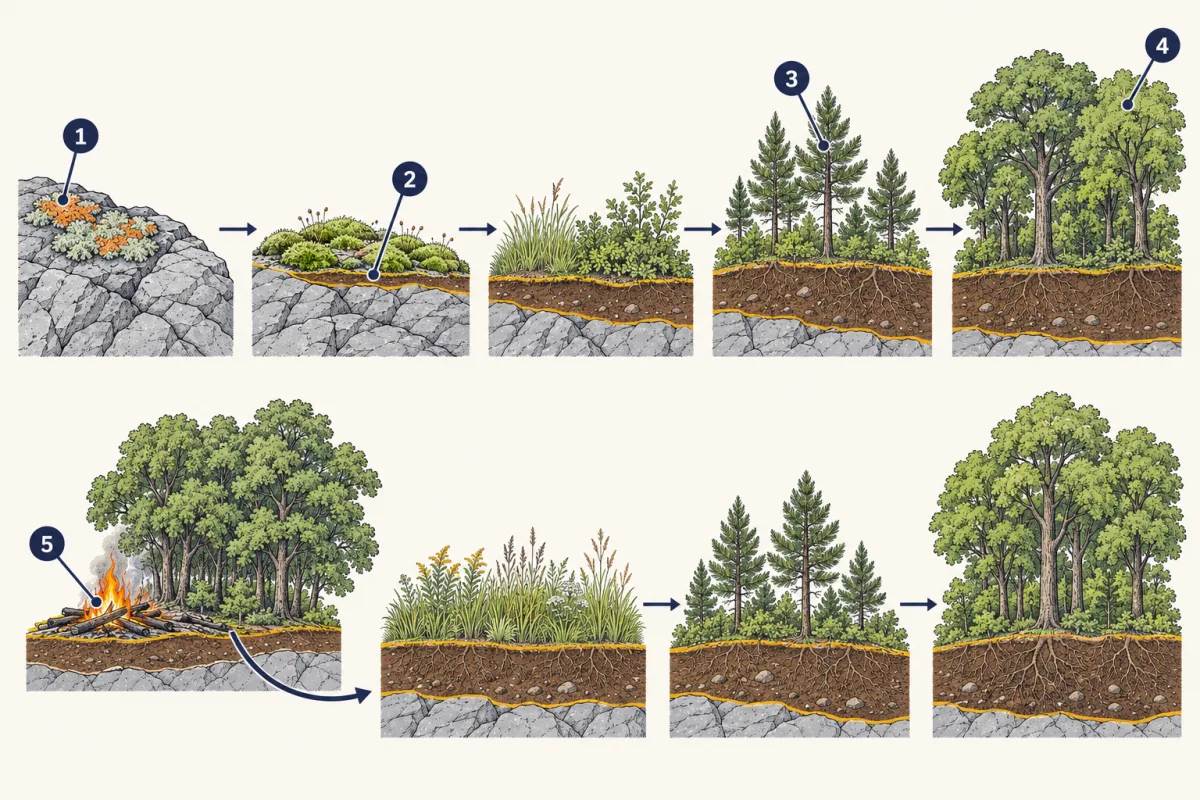
- pioneer species
- soil
- pines
- climax community
- disturbance
-
How a Virginia field can become a forest
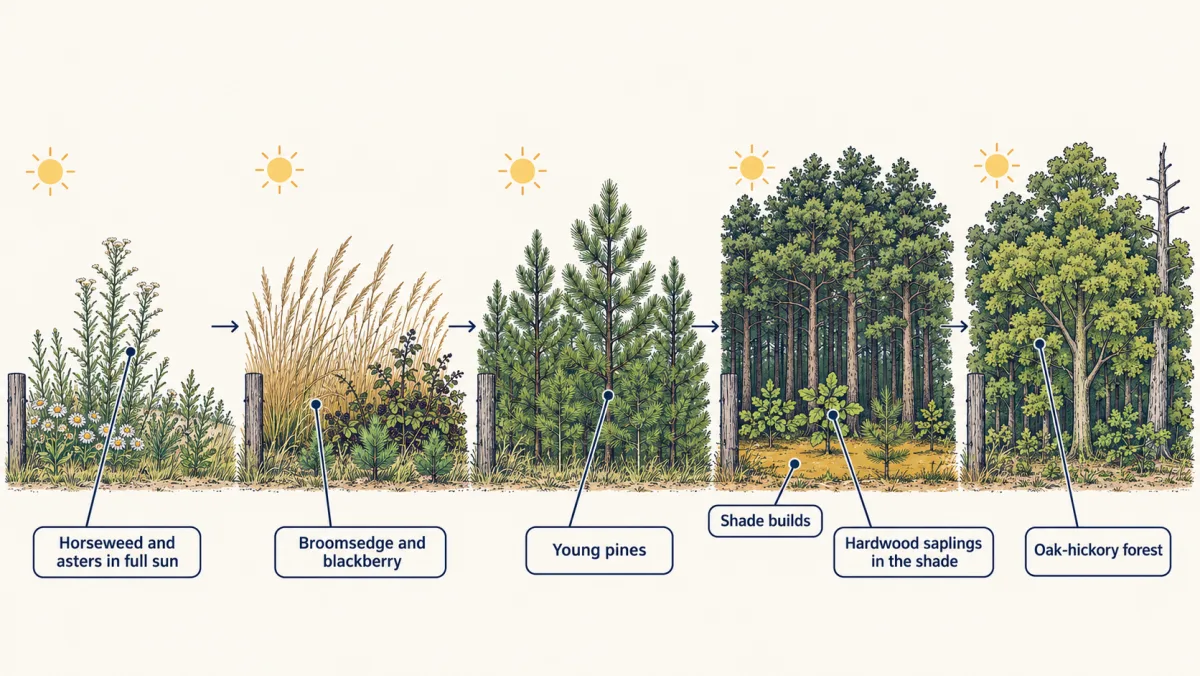
An old Piedmont field becoming forest: pines grow in full sun, young hardwoods survive in their shade, and the hardwoods take over as the pines die. AI-generated illustration -
Disturbance keeps the story open
-
Two timelines, two kinds of evidence
-
Evaluate: check your thinking
Where this lesson fits
Before thisReview first
- Energy in EcosystemsThis course · Lesson 30
You need the idea that producers like plants capture sunlight, and why light drives which plants thrive in shade.
- Matter CyclesThis course · Lesson 31
Soil nutrients and nitrogen built up by early plants feed later stages, using the cycling idea from there.
After thisStudy next
- The Chesapeake Under PressureThis course · Lesson 33
It uses disturbance and changed conditions to explain how a landscape shifts and recovers, as in this lesson.
Elsewhere on the siteFilms, simulations and method films in other courses
- Bring the eagles backSimulation · Life Science
Bringing eagles back shows how an ecosystem recovers after a disturbance is removed, as in succession.
- What Let the Eagles Return?Film · Life Science
It shows an ecosystem recovering after harm is removed, like recovery after a disturbance.
Suggested by an AI model from the lessons themselves, then checked. How we use AI