Biology · Skim version
Capturing Sunlight
Read the full lesson → Skim the whole course →
The guiding idea
How can a willow gain more than 160 pounds in five years while the soil in its pot loses only about 2 ounces, and how does sunlight end up stored in the sugar that built it?
A plant is built mostly from air and water, powered by light: photosynthesis rearranges carbon dioxide and water into sugar and oxygen, so most of a plant's dry mass comes from the air, and photosynthesis runs only as fast as its limiting factor allows.
From the film: A Tree Made of Air
- Photosynthesis uses light energy to rearrange carbon dioxide and water into glucose and oxygen.
- Atoms are not made or destroyed, so the same 6 carbon, 12 hydrogen and 18 oxygen atoms appear on both sides.
- Most of a plant's dry mass is built from carbon dioxide taken in from the air.
- Light adds no atoms; part of its energy is stored as chemical energy in glucose and oxygen together.
- A plant is built mostly from air and water, powered by light.
From the film: The Slowest Worker Sets the Pace
- A limiting factor is the input or condition that holds a process back.
- More light speeds photosynthesis only until another factor, such as carbon dioxide, becomes the limit.
- When the rate curve goes flat, adding more of that factor barely changes the rate.
- Murky water can make light the limiting factor for underwater grasses.
- One or more limiting factors cap how fast photosynthesis runs.
-
Explore: race leaf disks under a lamp
-
Explain: which atoms go where
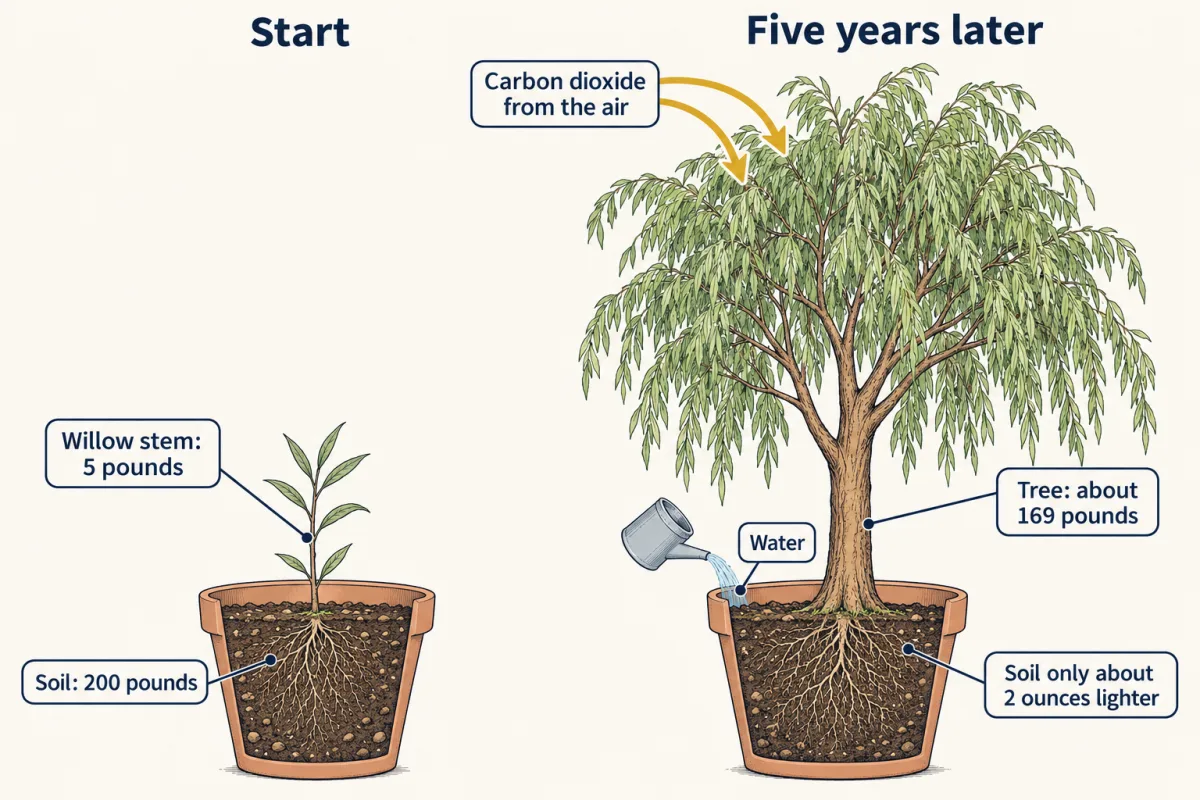
A soil loss of about 2 ounces cannot explain a gain of more than 160 pounds; the willow's dry matter was built mostly from carbon dioxide in the air. AI-generated illustration -
Explain: where it happens and where the sugar goes
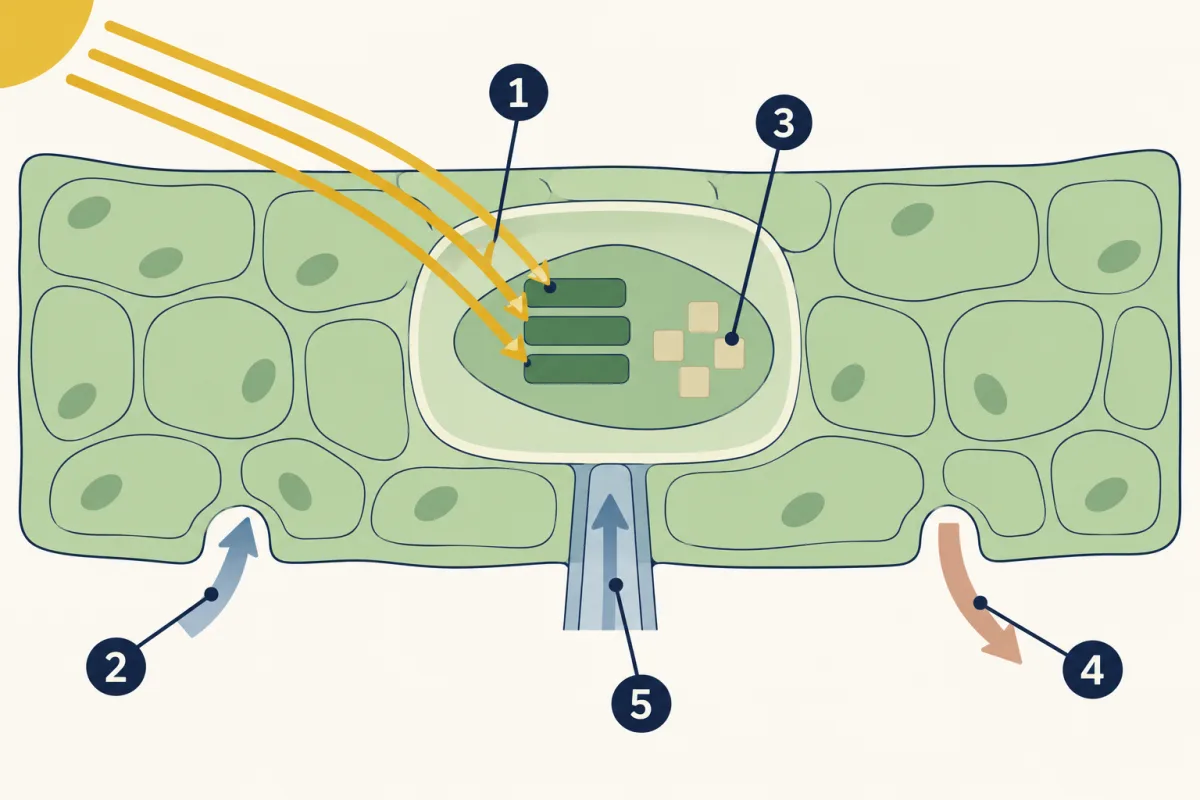
- light
- carbon dioxide
- glucose
- oxygen
- water
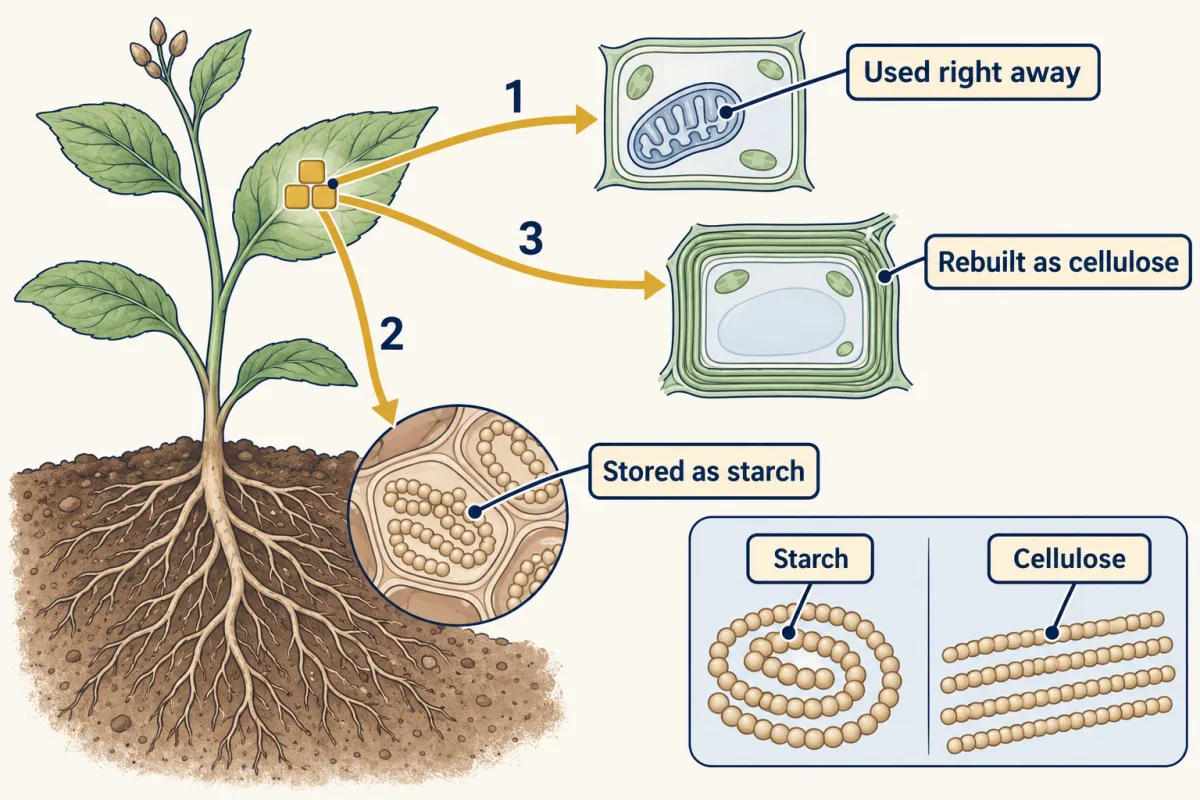
A plant uses its glucose three ways: it breaks some down right away in respiration, stores some as starch, and rebuilds some as cellulose for its cell walls. AI-generated illustration -
Explain: what limits the rate
-
Elaborate: underwater grass in the Chesapeake
-
Evaluate: check your thinking
-
Going deeper
Where this lesson fits
Before thisReview first
- Water and LifeThis course · Lesson 1
You need water's properties and its role as a reactant from there to follow how water is split and used here.
- What Am I Made Of?This course · Lesson 2
You need to know glucose is a carbohydrate and how sugars link into starch and cellulose, which this lesson assumes.
After thisStudy next
- Respiration and ATPThis course · Lesson 5
This lesson's glucose and oxygen are the fuel and oxidizer that respiration uses to release energy as ATP.
- Energy in EcosystemsThis course · Lesson 30
Light energy captured into glucose here is the energy that enters every food chain and gets passed along.
- Matter CyclesThis course · Lesson 31
Carbon from carbon dioxide fixed into sugar here is the step that carbon cycles through ecosystems start with.
Elsewhere on the siteFilms, simulations and method films in other courses
- A plant in a growth chamberSimulation · Life Science
Growth-chamber settings let you test how light and carbon dioxide limit a plant's sugar-building.
- What Becomes a Tree?Film · Life Science
This film follows a tree's mass back to carbon dioxide and water, as the willow data do.
- A day and a night in a Bay tankSimulation · Life Science
Oxygen swings over a day show photosynthesis rate changing with light.
Suggested by an AI model from the lessons themselves, then checked. How we use AI