Biochemistry · Skim version
Nucleotide Metabolism: Build It, Recycle It, or Pay in Uric Acid
Read the full lesson → Skim the whole course →
The guiding idea
Nucleotides are costly to build — Lesch-Nyhan lives where recycling breaks, and gout and allopurinol live at the uric-acid end.
Nucleotides are costly to build, so cells recycle much of what they have.
-
Three words first: base, nucleoside, nucleotide
-
Two doors in, one way out
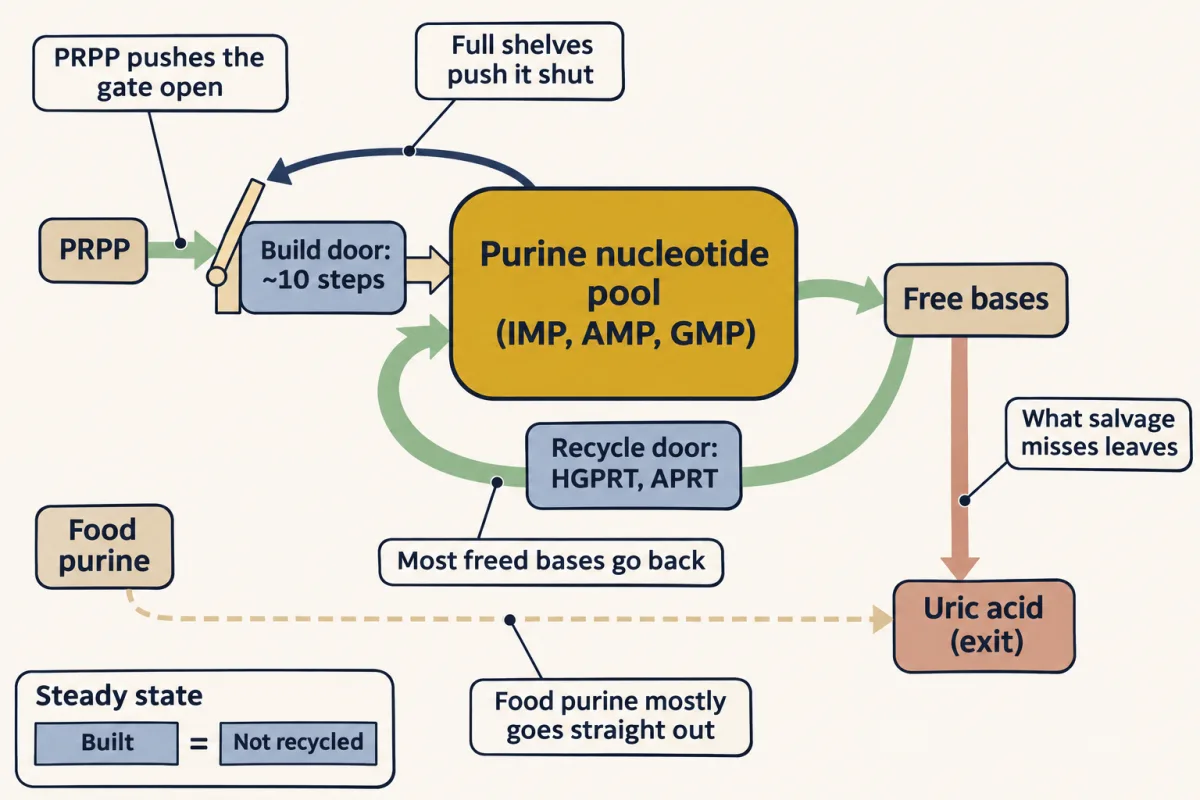
The purine pool as a loop: two doors in (recycle and build) and one way out (uric acid). Salvage returns a large share of freed bases; the gate on the build door is pushed open by PRPP and shut by finished nucleotides, so at steady state the cell builds what it fails to recycle. Food purine mostly goes straight to the exit. AI-generated illustration -
The way out: uric acid
-
When recycling breaks: Lesch-Nyhan syndrome
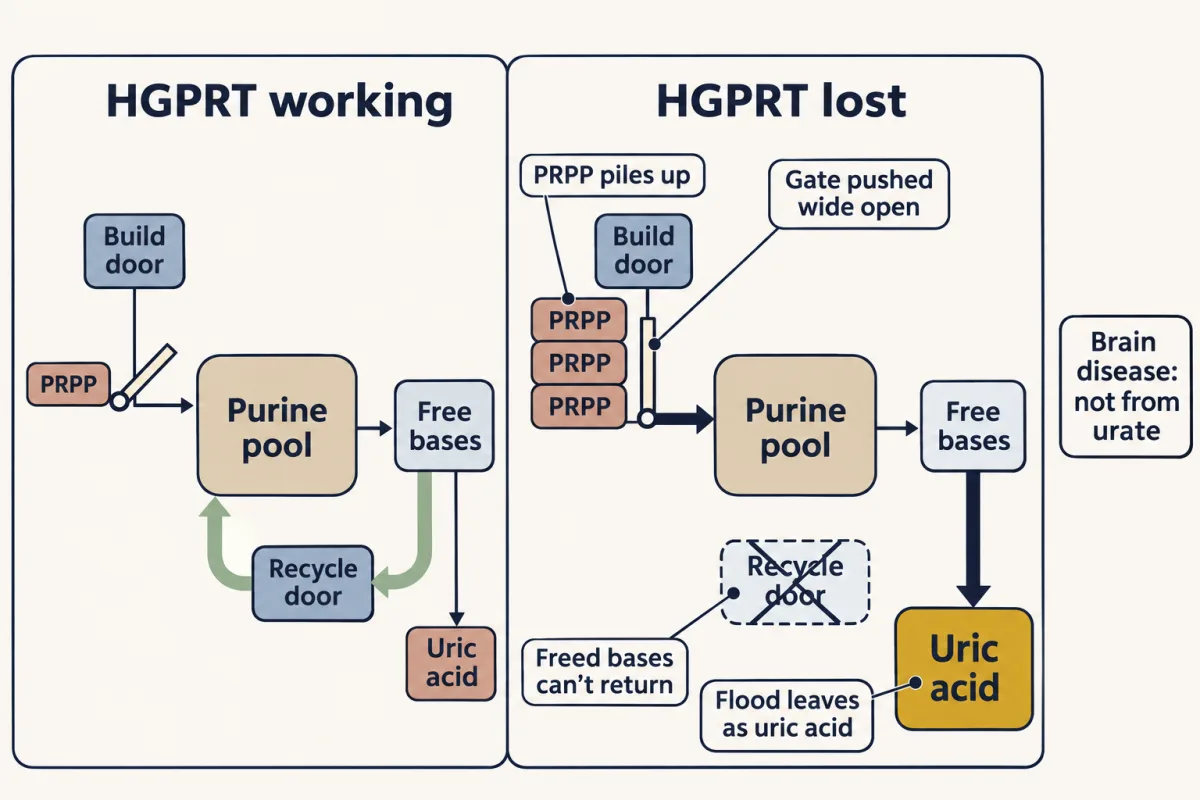
Lesch-Nyhan on the loop. Without HGPRT, freed hypoxanthine and guanine go to the exit, and the PRPP that salvage would have spent pushes the build gate open, so the extra purine leaves as uric acid too. The neurological disease is a separate harm whose mechanism is not fully understood. AI-generated illustration -
Pyrimidines: ring first
-
DNA’s building blocks
-
Counterfeits at each door
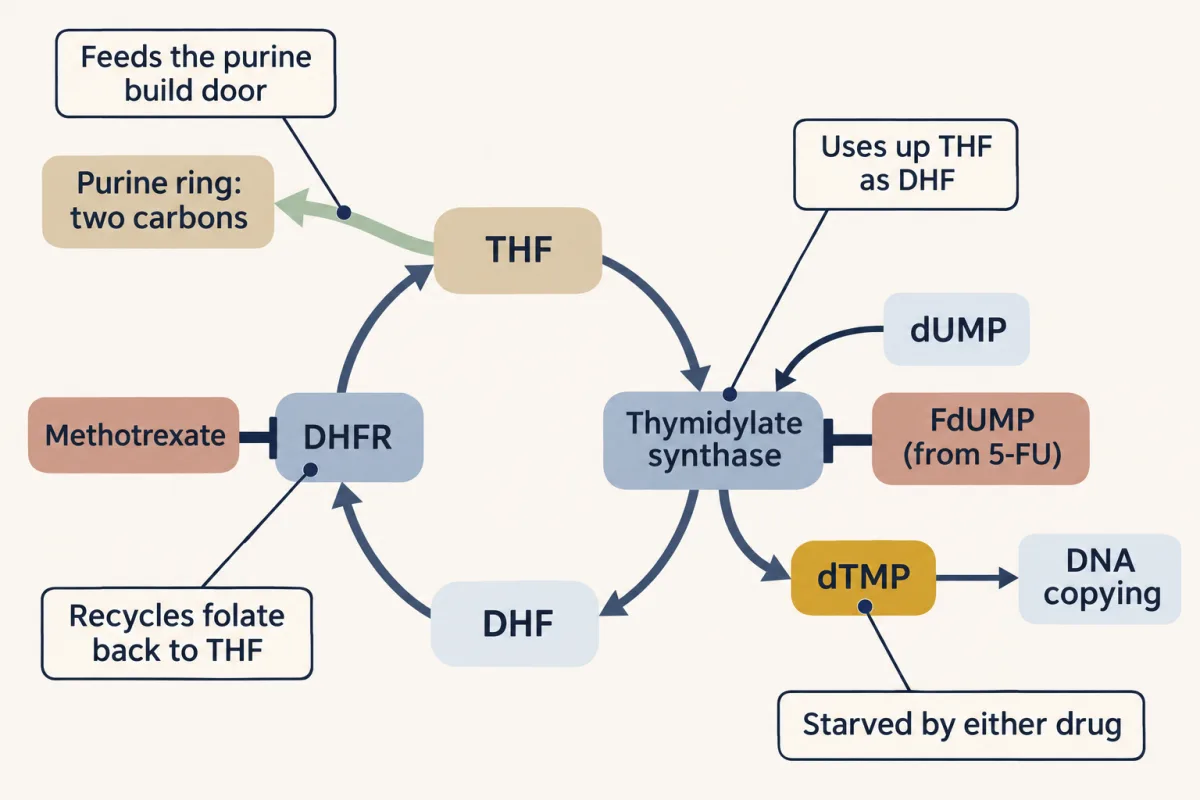
The folate cycle behind two cancer drugs. Thymidylate synthase uses a folate carbon to turn dUMP into dTMP and leaves the folate as DHF; DHFR must recycle DHF to THF before it can carry another carbon, to thymidylate or to the purine ring. Methotrexate jams DHFR, starving both; FdUMP, made from 5-fluorouracil, traps thymidylate synthase. Either way the cell runs short of the dTMP it needs to copy its DNA. AI-generated illustration -
Going deeper
Where this lesson fits
Before thisReview first
- The Pentose Phosphate Pathway: NADPH and Five-Carbon SugarsThis course · Lesson 24
You need it for ribose-5-phosphate, which is activated to PRPP, the molecule both purine doors start from.
- Metabolism: Basic Concepts and DesignThis course · Lesson 15
Counting costs in ATP equivalents and coupling uphill steps to ATP is used throughout the build-versus-recycle tally.
- Protein Turnover and Amino Acid Catabolism: Tag, Recognize, Destroy, RecycleThis course · Lesson 28
Glutamine and aspartate nitrogen feeding the ring, and the CPS-I versus CPS-II contrast, build on the urea cycle covered there.
After thisStudy next
- Integration of Metabolism: How the Body Switches FuelsThis course · Lesson 30
Shows how hormones switch pathways with the fed and fasting state, extending this lesson's gate and feedback control.
Elsewhere on the siteFilms, simulations and method films in other courses
- Spectrophotometry and enzyme kineticsMethod film
Xanthine oxidase inhibition by allopurinol is shown with rate measurements from absorbance changes.
- Radioactive and stable isotope tracersMethod film
Labelled precursors show whether a cell builds purines new or recycles free bases.
Suggested by an AI model from the lessons themselves, then checked. How we use AI