Biochemistry · Supplement · Nucleotide Metabolism
Nucleotide Metabolism: Build It, Recycle It, or Pay in Uric Acid
Rewritten on : new film. Your notes and highlights stay, but the text around them may have moved.
Nucleotides are costly to build — Lesch-Nyhan lives where recycling breaks, and gout and allopurinol live at the uric-acid end.
The main idea, the figures and what the films show. Under each heading, "Read this part" opens it.
Both films in order, 6 minutes.
The whole lesson: about 24 minutes of reading and 6 of film.
Pause when the reading reaches a film, and offer to play it. Saved on this device.
Watch the film now, or keep listening
That is the end of the reading
This idea at other levels
This lesson teaches nucleotide metabolism in Biochemistry, an upper-level college course. Simpler: read a short high school version here.
The high school version · about 1 minute to read
Nucleotides (the units of DNA and RNA; ATP is one too) can be made two ways: de novo, building the base ring from scratch (costly, ~6 ATP equivalents for a purine, counting the PRPP), or salvage, recycling a free base in one step (cheap). Many cells rely heavily on salvage. Old purines are broken down to uric acid; humans can't break uric acid down further, so if it builds up it crystallizes and causes gout. Allopurinol blocks the enzyme (xanthine oxidase) that makes uric acid. Several cancer drugs are 'antimetabolites' — look-alikes of nucleotides or their helpers (like folate) that jam the machinery of fast-dividing cells.
See nearby ideasHide nearby ideas
This lesson also teaches two more ideas; their ladders are below.
Making and recycling nucleotides
Cells build nucleotides at high cost, so they recycle free bases and break down the rest.
Taught at one level so far: upper-level college.
College, upper level · the level you chose
Nucleotide Metabolism: Build It, Recycle It, or Pay in Uric Acid · this lesson
Build a purine for about 6 ATP, recycle a free base for 2.
Biochemistry · about 24 min · film 2:58 · 3 practice questions
Next door to nucleotide metabolism
- Antimetabolite drugsDrugs that look like nucleotide building blocks jam these pathways and stop fast-dividing cells copying DNA.
- Uric acid and goutPurines that are not recycled end up as uric acid, which can form crystals in joints.
Uric acid and gout
Humans end the breakdown of purines at uric acid, which can form crystals in joints when blood levels climb too high.
Taught at one level so far: upper-level college.
College, upper level · the level you chose
Nucleotide Metabolism: Build It, Recycle It, or Pay in Uric Acid · this lesson
Humans lack uricase, so urate past 6.8 mg/dL crystallizes in joints.
Biochemistry · about 24 min · 3 practice questions
Next door to uric acid and gout
- Nitrogen waste: ammonia, urea and uric acidUric acid is the nitrogen waste that birds and reptiles make to save water.Nearest lesson: Osmoregulation and Nitrogenous Waste (a first college course)
- Making and recycling nucleotidesPurines that the cell does not recycle are broken down all the way to uric acid.
Antimetabolite drugs
Some drugs mimic the molecules cells use to make nucleotides, jamming the enzymes so fast-dividing cells cannot copy DNA.
Taught at one level so far: upper-level college.
College, upper level · the level you chose
Nucleotide Metabolism: Build It, Recycle It, or Pay in Uric Acid · this lesson
Fake building blocks jam nucleotide synthesis: methotrexate, 5-fluorouracil, 6-mercaptopurine hit dividing cells.
Biochemistry · about 24 min · 3 practice questions
Next door to antimetabolite drugs
- DNA replicationWithout nucleotides DNA cannot be copied, which is why these drugs hit dividing cells hardest.Nearest lesson: DNA Replication: Semiconservative Copying and Its Machinery (college core)
- Drug resistance in cancerA tumour can change the enzyme a drug jams, so the drug stops working.Nearest lesson: Drugs Against a Part (graduate level)
Short versions inside this lesson
The graduate version · about 1 minute to read
The architecture is an economy under allosteric control. De novo purine flux is gated at PRPP amidotransferase (feedback-inhibited by IMP/AMP/GMP and activated by PRPP), with IMP partitioned to AMP (GTP-dependent) and GMP (ATP-dependent) — a reciprocal energy requirement that helps balance the pools. Salvage is not a backup but a major, tissue-dependent source, and the PRPP node couples salvage, de novo, and the pyrimidine and NAD pathways, which is why HGPRT loss raises PRPP and de novo flux (Lesch-Nyhan). De novo dNTP supply funnels through ribonucleotide reductase, allosterically tuned at specificity and activity sites to keep the four dNTPs balanced — mis-tuning is mutagenic. The therapeutic surface is broad precisely because the network is shared: DHFR/thymidylate-synthase inhibition (methotrexate, 5-FU) and purine-analog incorporation (6-MP, thiopurines) hit nodes whose load scales with proliferation, while xanthine-oxidase inhibition (allopurinol) acts on catabolism to lower urate.
The plainest version · about 1 minute to read
Your cells use little building blocks called nucleotides to make DNA, RNA, and energy (ATP). Building one from scratch is expensive, so the cell usually grabs old ones and reuses them, like returning bottles for the deposit. When the recycling breaks, or when old blocks pile up as a waste called uric acid, you can get gout — sharp crystals in a joint. Some cancer drugs work by handing the cell fake building blocks so it can't copy its DNA and divide.
Find an idea: every idea, searchable
Which lessons teach an idea, and the notes on each level, were written by AI models from the lessons and checked by a second model. A person has not yet read every one. How we use AI
About this lesson goals, parts
What you'll learn
- Contrast de novo purine synthesis (build the ring on PRPP, ~6 ATP equivalents counting PRPP) with salvage (recycle a free base in one step), and explain why many tissues lean heavily on salvage: it is cheaper, and it turns building down.
- Trace purine catabolism to its human end product, uric acid, and explain why humans — lacking uricase — are prone to gout.
- Explain how allopurinol lowers urate by inhibiting xanthine oxidase, and connect Lesch-Nyhan syndrome to a broken salvage enzyme.
- Describe how antimetabolite drugs (methotrexate, 5-fluorouracil, 6-mercaptopurine) kill dividing cells by starving nucleotide synthesis.
- State the one structural rule that separates purine from pyrimidine synthesis: purines build the ring onto ribose; pyrimidines build the ring first.
Builds on:The Pentose Phosphate Pathway: NADPH and Five-Carbon Sugars (read)Metabolism: Basic Concepts and Design (read)Protein Turnover and Amino Acid Catabolism: Tag, Recognize, Destroy, Recycle (read)Why these?
Rewritten on : new film. Notes and highlights stay, but the text around them may have moved.
The main idea. Nucleotides are costly to build, so cells recycle much of what they have.
The films
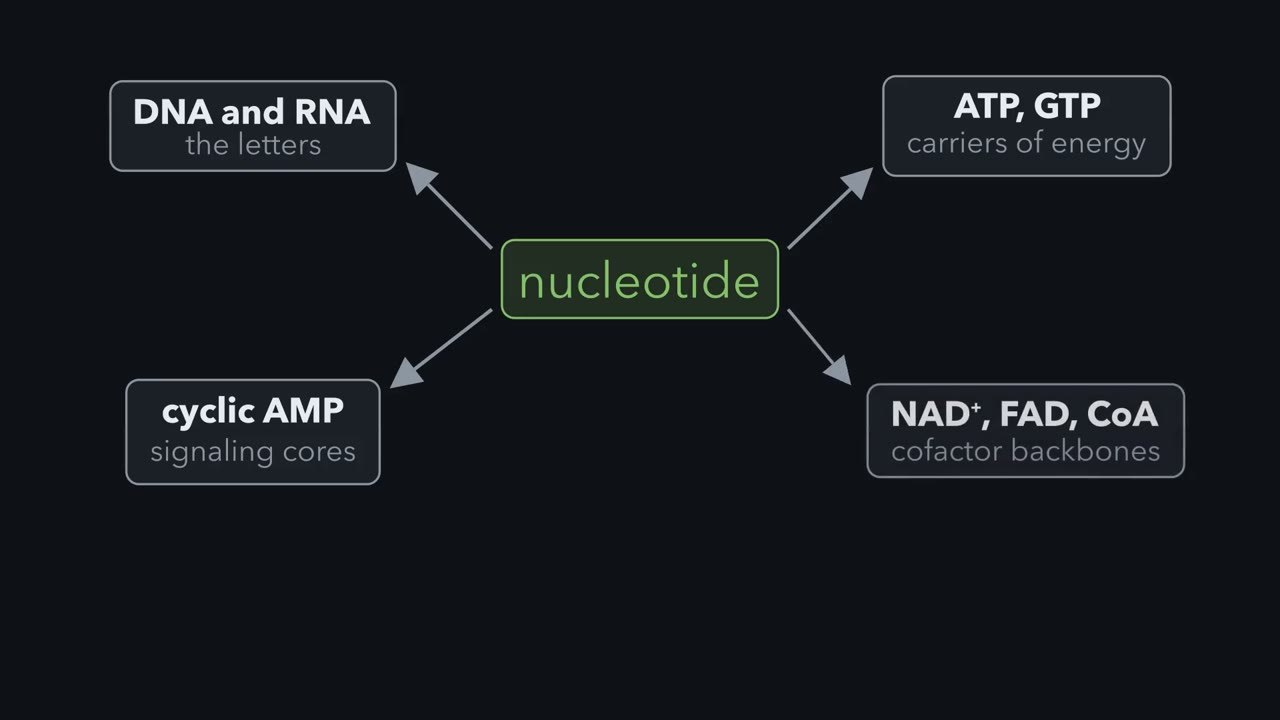 ▶ Watch Too Costly to Throw Away · 2:58
Read the transcript of “Too Costly to Throw Away”
Film transcript: Too Costly to Throw Away
A nucleotide is costly for a cell to build. Nucleotides are the letters of DNA and RNA, and the carriers of energy, ATP and GTP. They form the cores of signaling molecules like cyclic A M P. They also form the backbones of cofactors such as NAD +, FAD, and coenzyme A. Building their rings from scratch costs a small fortune in ATP. So the cell recycles much of what it has. There are two routes to purine nucleotide, and the difference is mostly about cost. De novo synthesis builds the purine ring atom by atom, directly onto an activated ribose called P R P P. It runs about ten enzymatic steps and spends roughly six ATP to make the first finished purine nucleotide, I M P. Both A M P and G M P branch from I M P.
Salvage takes a free base that already exists, such as hypoxanthine, guanine, or adenine, and reattaches it to P R P P in a single step. The enzyme H G P R T salvages hypoxanthine and guanine. A P R T salvages adenine. Recycling is so much cheaper that many cells recover a large share of their free purines. Salvage is a major source in many tissues. Now imagine the recycling is gone. In Lesch-Nyhan syndrome, an X-linked defect, H G P R T is missing. Free bases that should have been reclaimed are dumped into the catabolic pathway and turned into uric acid. The P R P P that salvage would have used piles up and pushes de novo synthesis even higher. That makes still more purines to degrade.
The result is severe hyperuricemia alongside profound neurological disease. When a purine is finally retired, it is taken apart down a short tail. A M P and adenosine funnel through inosine to hypoxanthine. Then the enzyme xanthine oxidase oxidizes hypoxanthine to xanthine, and xanthine to uric acid. Guanine joins the route one step later, at xanthine. Most mammals carry uricase, which converts uric acid into highly soluble allantoin. Humans and the other apes lost a working uricase during evolution. For us, uric acid is the end product, and it is only sparingly soluble. That missing enzyme makes us prone to gout, along with how well we excrete urate.
Once serum urate climbs past roughly 6.8 milligrams per deciliter, it can crystallize as monosodium urate. A flare is the inflammation those needle-sharp crystals trigger. One fix is to make less of it. Allopurinol, a hypoxanthine look-alike, inhibits xanthine oxidase, so urate production falls and the crystals slowly dissolve. Gertrude Elion and George Hitchings designed it by reasoning about the enzyme.
Lose one enzyme that recycles purines, and the body builds purines far faster than normal and makes several times more uric acid.
That is Lesch-Nyhan syndrome; a classic early sign is orange, sand-like urate crystals in a baby’s diaper. A broken recycling enzyme ought to leave the cell short of purines. Why does it make a flood instead, and why does the flood leave as uric acid?
About the film above: it covers purines only; its “roughly six ATP” counts making the phosphoribosyl pyrophosphate (PRPP) (in ATP equivalents, explained below); and uricase, which it says converts uric acid to allantoin, does only the first of three steps.
Nucleotides are the letters of DNA and RNA, the energy carriers ATP and GTP and the core of cyclic AMP, and NAD⁺, FAD and coenzyme A each contain one. Their rings cost a small fortune in ATP, so the cell recycles much of what it has.
Three words first: base, nucleoside, nucleotide
A purine base is a two-ring molecule on its own (a pyrimidine base has one ring). Add a ribose and it is a nucleoside; add a phosphate to that ribose and it is a nucleotide.
| Base | + ribose = nucleoside | + phosphate = nucleotide |
|---|---|---|
| hypoxanthine | inosine | IMP |
| guanine | guanosine | GMP |
| adenine | adenosine | AMP |
IMP is the first purine nucleotide the cell builds, and the parent of both AMP and GMP.
Two doors in, one way out
Nucleotides do not last: RNA is made and broken down all day, and nucleotides are turned over constantly, so a cell is always releasing free bases.
The one idea to carry through this lesson. A cell’s purine nucleotides are a pool on a loop, with two doors in (build and recycle) and one way out. Salvage puts a large share of freed bases straight back (how large depends on the tissue); whatever it misses leaves the loop, almost all of it as uric acid. De novo synthesis refills the pool through a gate that phosphoribosyl pyrophosphate (PRPP) pushes open and finished nucleotides push shut. So, at steady state, the cell builds what it fails to recycle, and the uric acid the body makes equals what it builds plus the purine it absorbs from food.
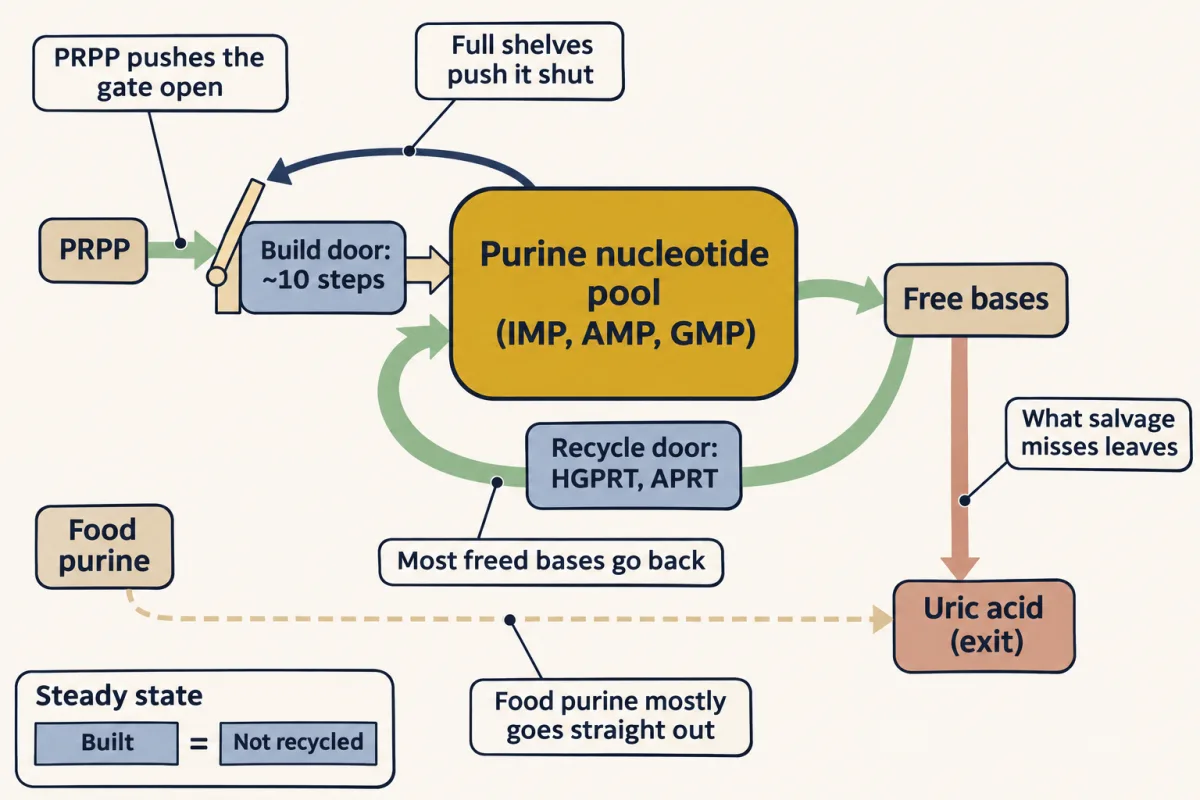
Two exceptions: a growing tissue builds extra to grow, and a sudden loss of many cells sends their nucleic acids and nucleotides into the exit (the last prediction). Food purine is mostly broken down in the gut wall and liver rather than reused, so it adds to the exit, not the pool. Pyrimidines have their own build and recycle routes (recycling runs through different enzymes) and a harmless exit, covered below.
The molecule both doors use: PRPP
Both doors start from PRPP, 5-phosphoribosyl-1-pyrophosphate: ribose-5-phosphate (from the pentose phosphate pathway) carrying a pyrophosphate, two linked phosphates, on carbon 1. PRPP synthetase takes that pyrophosphate from ATP, leaving AMP. PRPP is “activated”: when something attaches to carbon 1 the pyrophosphate leaves, and its rapid breakdown makes the attachment effectively one-way. Costs here are counted in ATP equivalents: one high-energy phosphate bond spent, as when ATP becomes ADP (a GTP becoming GDP counts the same). PRPP uses one ATP molecule, but turning it into AMP spends two bonds, and the AMP must be recharged twice to become ATP again. So one PRPP costs 2 ATP equivalents.
Door 1, build: de novo synthesis
The cell assembles the purine ring atom by atom directly on carbon 1 of PRPP, and about ten enzymatic steps later IMP appears. The ring’s nine atoms come from glycine (three), glutamine (two), aspartate (one), CO₂ (one) and two one-carbon (formyl) groups carried by tetrahydrofolate (THF), the working form of the folate vitamin. Remember those two folate carbons.
| What building spends | ATP equivalents |
|---|---|
| Making the PRPP | 2 |
| Four steps that each turn ATP into ADP (adding glycine, adding the second glutamine nitrogen, closing the first ring, adding aspartate) | 4 |
| IMP, total | 6 |
| IMP → AMP (a GTP → GDP, +1) | 7 for AMP |
| IMP → GMP (an ATP → AMP, +2) | 8 for GMP |
Door 2, recycle: salvage
Salvage attaches an existing base to PRPP in a single step, by phosphoribosyltransferases, which move the phosphoribose from PRPP onto the base. HGPRT (hypoxanthine-guanine phosphoribosyltransferase) turns hypoxanthine into IMP and guanine into GMP; APRT (adenine phosphoribosyltransferase) turns adenine into AMP.
The only cost is the PRPP, 2 ATP equivalents, with no amino acids or folate: three to four times cheaper than building. In many tissues salvage is a major source, not a backup; how much a cell relies on it also depends on how fast it is growing.
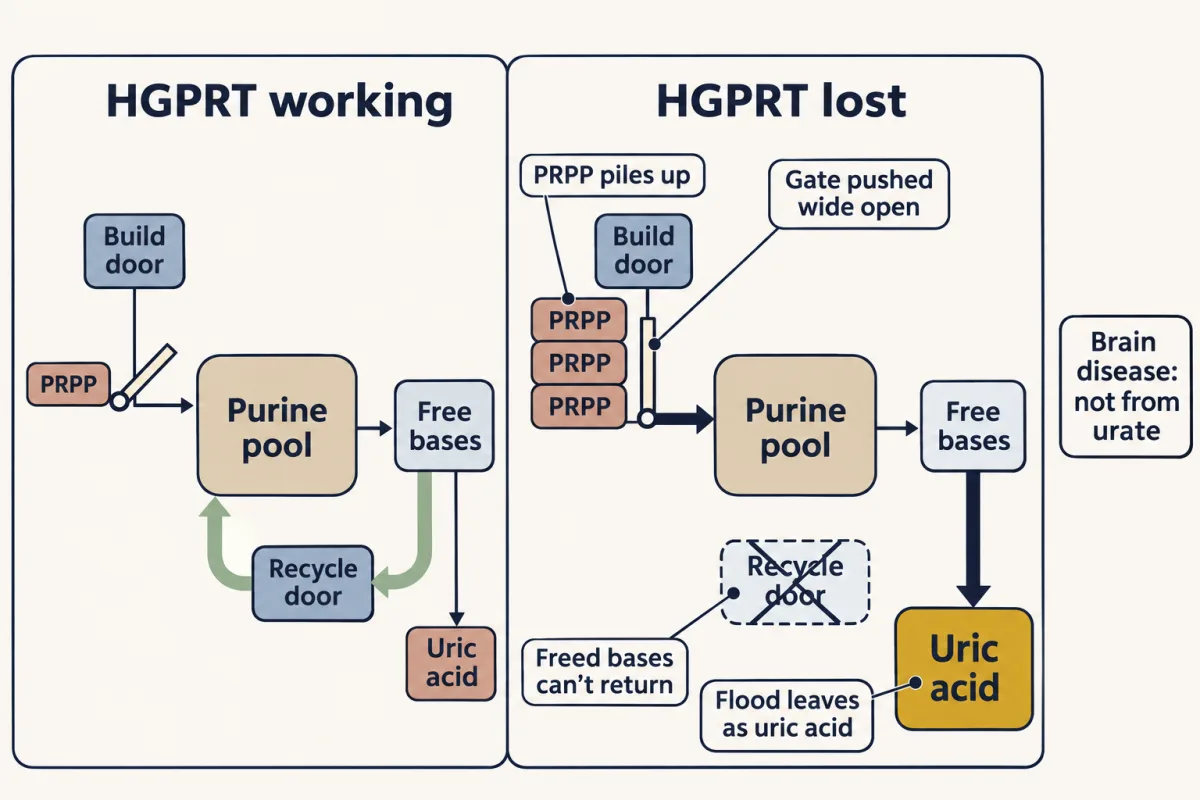
Knock out HGPRT and the recycle door shuts. Freed hypoxanthine and guanine can no longer go back into the pool, so they are oxidized to uric acid. The PRPP that salvage would have spent piles up and pushes the committed step open, so de novo building speeds up, and that extra purine leaves as uric acid too: the cell still builds what it fails to recycle. The result is severe hyperuricemia (urate crystals, kidney stones, gout). The neurological disease is a separate harm, not caused by urate.
Many tissues rely heavily on salvage — it is cheaper to glue a used base back onto PRPP than to build the nine-atom double ring (five carbons, four nitrogens) from glutamine, glycine, aspartate, CO₂, and folate-carried formyl groups. De novo is the route a rapidly dividing cell pays for when there simply aren't enough scrap bases to go around. The lesson sits in the contrast: salvage is the thrifty default, and Lesch-Nyhan shows what it costs to lose it — you pay twice, once in ATP and once in uric acid.
The gate: where the cell decides to build
PRPP itself can still go to salvage, to pyrimidines or to NAD⁺. The first step that sends it to purines only is glutamine-PRPP amidotransferase, which swaps PRPP’s pyrophosphate for an amino group from glutamine. That makes it the committed step, and so the place for control.
- Is there PRPP to spend? PRPP is the gate’s substrate and also switches it on. More PRPP, more building.
- Are the shelves full? IMP, AMP and GMP bind the enzyme away from its active site and switch it off (feedback inhibition). AMP and GMP together shut it down more than either alone.
Predict. A cell already has plenty of AMP and GMP, and it is handed free hypoxanthine. What happens to its rate of building?
Check your prediction
It falls, for two reasons. Salvaging the hypoxanthine uses up PRPP, so the gate has less to spend, and it makes IMP, which adds to the feedback. Recycling does more than save ATP: it turns building down.
The way out: uric acid
A purine that is not recycled is taken apart in three moves.
- Strip the phosphate and the amino group: AMP and adenosine funnel through to inosine (losing adenine’s amino group is what turns the adenosine into inosine, whose base is hypoxanthine).
- Remove the ribose: inosine becomes the free base hypoxanthine, which salvage can still catch.
- Oxidize twice: xanthine oxidase turns hypoxanthine into xanthine, and xanthine into uric acid. Guanine joins at xanthine, by losing its amino group.
Most mammals go further: their uricase oxidizes uric acid, the first of three steps to highly soluble allantoin. Humans and the other apes lost a working uricase during evolution, so for us sparingly soluble uric acid is the end product.
That missing enzyme is why humans are prone to gout, though who gets it depends mostly on how well the kidneys and gut excrete urate. Once serum urate (uric acid’s ionized form, the one in blood) climbs past roughly 6.8 mg/dL, it is supersaturated and can slowly crystallize as monosodium urate in and around joints. A flare is the body’s inflammatory attack on those needle-sharp crystals.
One fix is to make less urate. Allopurinol, a hypoxanthine look-alike, inhibits xanthine oxidase, so urate production falls and, over months, the crystals can dissolve. It came out of Gertrude Elion and George Hitchings’s lab, but not as a gout drug: they first tested it as a xanthine oxidase blocker to slow the breakdown of their leukemia drug 6-mercaptopurine, and its urate-lowering effect led to its use in gout. Other drugs instead help the kidneys excrete more urate.
Uric acid is where purine catabolism dead-ends in us — we lost uricase, the enzyme other mammals use to begin breaking it down further, so the poorly soluble acid is the last stop. Gout is simply that acid crossing its solubility line and crystallizing in a joint. Allopurinol, one of Elion and Hitchings's rationally designed purine analogs, is the elegant fix: it is itself oxidized by xanthine oxidase into oxypurinol, which then jams the enzyme shut — fewer urate molecules made, the serum level falls back under the line, and the crystals dissolve.
When recycling breaks: Lesch-Nyhan syndrome
Back to the opening puzzle. In Lesch-Nyhan syndrome the HGPRT gene, on the X chromosome, does not work, so nearly all patients are boys.
Predict. HGPRT is gone. Follow the freed hypoxanthine and guanine. Then ask what happens to phosphoribosyl pyrophosphate (PRPP), to the gate and to uric acid.
Check your prediction
The freed bases cannot go back into the pool, so they are oxidized to uric acid. The PRPP that salvage would have spent piles up and pushes the gate open, so building speeds up. Almost all of that extra purine leaves as uric acid too: the cell still builds what it fails to recycle, and now it fails to recycle far more. The result is severe hyperuricemia (too much urate in the blood): urate crystals in the diaper, then kidney stones and, later, gout.
Predict. Allopurinol brings these boys’ urate down. Will it also prevent the syndrome’s profound neurological disease, with severe movement problems and compulsive self-injury?
Check your prediction
No. Allopurinol protects the kidneys and joints, but the neurological disease is not caused by urate, and its mechanism is still not fully understood. Losing HGPRT does two separate kinds of harm, and allopurinol treats only the urate flood.
Pyrimidines: ring first
Pyrimidines (cytosine, uracil, thymine) mirror the purine build door: they build the ring first, from carbamoyl phosphate and aspartate, and take the ribose-phosphate from phosphoribosyl pyrophosphate (PRPP) only afterward. The carbamoyl phosphate comes from CPS-II, not the urea cycle’s carbamoyl phosphate synthetase I (CPS-I). CPS-I is mitochondrial, takes free ammonia and needs N-acetylglutamate; CPS-II is cytosolic, takes glutamine’s nitrogen and is shut off by UTP, a finished pyrimidine. Different places and signals let nitrogen disposal and nucleotide building run independently.
The exit differs too: pyrimidines break down to soluble products (β-alanine, β-aminoisobutyrate, CO₂ and ammonia), so they have no gout.
Read the transcript of “Almost Right”
Film transcript: Almost Right
Last time, a cell recycled purines because building them is costly. A dividing cell must copy all its DNA, so it needs building blocks fast. One drug is shaped almost like the vitamin folate. How can a vitamin look-alike starve that copying?
But DNA needs deoxy building blocks. In a dividing cell, most new ones come through one gateway, ribonucleotide reductase, which reduces ribonucleotides. Its activity is tied tightly to cell division. Thymine needs one more step. Thymidylate synthase adds a carbon, carried by a folate, to dUMP. That makes thymidylate, dTMP, and leaves the folate as dihydrofolate. Dihydrofolate reductase, DHFR, turns it back into THF. Only then can it carry another carbon. The same carrier supplies two carbons of the purine ring. So one folate loop feeds both thymidylate and purines. Here is the rule. An enzyme accepts what has the right shape. A counterfeit that fits the lock well enough to turn it, or jam it, is a medicine, an antimetabolite.
The dividing cell is the most exposed, because it needs nucleotides fastest. Methotrexate mimics folate and jams DHFR, the enzyme that recycles the carrier. What runs short: thymidylate, the purine ring, or both? Both. With DHFR jammed, THF is not regenerated. Thymidylate and the purine ring are both starved of their folate carbons. The cell runs short of the dTMP it needs to copy its DNA. 5-fluorouracil mimics uracil. Inside the cell it becomes FdUMP, which traps thymidylate synthase itself. A different lock, the same shortage of dTMP. 6-mercaptopurine, a fake purine, enters through the recycle door.
HGPRT, the recycling enzyme, turns it into counterfeit nucleotides. These shut down purine building. Once built into DNA, they damage the leukemia cells that took up the drug. So each of these drugs is almost right. Each fools an enzyme on the road to DNA. A dividing cell needs that road most, though fast-dividing normal tissues are hit too.
From the film
- In a dividing cell, most new DNA building blocks come through one gateway, ribonucleotide reductase.
- Thymidylate synthase uses a folate carbon to make dTMP, and DHFR must recycle the folate before it can carry another carbon.
- An antimetabolite is a counterfeit shaped enough like the real thing to turn or jam an enzyme.
- Methotrexate jams DHFR and 5-fluorouracil traps thymidylate synthase, so both leave the cell short of dTMP.
- Dividing cells are the most exposed because they need nucleotides fastest, though fast-dividing normal tissues are hit too.
DNA’s building blocks
DNA needs deoxyribonucleotides, a branch off the pool outside the loop’s balance. In a dividing cell most new dNTPs (deoxynucleoside triphosphates) come through one gateway, ribonucleotide reductase, which reduces ribonucleotides; cells can also salvage ready-made deoxynucleosides. Its activity is therefore tied tightly to cell division, and hydroxyurea inhibits it (used in sickle-cell disease and some leukemias).
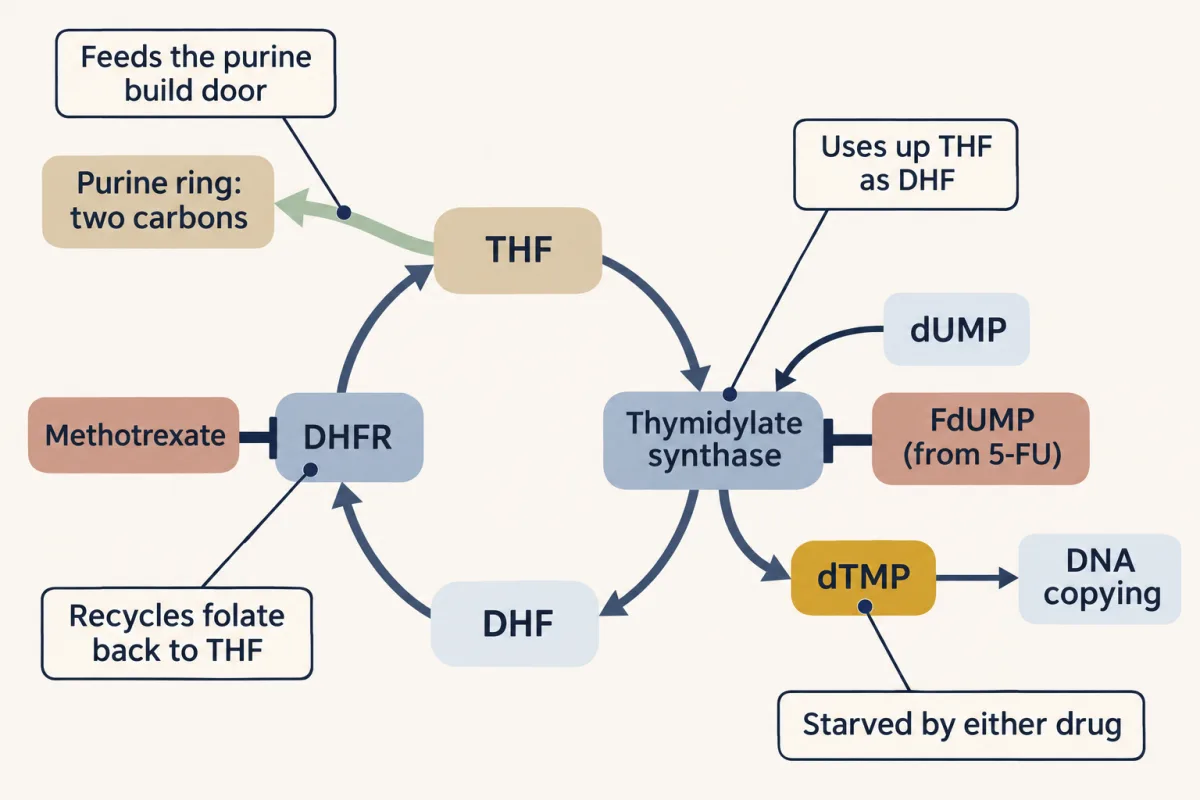
Thymine needs one more step. Thymidylate synthase adds a carbon, carried by a folate, to dUMP (uracil’s deoxynucleotide) to make thymidylate (dTMP), leaving the folate as dihydrofolate (DHF). Dihydrofolate reductase (DHFR) must turn DHF back into tetrahydrofolate (THF) before it can carry another carbon, to thymidylate or to the purine ring.
Counterfeits at each door
The drugs here run on Emil Fischer’s old principle: a molecule’s shape decides what an enzyme will accept. A counterfeit that fits the lock well enough to turn it, or jam it, is a medicine: an antimetabolite. The dividing cell is the most exposed, because it needs nucleotides fastest, though fast-dividing normal tissues are hit too.
- Methotrexate mimics folate and jams dihydrofolate reductase (DHFR), so tetrahydrofolate (THF) is not regenerated, starving both the purine ring’s two folate carbons and the carbon that makes dTMP.
- 5-fluorouracil mimics uracil. Inside the cell it becomes FdUMP, which traps thymidylate synthase itself, so it too starves the cell of the dTMP it needs to copy its DNA.
- 6-mercaptopurine (6-MP), a fake purine, enters through the recycle door: HGPRT turns it into counterfeit nucleotides. These shut down purine synthesis and, once built into DNA, damage the leukemia cells that took it up.
Predict. A leukemia cell loses its HGPRT to a mutation. What happens when it meets 6-MP?
Check your prediction
It is resistant. Without HGPRT, 6-MP is never made into nucleotides, and the cell can still build its purines de novo. That is why the related drug 6-thioguanine selects HGPRT-mutant cells in culture.
Predict. A treatment kills a large, fast-growing tumor within days. What happens to urate, and what would you give before treatment starts?
Check your prediction
Urate surges. This is the exception set aside earlier: dying cells release their DNA, RNA and nucleotides at once, their purines go down the exit to uric acid (tumor lysis), and the urate can crystallize in the kidneys. Allopurinol given beforehand blocks the exit’s last two steps, so less urate is made. Urate already in the blood needs rasburicase, a uricase made as a drug, which breaks it down.
The thread runs from Fischer naming the purine ring to Hitchings and Elion turning it into leukemia therapy, transplant drugs, the gout drug above and the antiviral acyclovir. Most aim at the doors, the exit or the DNA branch of one loop; acyclovir, a guanosine look-alike, instead jams the herpes virus’s own DNA polymerase.
Going deeper
The fine print of the tally
Phosphoribosyl pyrophosphate (PRPP) to IMP is ten steps in vertebrates (eleven counting PRPP synthetase). The CO₂ step uses no ATP in vertebrates; bacteria spend one there. IMP dehydrogenase, on the way to GMP, uses an NAD⁺ and is the target of the transplant drug mycophenolate. That AMP needs GTP and GMP needs ATP helps balance the two pools.
Variations on the loop
- An overactive PRPP synthetase pushes the gate open even with working HGPRT: urate overproduction and gout by the same logic.
- Partial HGPRT deficiency still causes urate overproduction, with gout and kidney stones, but milder or no neurological disease.
- In Lesch-Nyhan the established driver is the rise in PRPP. Weaker feedback from lower IMP and GMP may add to it, but that is secondary and debated.
- With working HGPRT, allopurinol tends to lower total purine output, not just urate, because the hypoxanthine it leaves behind is salvaged. In Lesch-Nyhan it only swaps urate for hypoxanthine and xanthine, with a risk of xanthine stones.
Pyrimidine and dNTP control
Besides UTP feedback, CPS-II is switched on by PRPP and ATP. In mammals it sits in one large protein, CAD, with the next two steps; a later enzyme, DHODH, makes orotate. In orotic aciduria, an inherited block after orotate, orotate spills into the urine. Mammalian ribonucleotide reductase works on ribonucleoside diphosphates; one allosteric site sets its overall activity and another sets which substrate it reduces, keeping the four dNTPs balanced (mis-tuning is mutagenic).
More on the drugs
- Inside cells methotrexate gains a chain of glutamates, and these forms also inhibit the purine formyl-adding enzymes directly, most strongly AICAR transformylase.
- The leucovorin paradox. Leucovorin, a ready-made reduced folate, bypasses dihydrofolate reductase (DHFR) and rescues normal cells from methotrexate. With 5-FU it does the opposite: it supplies the folate partner that locks FdUMP onto thymidylate synthase.
- TPMT (thiopurine methyltransferase) inactivates 6-MP, so people with low TPMT build up toxic amounts of its nucleotides. Xanthine oxidase also breaks 6-MP down, so giving allopurinol with 6-MP means cutting the 6-MP dose.
Your notes
Select any text in the lesson to highlight it or add a note to it. Your highlights and notes are saved in this browser and collected in your notebook.
This browser is not letting the site save anything (a private window or strict privacy settings), so highlights and notes will be lost when you leave the page.
Try the Predict questions again
Five Predict questions from this lesson, on their own. Answer each one first, then open its check.
A cell already has plenty of AMP and GMP, and it is handed free hypoxanthine. What happens to its rate of building?
From: Two doors in, one way out
Check your prediction
It falls, for two reasons. Salvaging the hypoxanthine uses up PRPP, so the gate has less to spend, and it makes IMP, which adds to the feedback. Recycling does more than save ATP: it turns building down.
HGPRT is gone. Follow the freed hypoxanthine and guanine. Then ask what happens to PRPP, to the gate and to uric acid.
From: When recycling breaks: Lesch-Nyhan syndrome
Check your prediction
The freed bases cannot go back into the pool, so they are oxidized to uric acid. The PRPP that salvage would have spent piles up and pushes the gate open, so building speeds up. Almost all of that extra purine leaves as uric acid too: the cell still builds what it fails to recycle, and now it fails to recycle far more. The result is severe hyperuricemia (too much urate in the blood): urate crystals in the diaper, then kidney stones and, later, gout.
Allopurinol brings these boys’ urate down. Will it also prevent the syndrome’s profound neurological disease, with severe movement problems and compulsive self-injury?
From: When recycling breaks: Lesch-Nyhan syndrome
Check your prediction
No. Allopurinol protects the kidneys and joints, but the neurological disease is not caused by urate, and its mechanism is still not fully understood. Losing HGPRT does two separate kinds of harm, and allopurinol treats only the urate flood.
A leukemia cell loses its HGPRT to a mutation. What happens when it meets 6-MP?
From: Counterfeits at each door
Check your prediction
It is resistant. Without HGPRT, 6-MP is never made into nucleotides, and the cell can still build its purines de novo. That is why the related drug 6-thioguanine selects HGPRT-mutant cells in culture.
A treatment kills a large, fast-growing tumor within days. What happens to urate, and what would you give before treatment starts?
From: Counterfeits at each door
Check your prediction
Urate surges. This is the exception set aside earlier: dying cells release their DNA, RNA and nucleotides at once, their purines go down the exit to uric acid (tumor lysis), and the urate can crystallize in the kidneys. Allopurinol given beforehand blocks the exit’s last two steps, so less urate is made. Urate already in the blood needs rasburicase, a uricase made as a drug, which breaks it down.
How we measure it
Salvage (phosphoribosyltransfer)
Recycling a free base by attaching it to PRPP in a single step — HGPRT for hypoxanthine and guanine, APRT for adenine. The cheap route, and a major purine source in many tissues.
Antimetabolite drug design
Building a molecule that mimics a real metabolite closely enough to fool an enzyme, then jams it. Allopurinol (xanthine oxidase), methotrexate (DHFR), 5-FU (thymidylate synthase), 6-MP (activated by HGPRT; its nucleotides block purine synthesis and are built into DNA).
Enzyme inhibition
Blocking a single committed step to choke an entire pathway. For anticancer antimetabolites, the faster a cell divides, the harder the block bites, which is part of the therapeutic window; fast-dividing normal tissues feel it too.
Practice questions on this lesson (3) → MCAT-style, original, each with an explanation
Where this lesson fits
Before thisReview first
- The Pentose Phosphate Pathway: NADPH and Five-Carbon SugarsThis course · Lesson 24
You need it for ribose-5-phosphate, which is activated to PRPP, the molecule both purine doors start from.
- Metabolism: Basic Concepts and DesignThis course · Lesson 15
Counting costs in ATP equivalents and coupling uphill steps to ATP is used throughout the build-versus-recycle tally.
- Protein Turnover and Amino Acid Catabolism: Tag, Recognize, Destroy, RecycleThis course · Lesson 28
Glutamine and aspartate nitrogen feeding the ring, and the CPS-I versus CPS-II contrast, build on the urea cycle covered there.
After thisStudy next
- Integration of Metabolism: How the Body Switches FuelsThis course · Lesson 30
Shows how hormones switch pathways with the fed and fasting state, extending this lesson's gate and feedback control.
Elsewhere on the siteFilms, simulations and method films in other courses
- Spectrophotometry and enzyme kineticsMethod film
Xanthine oxidase inhibition by allopurinol is shown with rate measurements from absorbance changes.
- Radioactive and stable isotope tracersMethod film
Labelled precursors show whether a cell builds purines new or recycles free bases.
Suggested by an AI model from the lessons themselves, then checked. How we use AI
That is the skim: you have the shape of it.
That is both films: the lesson in pictures.
The rest of the lesson is here when you want it.
Finish line
Test yourself
8 questions
Practice and MCAT-style, with explained answers.
Next · Lesson 30
Integration of Metabolism: How the Body Switches Fuels
Fed, fasting, starving: led by two hormones, the body turns every pathway in this course up or down in a timed sequence.
Continue →← Lesson 28 · Protein Turnover and Amino Acid Catabolism: Tag, Recognize, Destroy, Recycle
Rewritten on : new film. Notes and highlights stay, but the text around them may have moved.