Life Science · Skim version
Natural Selection in Action
Read the full lesson → Skim the whole course →
The guiding idea
Why did nearly black peppered moths become common in smoky industrial areas, and then become rare again once the air got cleaner?
Inherited traits that help survival and reproduction become more common over generations.
From the film: How a Population Changes Colour
- Inherited traits that help survival and reproduction become more common over generations.
- Natural selection changes trait frequency in a population, not one individual.
- Whether a colour helps a moth depends on the bark around it.
- Variation, inheritance and unequal reproduction drive the shift.
From the film: Who Selects the Breeders?
- People shift inherited traits by choosing which organisms reproduce.
- Natural and artificial selection both shift inherited traits across generations.
- An adaptation is shaped by natural selection, and its value depends on the environment.
- Natural selection is one cause of evolution.
-
Explore: be the birds that hunt moths
-
Explain: how natural selection works
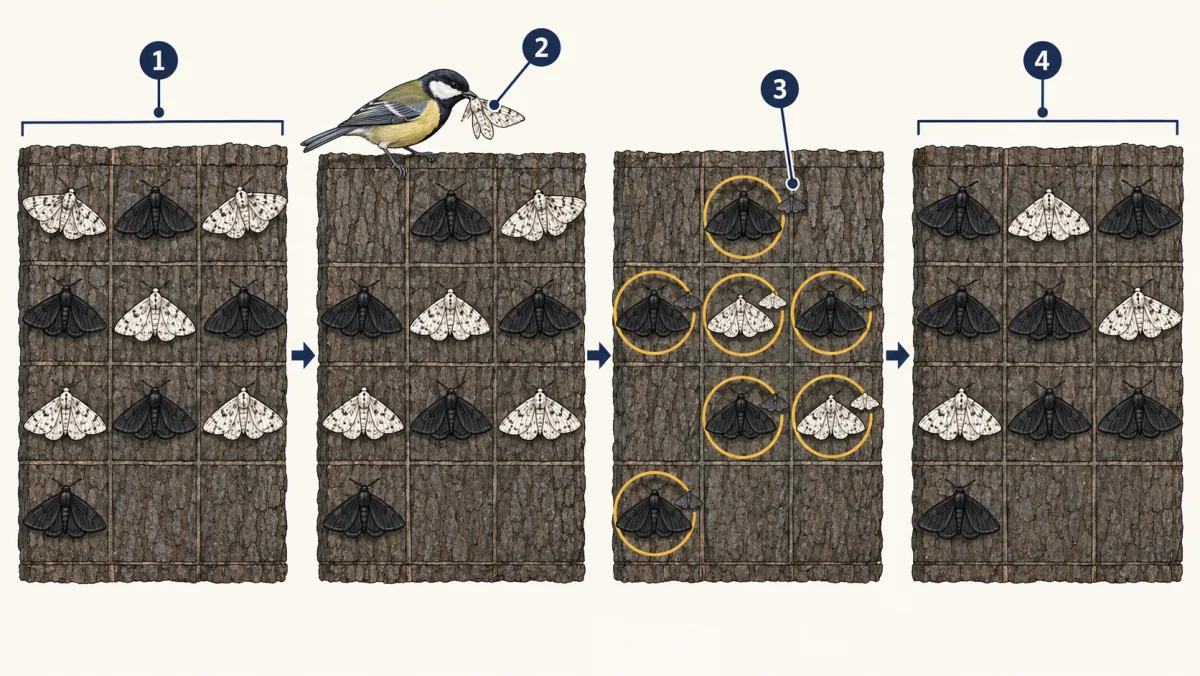
- moths vary in colour
- birds spot moths that stand out
- survivors reproduce
- the next generation
-
Explain: adaptations, breeders and evolution
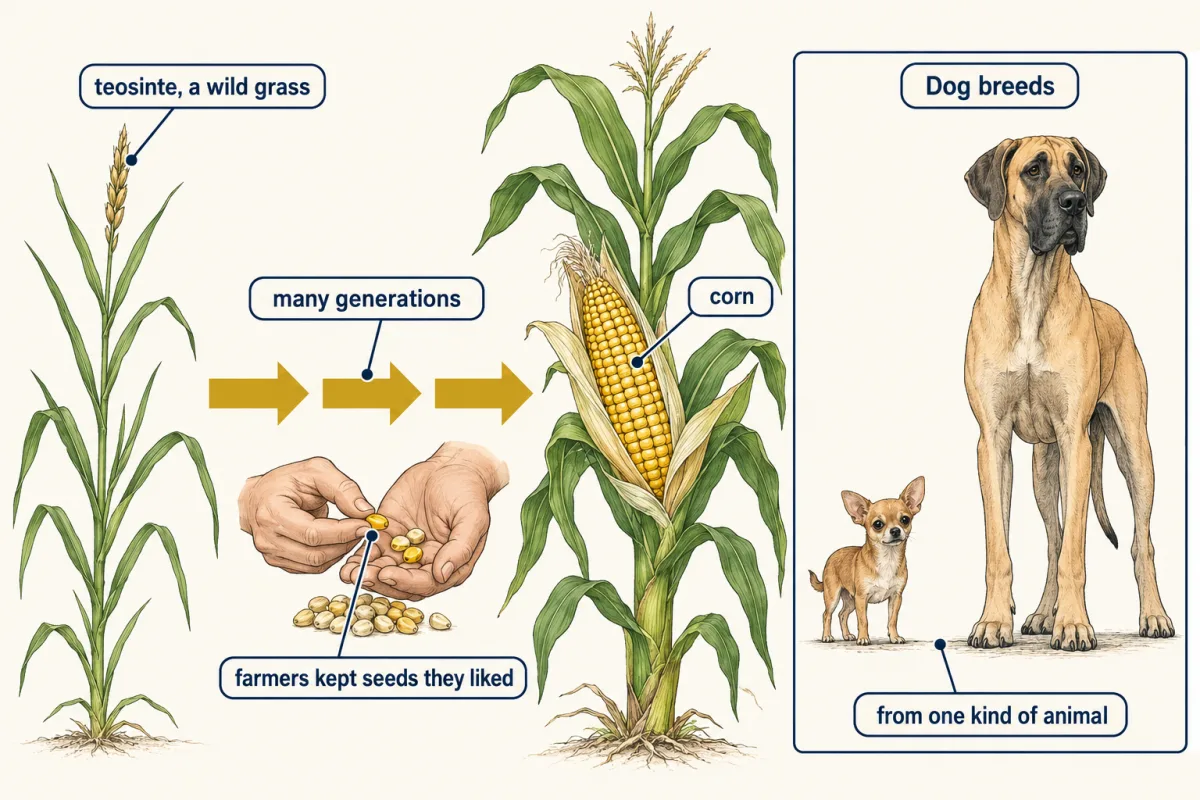
When people repeatedly choose which organisms reproduce, wanted inherited traits become more common over generations. AI-generated illustration -
Elaborate: read the moth counts
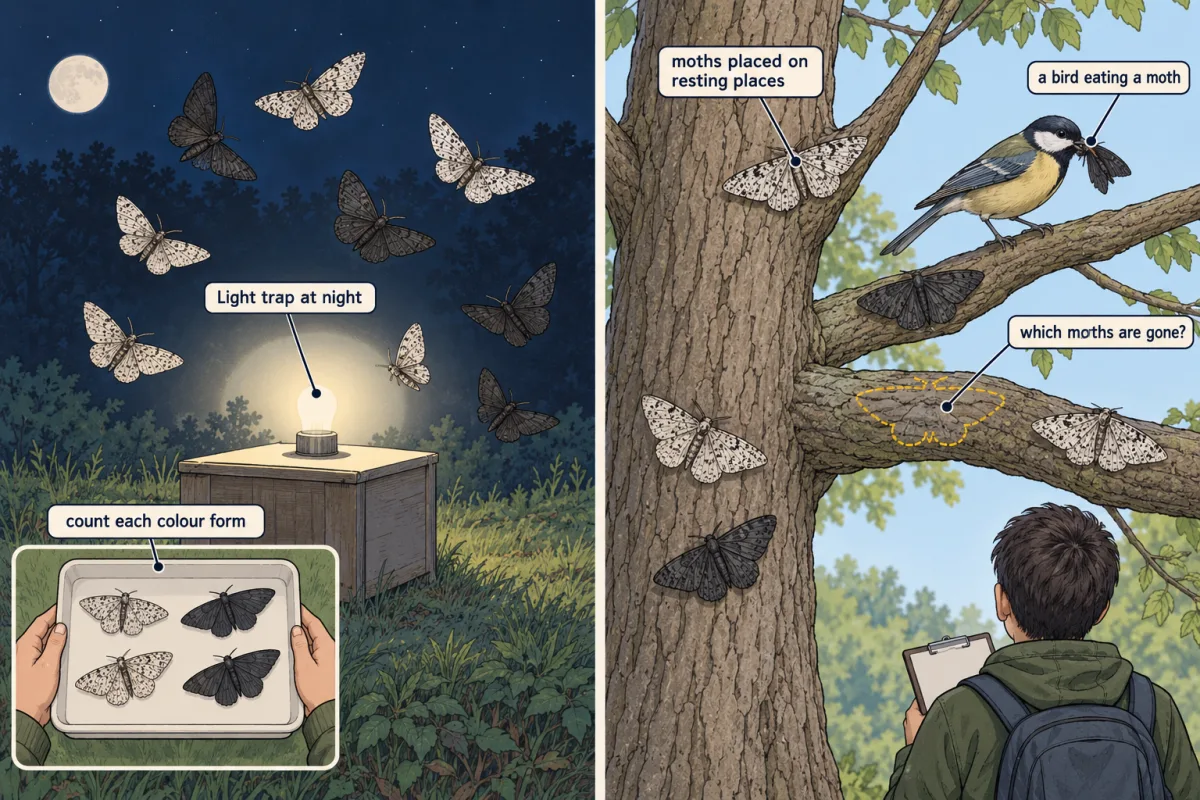
Two ways the Madingley moths were studied: light traps counted each colour form at night, and released moths were checked hours after sunrise to see which ones birds had taken. AI-generated illustration -
Evaluate: check your thinking
Where this lesson fits
Before thisReview first
- Mutations and VariationThis course · Lesson 31
You need to know that inherited differences between individuals first arise by chance, since selection acts on that variation.
- Predicting Traits with Punnett SquaresThis course · Lesson 29
You need to know how traits pass from parents to offspring, since selection works only on inherited traits.
- Adaptations for SurvivalThis course · Lesson 21
This lesson explains how adaptations arise, and that one first showed how a trait helps survival in an environment.
After thisStudy next
- Evidence for Change Over TimeThis course · Lesson 33
It uses natural selection and evolution to explain what fossils, anatomy and proteins show about change over time.
- Extinction and SurvivalThis course · Lesson 34
It shows what happens when no individuals have traits that suit a changed environment.
Elsewhere on the siteFilms, simulations and method films in other courses
- Set Up: The Camouflage HuntFilm · Biology Together
A hungry-bird game shows which colours stay hidden, the same predator pressure that favoured certain moths.
- Set Up: Beak BuffetFilm · Biology Together
Different beaks suit different foods, a simple case of a trait helping survival in one setting.
Suggested by an AI model from the lessons themselves, then checked. How we use AI