Biology Together · Unit 2: Our senses
The Mystery Feely Bag
Rewritten on : new text and film. Your notes and highlights stay, but the text around them may have moved.
Can you tell what something is without looking? A bag of hidden objects lets a child find out what skin can sense.
Three real-life stories behind this activity, about 2 minutes aloud, or read them below.
The film, 3 minutes, and the safety notes, for the grown-up to look at before the activity.
The hands-on part, done with a child: about 25 minutes.
Pause when the reading reaches a film, and offer to play it. Saved on this device.
Watch the film now, or keep listening
That is the end of the reading
This idea at other levels
An activity for ages 5 to 10 about the sense of touch.
See every levelHide the levels
The sense of touch
Skin holds several kinds of touch sensors that tell you about pressure, stretch, texture and vibration.
Taught at three levels: ages 5 to 10, upper-level college and graduate level.
Graduate · the level you chose
The Low-Threshold Mechanoreceptors: One Touch, Several Signals
One light stroke is split into several signals by different touch neurons.
Sensory Systems · about 31 min · film 2:50 · 3 practice questions
Merkel Cells: Touch Receptors That Are Not Neurons
Merkel cells hold a press while the ending feels change: three 2014 mouse experiments.
Sensory Systems · about 34 min · film 2:24 · 3 practice questions
Meissner and Pacinian Corpuscles: Flutter and Vibration
Meissner for flutter, Pacinian for hum: peeling the capsule tests why responses are brief.
Sensory Systems · about 32 min · film 2:18 · 3 practice questions
Hairy Skin, Stroking and Affective Touch
C-tactile fibres fire most at 1 to 10 cm/s, the speeds rated pleasant.
Sensory Systems · about 33 min · film 2:42 · 3 practice questions
College, upper level · the level you chose
Four kinds of touch receptor, two pathways up, and why capsaicin burns.
Neuroscience · about 30 min · 3 practice questions
No lesson on the sense of touch at grade 7 or at high school yet.
Ages 5 to 10 · the level you chose
The Mystery Feely Bag · this lesson
Name hidden objects by touch alone, and find what touch cannot tell.
Biology Together · about 25 min · film 3:22 · Virginia K.5 a, K.5 b
Next door to the sense of touch
- The sense of smellA sense built on hundreds of receptor types, where touch uses a handful.Nearest lesson: Smell Detectives (ages 5 to 10)
- Nerve signals (the action potential)How the message gets from skin to spinal cord.Nearest lesson: Nervous Control: A First Look (a first college course)
Short versions inside this lesson
The grade 7 version · about 1 minute to read
Later in school, children learn that each sense starts with special cells called receptors. Touch, warmth, cold and pain each have their own kinds of receptors in the skin. These send signals along nerves to the brain, which puts them together. In middle and high school biology, students learn that the body is built of cells with different jobs. The two-point test gives a rough hint about how finely each patch of skin feels detail. How closely touch receptors are packed is part of the reason, but the test does not measure it directly.
The plainest version · about 1 minute to read
You have five main senses: seeing, hearing, smelling, tasting and touching. Each one uses a part of your body. Your eyes see and your ears hear. Your nose smells and your tongue tastes. Your skin feels. Skin covers your whole body, so you can feel with your feet and elbows too. Your fingertips are very good at feeling tiny bumps. That is why we use them to explore.
Find an idea: every idea, searchable
Which lessons teach an idea, and the notes on each level, were written by AI models from the lessons and checked by a second model. A person has not yet read every one. How we use AI
About this activity what is in it
Rewritten on : new text and film. Notes and highlights stay, but the text around them may have moved.
Before you start
- Hands-on time
- About 25 minutes
- Where
- Indoors
- Ages
- 5 to 10, with an easier and a harder version below
- Grown-up
- Stay with your child the whole time. You pack the bag and check every object; you also handle the paper clip in the harder test.
What you need
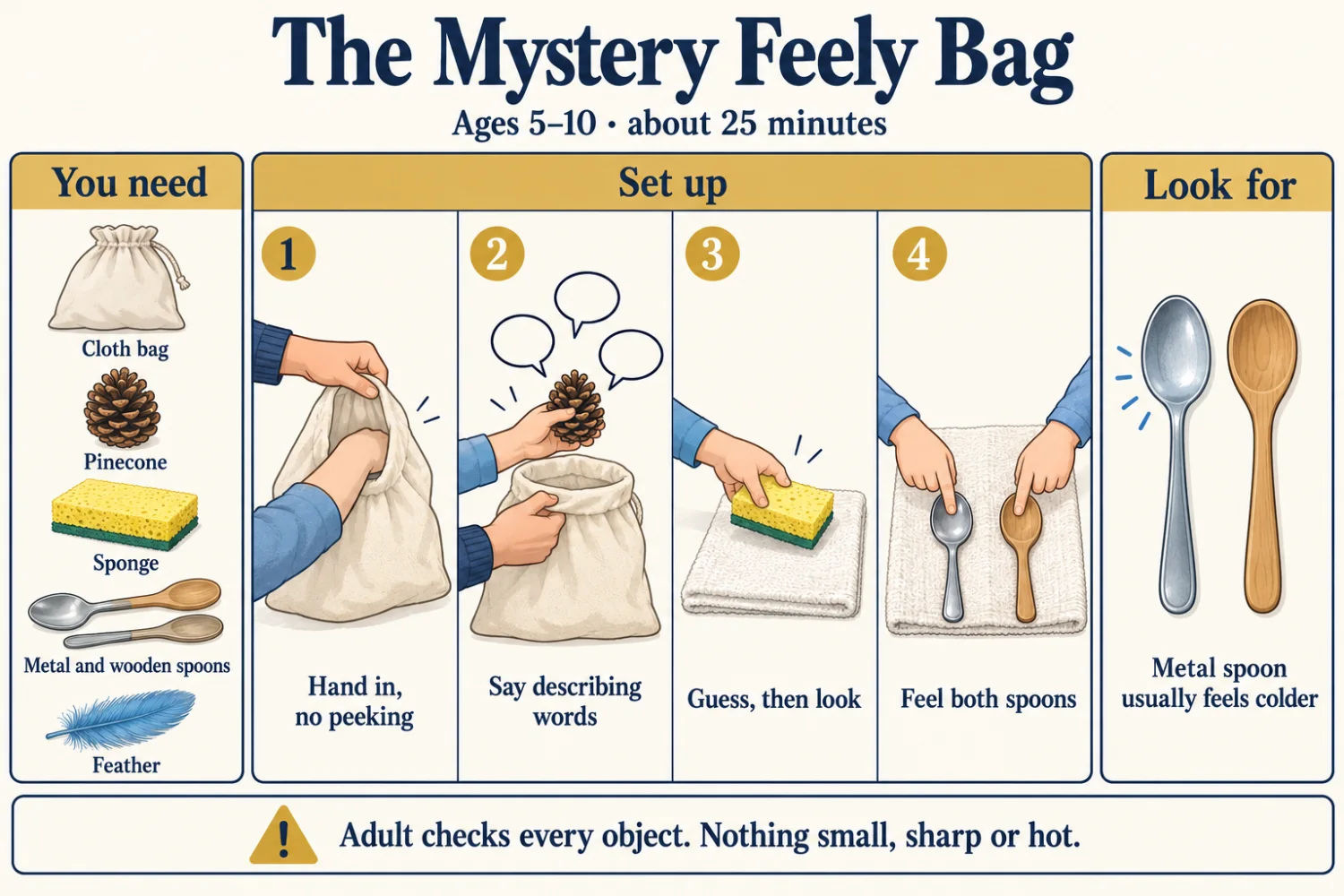
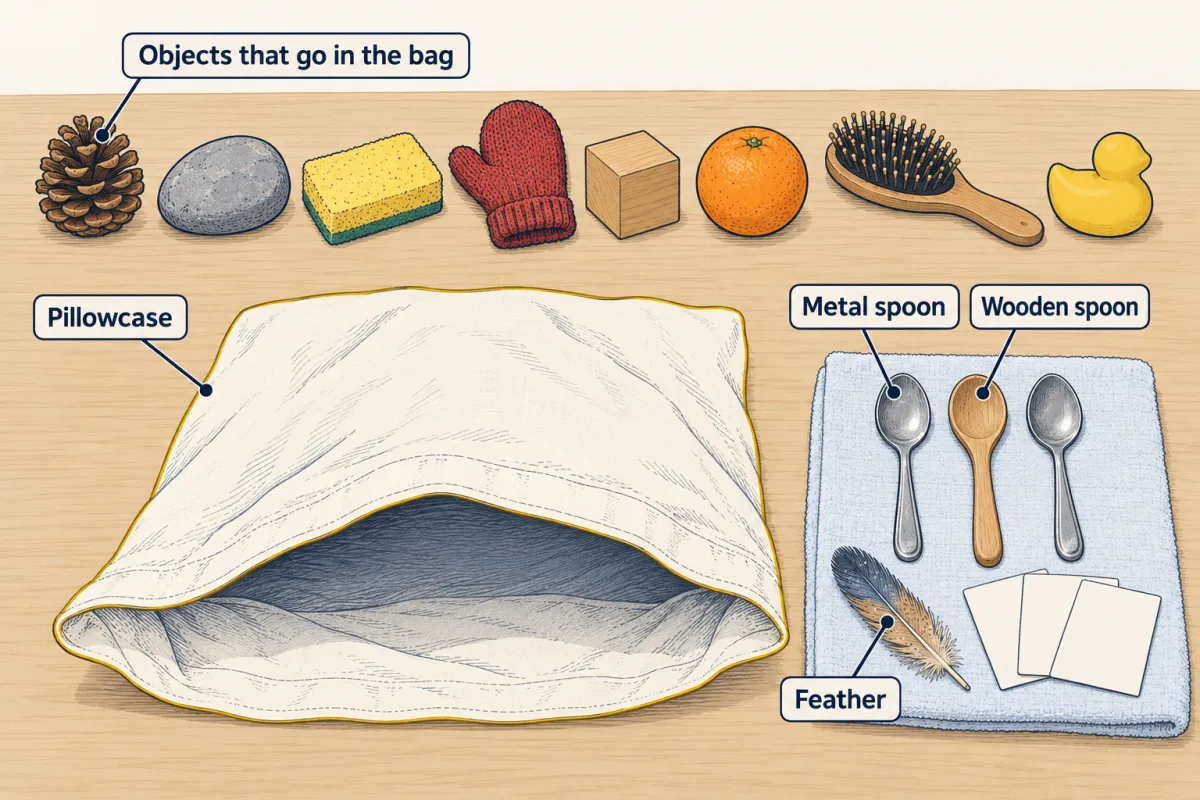
- A pillowcase, cloth bag or large clean sock
- 8 to 10 objects too big to fit inside a toilet-paper tube, with different textures: a pinecone, a large smooth stone, a new kitchen sponge, a wool mitten, a wooden block, an orange, a clean hairbrush, a clean, dry bath toy
- A metal spoon and a wooden spoon
- A second metal spoon, kept in the fridge for 30 minutes (not the freezer)
- A craft-store feather or a soft paintbrush
- Index cards or paper scraps for describing words, and a pencil
- A large paper clip, tape and a ruler (ages 8 to 10)
- The printed observation sheet below (optional)
Virginia science standards SOL K.5 aSOL K.5 b
In this activity. You hide everyday objects in a pillowcase, and your child finds them using touch alone.
The film
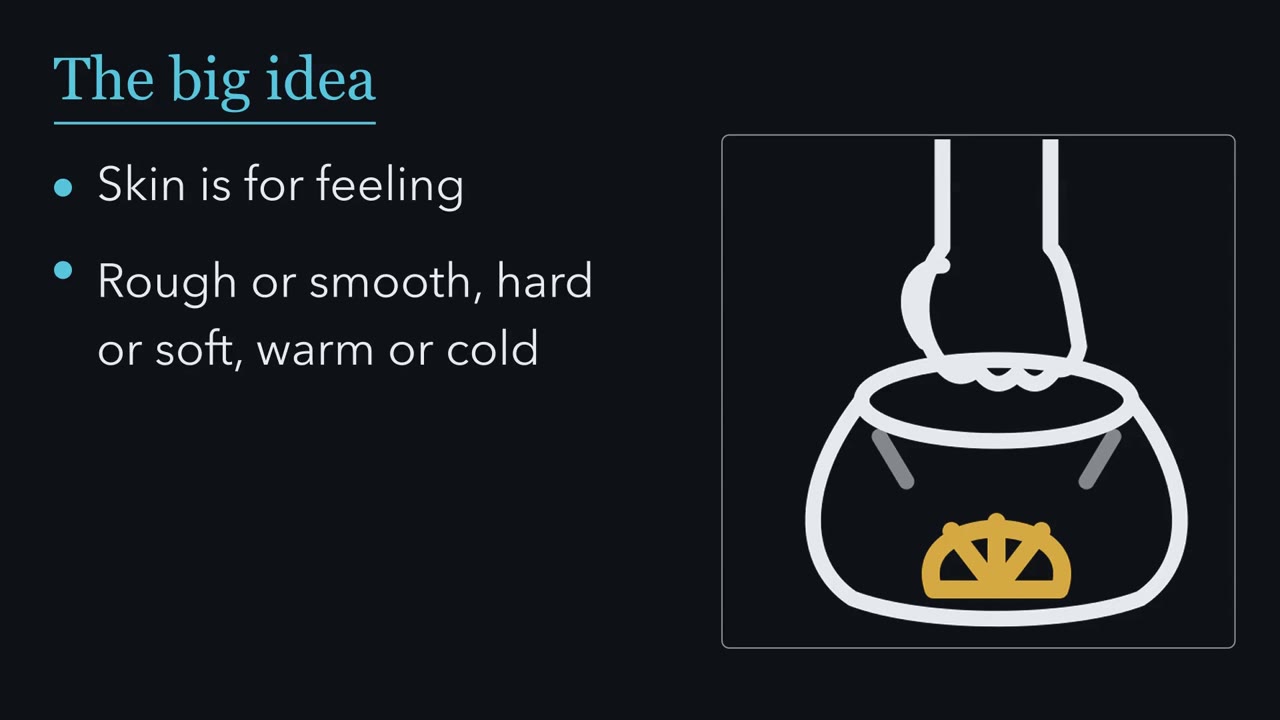 ▶ Watch The Mystery Feely Bag: Parent Guide · 3:22
Read the transcript of “The Mystery Feely Bag: Parent Guide”
Film transcript: The Mystery Feely Bag: Parent Guide
Can you tell what something is without looking? A pillowcase and a few everyday objects let your child find out what skin can sense. The bag takes sight away, so touch has to do the job alone. Your child practices describing what they feel, making a guess, and checking it with their eyes. It takes about twenty-five minutes. You need a pillowcase and eight to ten objects with different textures. Think of a pinecone, a large smooth stone, a new sponge, a wool mitten, and an orange. Keep a metal spoon, a wooden spoon, and a spoon from the fridge aside. Stay with your child throughout.
Pack and check the objects yourself. Even when squeezed, they should be too big for a toilet paper tube. Skip anything sharp, hot, frozen, breakable, alive, or with loose parts. Keep all bag objects out of mouths. Your child puts one hand in and holds one object without looking. Say, 'Don't tell me what it is yet. Tell me what it feels like.' Ask for three describing words, like bumpy, hard, and light. Write them down. Have your child guess, then pull out the object.
Compare what they felt with what they can see. Their hand could feel the shape and bumps. Their eyes can see the color. Next, put the metal spoon and the wooden spoon in the bag. They have been in the same room all day. Both spoons are at room temperature. What do you predict? When your child feels both spoons, will one feel colder?
The metal spoon usually feels colder because it draws heat from fingers faster. Dry the fridge spoon. Hand it over with your child’s eyes closed. Ask whether it feels wet. Wipe the spoon with a dry towel and check the towel. If your child felt wetness and the towel stays dry, the cold may explain the feeling. A damp spot can come from condensation. Ask your child to close their eyes. Brush a craft feather over a fingertip, the back of the hand, an elbow, and a foot. Ask where they felt it best. Then label five cards for eyes, ears, nose, tongue, and skin. Sort the describing words together. Stay with your child the whole time. Keep small things like marbles, beads, coins, batteries, and magnets away from children under four.
Call nine one one if a child is choking. Check for allergies first, and leave out balloons and rubber gloves if anyone has a latex allergy. Use a craft-store feather. Everyone washes hands afterward. End by asking, 'What could your hand tell you about the orange? What could only your eyes tell you?' Skin found shape, texture, and cold. Eyes found color.
Before you start
- Hands-on time
- About 25 minutes
- Where
- Indoors
- Ages
- 5 to 10, with an easier and a harder version below
- Grown-up
- Stay with your child the whole time. You pack the bag and check every object; you also handle the paper clip in the harder test.
What you need
- A pillowcase, cloth bag or large clean sock
- 8 to 10 objects too big to fit inside a toilet-paper tube, with different textures: a pinecone, a large smooth stone, a new kitchen sponge, a wool mitten, a wooden block, an orange, a clean hairbrush, a clean, dry bath toy
- A metal spoon and a wooden spoon
- A second metal spoon, kept in the fridge for 30 minutes (not the freezer)
- A craft-store feather or a soft paintbrush
- Index cards or paper scraps for describing words, and a pencil
- A large paper clip, tape and a ruler (ages 8 to 10)
- The printed observation sheet below (optional)
Virginia science standards SOL K.5 aSOL K.5 b
The big idea
Your child feels hidden objects, describes them, guesses what they are, and looks to check. It is the same sense of touch they use when they reach into a pocket or toy box and recognize what they grab.
Say it together (read aloud): “My skin feels. It can tell rough from smooth, hard from soft, and warm from cold. My eyes, not my skin, tell me colour.”
People have five basic senses, and each goes with a body part: eyes for sight, ears for hearing, nose for smell, tongue for taste and skin for touch. Skin can tell rough from smooth, hard from soft, and warm from cold. It covers the whole body, and fingertips feel finer detail than most of it.
The feely bag takes sight away, so touch has to do the job alone. Your child finds out what touch can tell them (shape, texture, warm or cold, heavy or light) and what it cannot (colour, words printed on a label). Then they sort describing words to the senses they belong to.
For teachers (Virginia standards)
Virginia’s kindergarten standard asks children to match each sense to its body part and to use the senses to describe things. It gives word lists for each sense, and this activity uses them.
What to do
- Fill the bag. Out of sight, put 8 to 10 objects in the pillowcase. Choose a mix: rough and smooth, hard and soft, heavy and light. Keep the two room-temperature spoons and the fridge spoon aside for later.
- Feel and describe. Your child puts one hand in and holds one object without looking. Before guessing, they give you three describing words, such as “bumpy, hard, light.” Say, “Don’t tell me what it is yet. Tell me what it feels like.” Write the words down.
- Guess, then look. Now they guess and pull it out. Ask, “What did your hand know that your eyes don’t?” and “What do your eyes know that your hand didn’t?” Touch knows warm and heavy; eyes know colour.
- Two spoons. Put the metal spoon and the wooden spoon in the bag. Ask, “They have been in the same room all day. Will one feel colder?” Then your child feels both. Most children find the metal one feels colder. Both are at room temperature, but metal draws heat out of fingers faster.
- The fridge spoon. Dry the cold spoon with a towel in front of your child, then hand it to them with their eyes closed. Ask, “Is it wet or dry?” Some children say wet. Wipe it on a dry towel together and check the towel. If it stays dry, the wet feeling came from the cold. If the towel gets damp, the spoon really did have water on it. Water from the air can collect on a cold spoon or glass, especially on a humid day.
- Feel with other skin. With your child’s eyes closed, brush the feather on a fingertip, then the back of the hand, an elbow and a foot. Ask, “Can you feel it? Where can you feel it best?” Any answer is fine. Hairy skin, like the back of the hand, is also very good at noticing a light brush. Fingertips stand out most at telling fine detail apart.
- Sort the words. Write sense words on cards: sweet, sour, bitter, salty, rough, smooth, hard, soft, cold, warm, loud, high, low, bright, dull, strong, faint. Lay out five cards labelled eyes, ears, nose, tongue and skin, and sort. “Soft” fits both skin and ears, so it can go in two places.
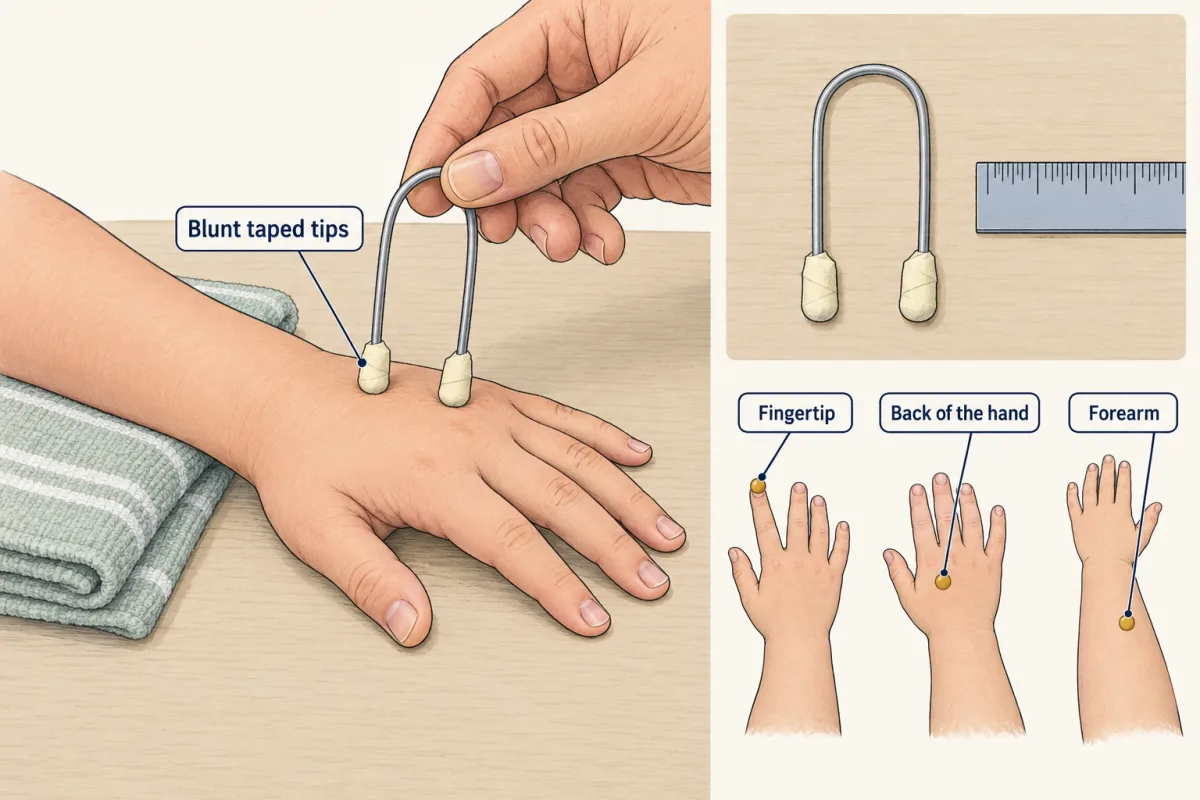
- Two points or one (ages 8 to 10). Unbend a large paper clip into a U with the ends 1 cm apart. Tape over each cut end until the tips are blunt. Test them lightly on your own hand first. With your child’s eyes closed, you touch either one end or both ends to a fingertip, then the back of the hand, then the forearm. Mix one and two at random. They say “one” or “two.” Repeat with the ends 2 cm and then 4 cm apart.
- Debrief. Ask two closing questions:
- “What could your hand tell you about the orange without looking?”
- “What could only your eyes tell you?” Read Say it together aloud again.
Questions to ask while you do it
Ask your child to guess first, then check.
- “I wonder what this is. What three words describe it before you guess?”
- “What do you think will happen if we swap the metal spoon for the wooden one?”
- “Is this spoon wet or just cold? How could we find out without looking?”
- “Can you feel the feather on your elbow? Where do you think you will feel it best?”
- “What do you think will happen when I touch your arm with two points close together?”
- “Which sense would tell you this orange is orange? Which would tell you it smells sweet?”
What children often think
-
A child might say “You can only feel with your hands.”
You could try Ask them to close their eyes while you brush a feather on the back of the hand, an elbow and a foot. "Could you feel that?" Skin covers the whole body and senses touch everywhere. Fingertips just notice more detail than most other skin.
-
A child might say “The metal spoon is colder.”
You could try Ask where both spoons have been all day. They are the same temperature. Metal carries heat away from warm fingers faster than wood does, and skin feels that heat loss as cold.
-
A child might say “Cold things are wet.”
You could try Wipe the fridge spoon on a dry towel together and check the towel. Skin has no sensor for wetness. The brain guesses "wet" from cold plus touch, so a cold, dry spoon can fool it.
-
A child might say “Each sense works by itself.”
You could try Hand them the orange in the bag and ask what it is. Then let them sniff the bag. Did the smell help? Senses often work together. Scientists also count more than five, such as balance and knowing where your arms are.
Why it works
Skin holds several kinds of sensors called receptors, special cells or nerve endings that each respond mainly to one kind of change. Some respond to pressure and vibration. Others respond to warmth, to cold, or to damage that we feel as pain.
Fingertips have many touch receptors packed close together. That is why they can tell two points apart when the points are only a few millimetres apart. On the forearm, the points often need to be several centimetres apart before they feel like two, and the back of the hand falls between the palm and the forearm. Exact numbers vary between people and with how the test is done.
Skin does not measure the temperature of an object directly. It senses its own temperature, which drops faster when heat leaves it quickly. Metal pulls heat away much faster than wood, so it feels colder at the same temperature. Skin also has no sensor for wetness. Research suggests the brain judges wetness from cold and touch signals together, which is why a cold, dry spoon can feel damp.
Easier and harder
Ages 5 to 7
Use five or six objects with big differences: a pinecone, a sponge, a stone, a mitten, an orange. Ask for one describing word instead of three. For the word sort, use picture cards (an eye, an ear, a nose, a tongue, a hand) and read the words aloud. Skip the two-point test. Your child can draw the object they liked best instead of writing.
Ages 8 to 10
Do the two-point test as a fair test: same paper clip, same gentle press, ten tries on each spot with one or two points mixed at random. Count correct answers and make a bar graph for fingertip, back of hand and forearm. Measure, with a ruler, the smallest gap that still feels like two on each spot. On a fingertip, also try a gap smaller than 1 cm, such as 5 mm. Ask them to predict how a toe will compare first, then test only the toe, never the lips or face.
If it doesn’t go as planned
If your child peeks, turn it into a rule they enforce: they can close their eyes and you hold the bag. If guessing gets too easy, use objects of the same shape, such as a tennis ball, an orange and a smooth stone. In the two-point test, children sometimes say “two” for a single point. That is normal. It is why you mix one and two points and count correct answers.
Observation sheet
Here is what two filled-in rows can look like:
| Object number | Words my hand found | My guess | What it really was |
|---|---|---|---|
| 1 | bumpy, round, heavy | a ball | an orange |
| 2 | rough, hard, light | a pinecone | a pinecone |
Observation sheet
The mystery feely bag
NameDate
Feel each thing without looking. Write or draw what you find.
| Object number | Words my hand found | My guess | What it really was |
|---|---|---|---|
Where on my skin I felt the feather best:
The two points felt like one point on my:
stemhop.com · Biology Together
The three stories, told aloud Side Hops: three stories that go with this lesson Side Hops
Three playful ways to talk about touch
1:46 · Narration: an AI narrator voice (Kokoro, af_heart).
Read the transcript
Before you pack that pillowcase, here are three easy ways to make the touch surprises stick.
First, ask your child which animal uses its nose like a feely bag. Cheer whatever they guess. Then tell them about the star-nosed mole. It lives in dark tunnels where eyes are not much help, so it feels its way instead. Eleven little rays on each side make a star around its nose. About twenty-five thousand tiny touch domes cover those rays and help the mole find food. It is a whole animal playing the feely-bag game all day long.
Second, carry the spoon surprise into tomorrow morning. Stand together with one bare foot on a rug and the other on a tile floor. Ask your child which foot feels cooler and why. Even when tile and a rug start at the same temperature, the tile can feel cooler because it draws warmth from your foot faster. That's what happens with the metal and wooden spoons, too.
Third, if your child wonders why fingertips feel tiny bumps better than palms do, grab a toothbrush and a wide-toothed comb. The bristles crowd shoulder to shoulder, while the comb teeth stand far apart. Fingertips are like the toothbrush. Scientists estimated that a little patch of fingertip skin has about four times as many touch-sensing nerve fibers as the same size patch on the palm, and those closely packed sensors help your fingertips tell tiny bumps apart.
Pick whichever tip fits your child's mood today, keep it playful, and enjoy finding out together what a hand can know without looking.
The idea underneath them. You hide everyday objects in a pillowcase, and your child finds them using touch alone.
Your notes
Select any text in the lesson to highlight it or add a note to it. Your highlights and notes are saved in this browser and collected in your notebook.
This browser is not letting the site save anything (a private window or strict privacy settings), so highlights and notes will be lost when you leave the page.
Where this lesson fits
After thisStudy next
- Smell DetectivesThis course · Lesson 5
Your child uses a second sense, smell, the same way: test it alone, then describe what it tells them.
- The Listening WalkThis course · Lesson 6
Your child uses hearing, another of the five senses, and describes what it detects on its own.
Suggested by an AI model from the lessons themselves, then checked. How we use AI
Those are the stories. The idea under them is the one the lesson builds.
That is the film. The rest of the activity is the fun part.
The rest of the activity is here when you want it.
Finish line
Test yourself
4 questions
Questions to talk over together.
Next · Lesson 5
Smell Detectives
Why does food taste so dull when you have a cold? Smell cups and a pinched-nose test help a child find out.
Continue →Rewritten on : new text and film. Notes and highlights stay, but the text around them may have moved.