The Fibre That Prefers a Caress
Read the transcript of “The Fibre That Prefers a Caress”
Film transcript: The Fibre That Prefers a Caress
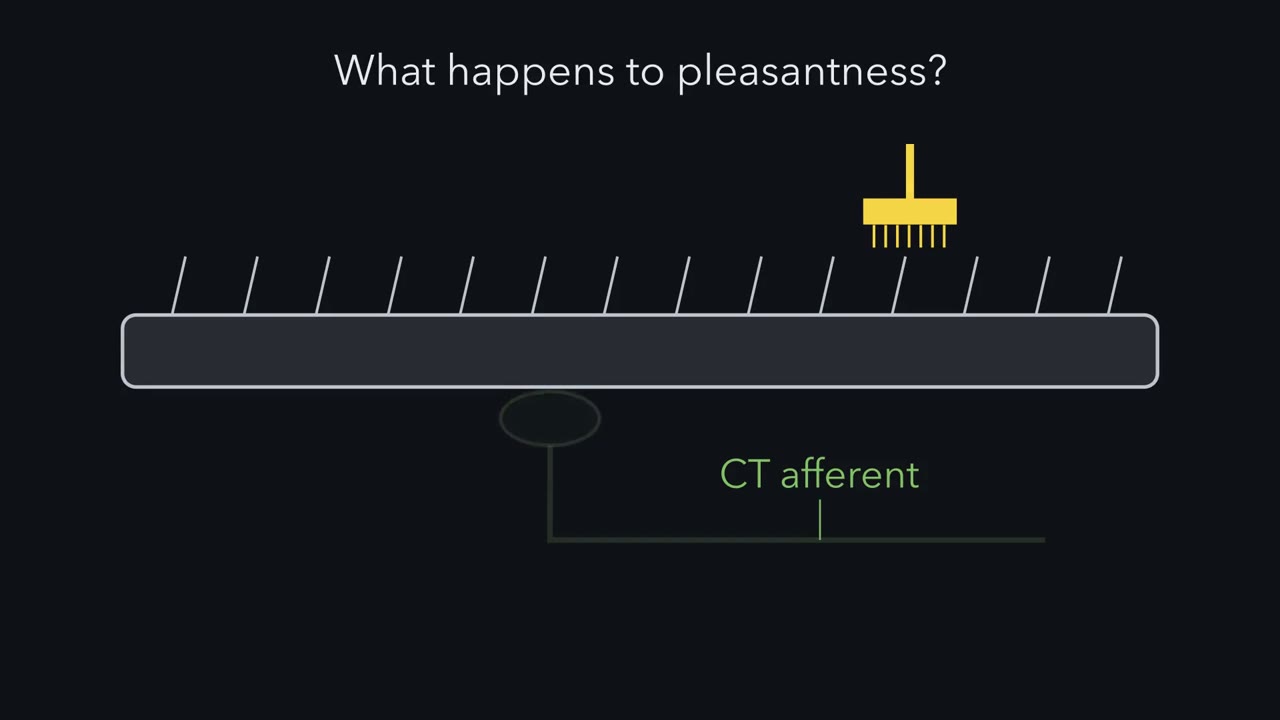
Brush a forearm slowly, then at a caress, then fast. One touch fibre seems to care how fast you stroke. Could that be why a caress feels nice? Put the speeds in your hand. Mark a 10 cm path on the forearm. At 3 cm/s, a brush crosses it in about 3 seconds: a slow caress. Ten times faster is a quick swipe. Ten times slower is a crawl of over half a minute. A low-threshold mechanoreceptor responds to gentle force. Hairy skin has fast, myelinated ones and slow, unmyelinated ones. A C-tactile afferent is a human one with a thin, unmyelinated axon. It conducts slowly. Microneurography records single axons from a skin nerve in an awake person. In 2009, Löken and colleagues recorded this way while a soft brush crossed the forearm at set speeds.
The recorded myelinated touch fibres fired harder the faster the brush moved. Predict. If C-tactile fibres worked the same way, what shape would their curve have? What shape would show a preference? Their firing traced an inverted U. It was highest for strokes between about 1 and 10 cm/s. Slower and faster strokes drove them less.
A separate group of volunteers rated the same strokes. Their average pleasantness had the same shape, highest over the same range. Of the fibre classes recorded, only the C-tactile afferent had a curve of that shape. Why does that matter? Suppose only fibres whose firing rises with speed drove the ratings. If more firing meant more pleasant, ratings would rise with speed. They do not. So the caress-tuned fibre is the obvious candidate. But a candidate is a suspect, not a proven cause. Ratings and recordings came from different people. And other signals combined could, in principle, make the same curve. The one idea: of the fibres recorded in human hairy skin, the C-tactile afferent fired most at caress speeds.
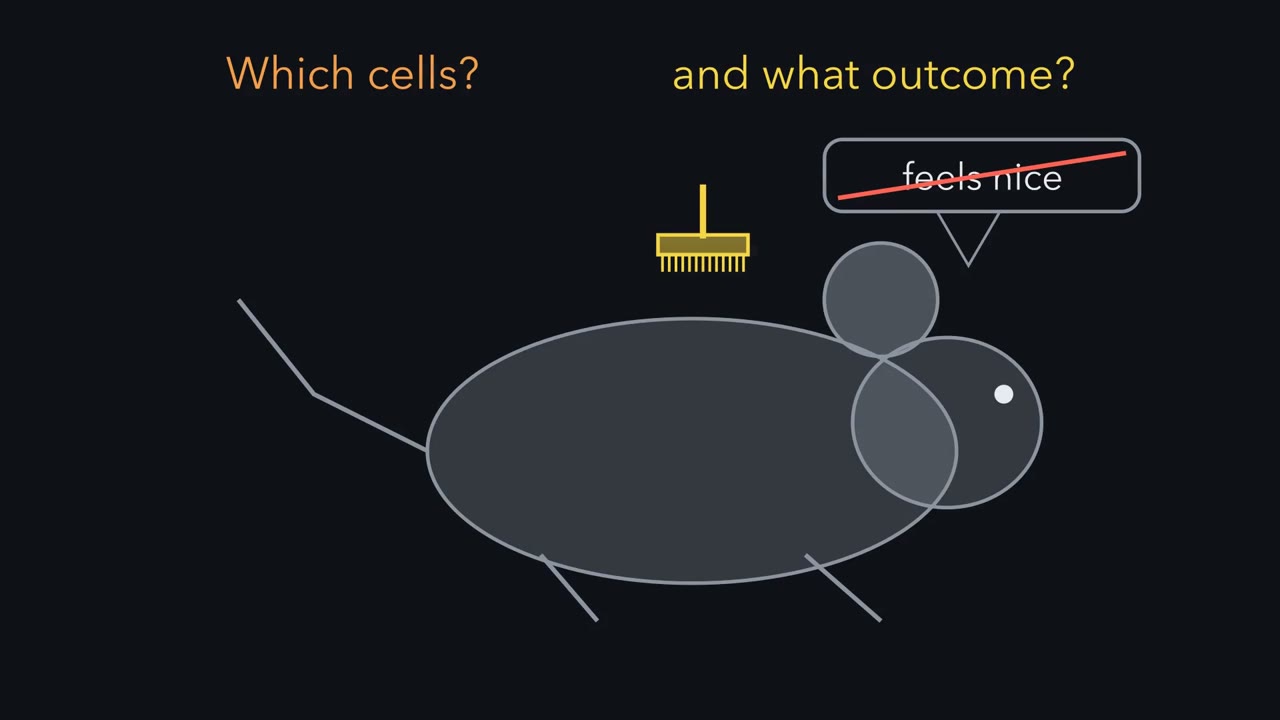
Average pleasantness follows its curve. So its input is the prime candidate for the pleasant side of touch. Only taking the input away can show whether it is needed.
Brush a forearm at a few centimetres per second and one slow, unmyelinated fibre fires hardest. Is that why it feels nice?
Continue in the lesson: Hairy Skin, Stroking and Affective Touch →
2:42 · Free, with captions and a transcript. The lesson has the full text, the questions and the sources.
More films from this lesson
How this film was made. Narration: an AI narrator voice (Kokoro, af_heart) reading narration written from this lesson's text. Animation: AI-generated in code (Manim) by Claude, a schematic with no drawn molecular structures. Captions come from the narration script. See something wrong? Report it.