Reporters of Change
Read the transcript of “Reporters of Change”
Film transcript: Reporters of Change
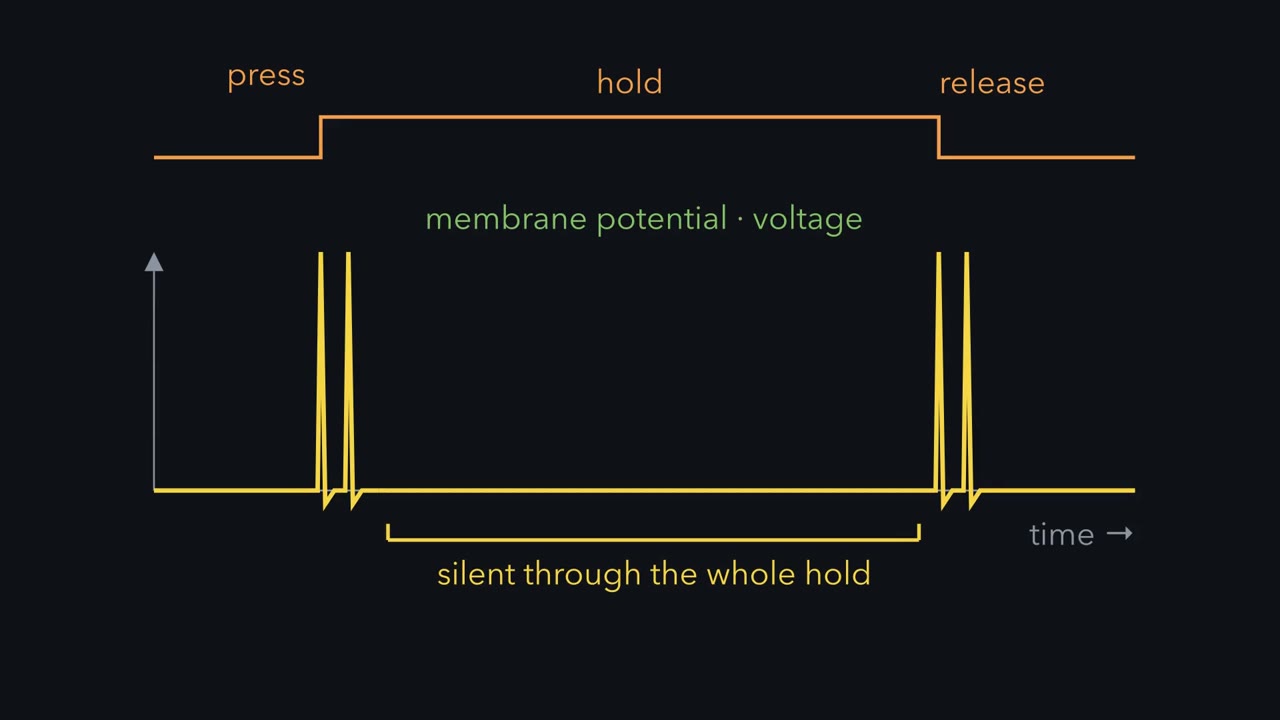
Slide a fingertip across cloth, or hold a buzzing phone. Two kinds of touch organ answer. What are they reporting? They are the Meissner and Pacinian corpuscles. Each is a nerve ending and the cells that help it feel. Push a probe into the skin, hold it still, then lift it. One kind of fibre, called slowly adapting, keeps firing through the whole press. Predict. What does a Meissner or Pacinian fibre do while the press is held? And when the probe lifts?
Typically, it fires a burst as the probe pushes in. It goes quiet during the hold. Then it often fires again as the probe lifts. That is rapidly adapting. The firing dies away while the press is held. A burst at the release is common, not required.
So these fibres report change, not level. They fire when the skin starts to move, stops, or keeps moving. Vibration is change that repeats. So it drives these fibres strongly. In 1968, Talbot and colleagues vibrated people's hands. From about 5 to 40 Hz, it felt like a light flutter. From around 60 to 80 Hz upward, it felt like a deeper hum. The same study recorded single fibres in monkeys. Flutter matched fibres now tied to Meissner corpuscles. The hum matched Pacinian fibres. The best frequency depends on species. Behavioural sensitivity peaked near 240 Hz in people, and near 1000 Hz in mice. Here is the idea to carry. Compare pushes of the same size.
The faster the response dies away in a hold, the more it discounts slow change. That dying-away can happen in three places. The capsule, the ending's channels, and the spike generator. Keep this. These corpuscles report change, not level.
Slide a fingertip across cloth and Meissner corpuscles report the movement; hold a buzzing phone and Pacinian corpuscles report the hum. Each is a nerve ending wrapped in cells that help it feel. How do the two split the work of sensing change?
Continue in the lesson: Meissner and Pacinian Corpuscles: Flutter and Vibration →
2:18 · Free, with captions and a transcript. The lesson has the full text, the questions and the sources.
More films from this lesson
How this film was made. Narration: an AI narrator voice (Kokoro, af_heart) reading narration written from this lesson's text. Animation: AI-generated in code (Manim) by Claude, a schematic with no drawn molecular structures. Captions come from the narration script. See something wrong? Report it.