Two Receptors, One Nerve
Read the transcript of “Two Receptors, One Nerve”
Film transcript: Two Receptors, One Nerve
Press a fingertip on the edge of a coin, and hold it still. What keeps telling your brain where that edge is? Some nerve fibres from that skin fire only while the skin is moving. Then they go quiet. Others keep firing for as long as you hold. One such class is the slowly adapting type I afferent, or SA1. In macaque fingertips, its firing carried the spatial layout of millimetre-scale features, such as raised patterns. Its firing has two parts. First, a fast burst as the press begins. That is the dynamic phase. Then firing through the hold, with irregular gaps between spikes. That is the static phase. Now the surprise. The cell that helps make the hold is not a neuron.
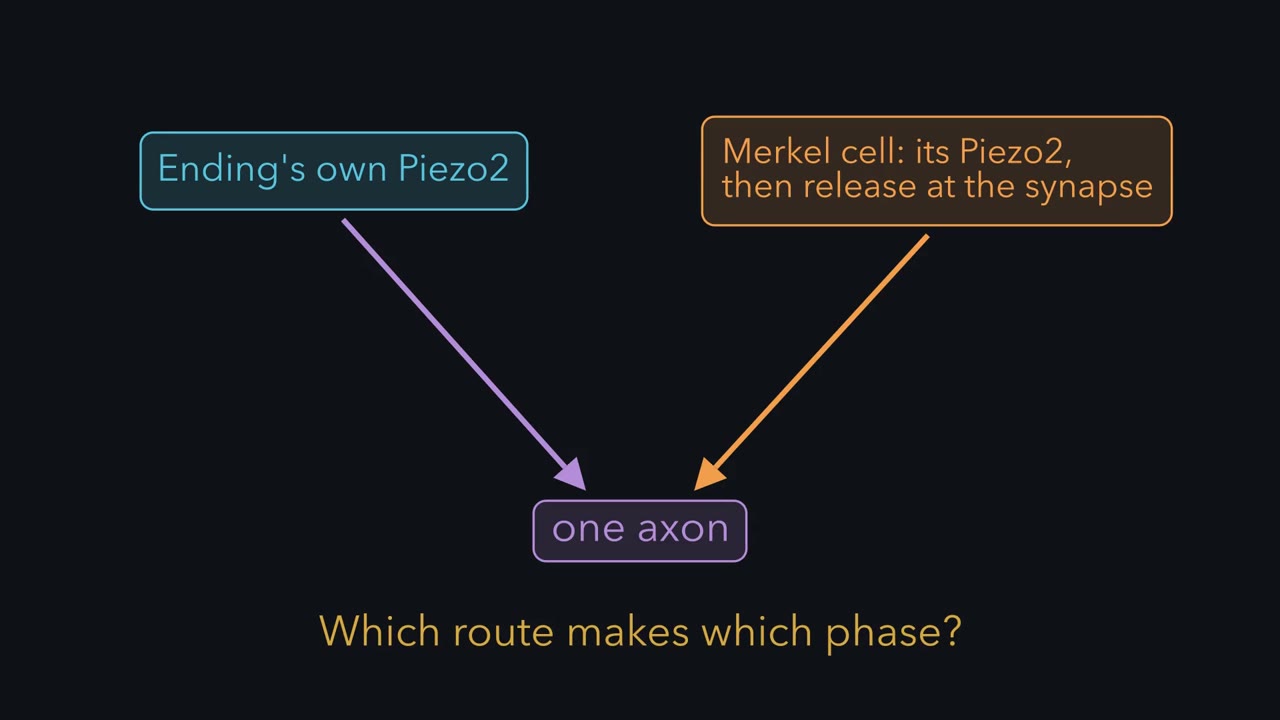
It is the Merkel cell. In mice, it comes from epidermal progenitors, not from neural crest. In hairy mouse skin, Merkel cells cluster in touch domes beside guard hairs. An afferent's branched ending makes disc-like contacts on them. So force can reach this fibre by two routes. The ending makes its own Piezo2. Even without Merkel cells, it still responds to touch. Or the Merkel cell feels force through its own Piezo2, and passes the signal across a synapse. Predict. One route reports change. One route holds the press. Which would you guess holds the press?
In mouse touch domes, the ending mainly carries the onset. The Merkel cell mainly holds the press. That is the idea for this lesson. The ending mainly feels the change, and the Merkel cell mainly holds the press. This is mouse hairy skin. And the word mainly matters. The Merkel cell may help with the onset too. Rat whiskers give a different reading. There, another laboratory argues that Merkel cells drive both phases. Keep this. Two receptors feed one nerve, and each mainly makes one phase.
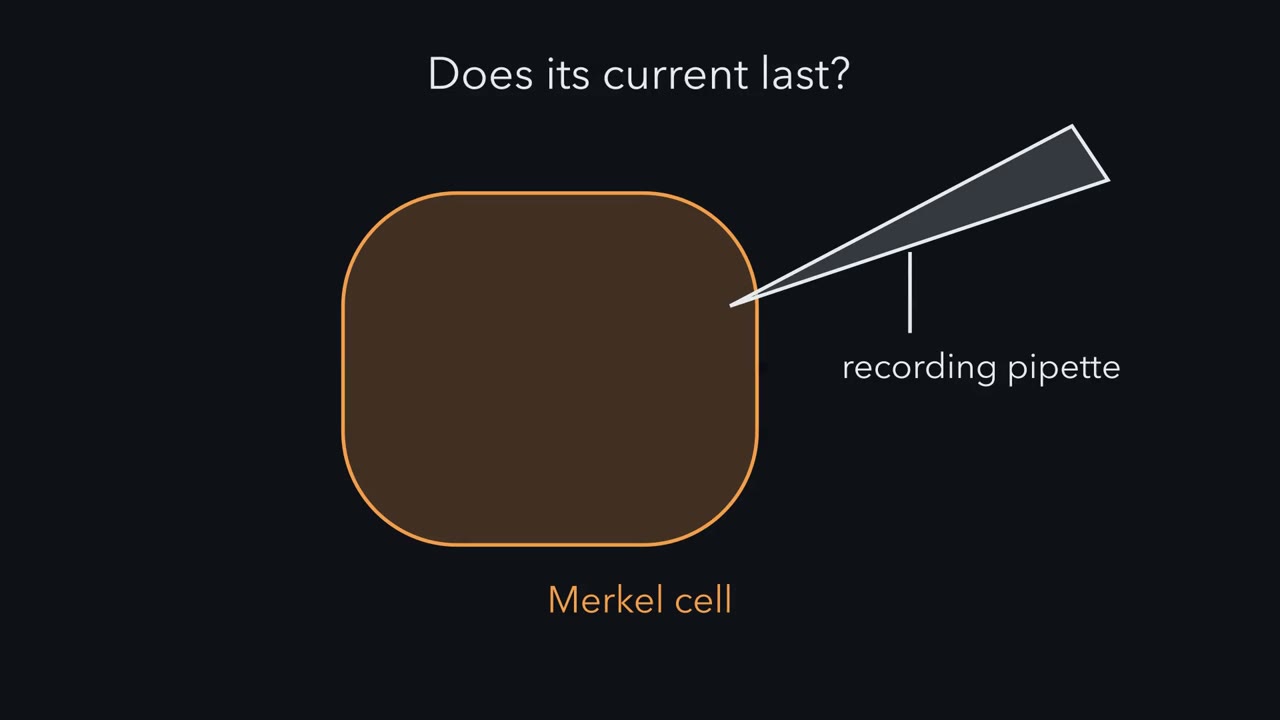
A skin cell that is not a neuron helps a nerve keep firing for as long as you press. How does it hold the press, and what does it tell the nerve?
Continue in the lesson: Merkel Cells: Touch Receptors That Are Not Neurons →
2:24 · Free, with captions and a transcript. The lesson has the full text, the questions and the sources.
More films from this lesson
How this film was made. Narration: an AI narrator voice (Kokoro, af_heart) reading narration written from this lesson's text. Animation: AI-generated in code (Manim) by Claude, a schematic with no drawn molecular structures. Captions come from the narration script. See something wrong? Report it.