Organismal Biology · Skim version
Muscle, Bone and Movement
Read the full lesson → Skim the whole course →
The guiding idea
In a skeletal muscle fibre, none of the filaments gets shorter, yet the whole fibre shortens. How can that be?
Every muscle pulls the same way: myosin heads use ATP to drag actin filaments past them, calcium switches the sliding on, and a muscle can only pull.
From the film: Sliding, Not Shrinking
- Myosin heads grab actin and pull the thin filaments toward the middle of each sarcomere; no filament gets shorter, only their overlap changes.
- Calcium is the switch: in skeletal and heart muscle it binds troponin, which moves tropomyosin off the sites where myosin binds.
- ATP binding lets a myosin head let go, and splitting ATP re-cocks it; without ATP the heads stay stuck, as in rigor mortis.
- A fibre's shortening is the sum of many tiny sarcomere shortenings in a row; a long fibre holds tens of thousands of them.
- Muscles can only pull, so something else must stretch each one back, such as a partner muscle on the other side of a joint.
From the film: Wings Faster Than Nerves
- In a locust, each flight-muscle contraction follows its own nerve impulse; in Pringle's blue-bottle flies, the large spikes came far less often than the wingbeats.
- In asynchronous flight muscle that the nerve keeps switched on, a stretch raises force after a short delay, so two muscle sets pulling on a springy thorax take turns stretching each other.
- The nerve still matters: its few impulses keep the muscle's calcium raised, so it stays switched on; without them the wings stop.
- Pringle's 1949 recordings showed the mismatch; how stretch raises force at the molecular level is still being worked out.
-
From nerve to calcium to cross-bridge
-
Three muscles, three triggers
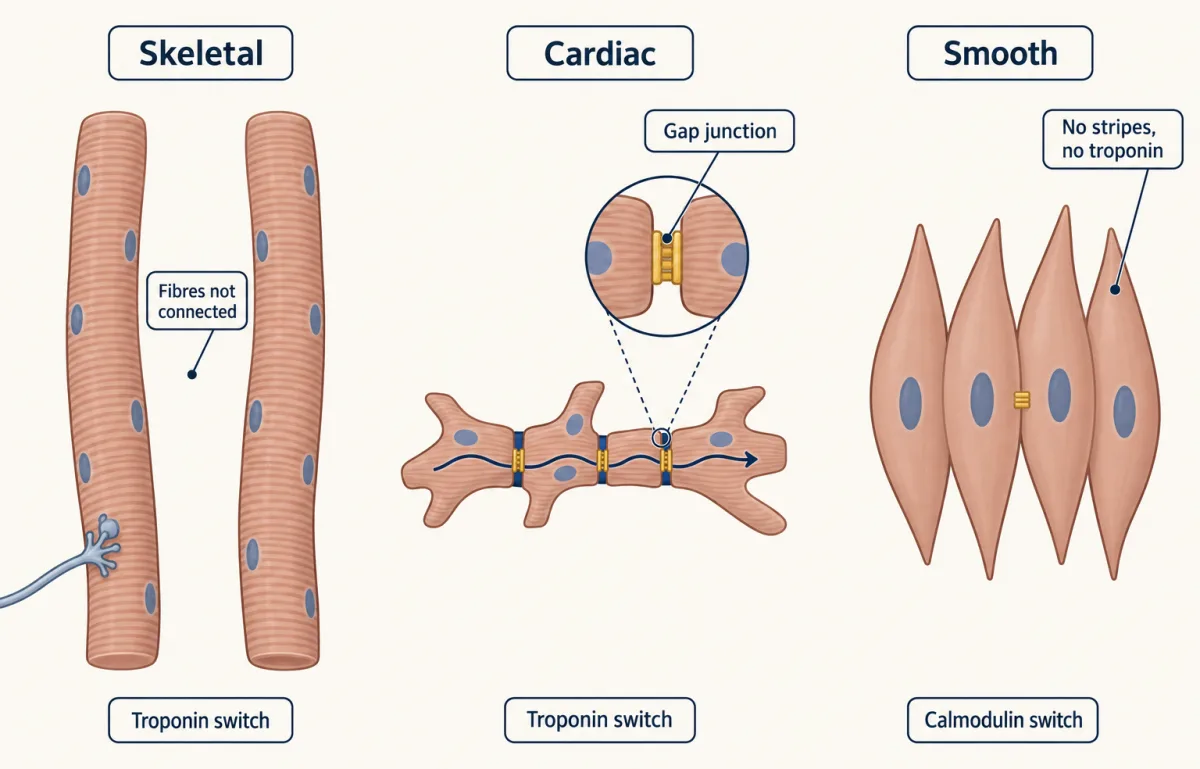
Skeletal fibres are long, striped and unconnected; cardiac cells are short, branched, striped and joined by gap junctions; smooth muscle cells are unstriped, with gap junctions coupling neighbours in many smooth muscles, such as the gut wall. Skeletal and cardiac muscle use a troponin switch, smooth muscle calcium-calmodulin. AI-generated illustration -
Fast and slow: fibres, tuna and chickens
-
A fly’s wings outrun its nerves
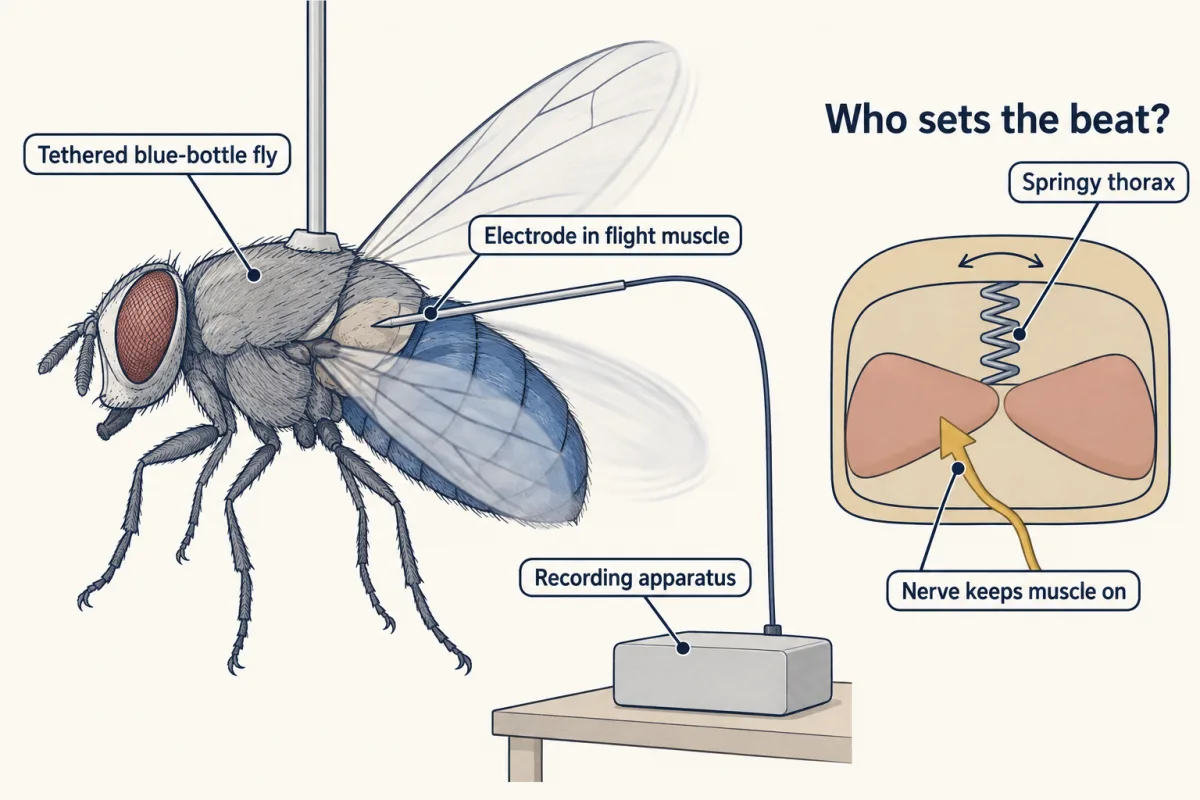
Pringle's setup: a tethered blue-bottle fly (Calliphora) with a fine electrode in its flight muscle. Inset: the springy thorax that two muscle sets take turns stretching. AI-generated illustration -
Skeletons: water, armour and bone, with levers
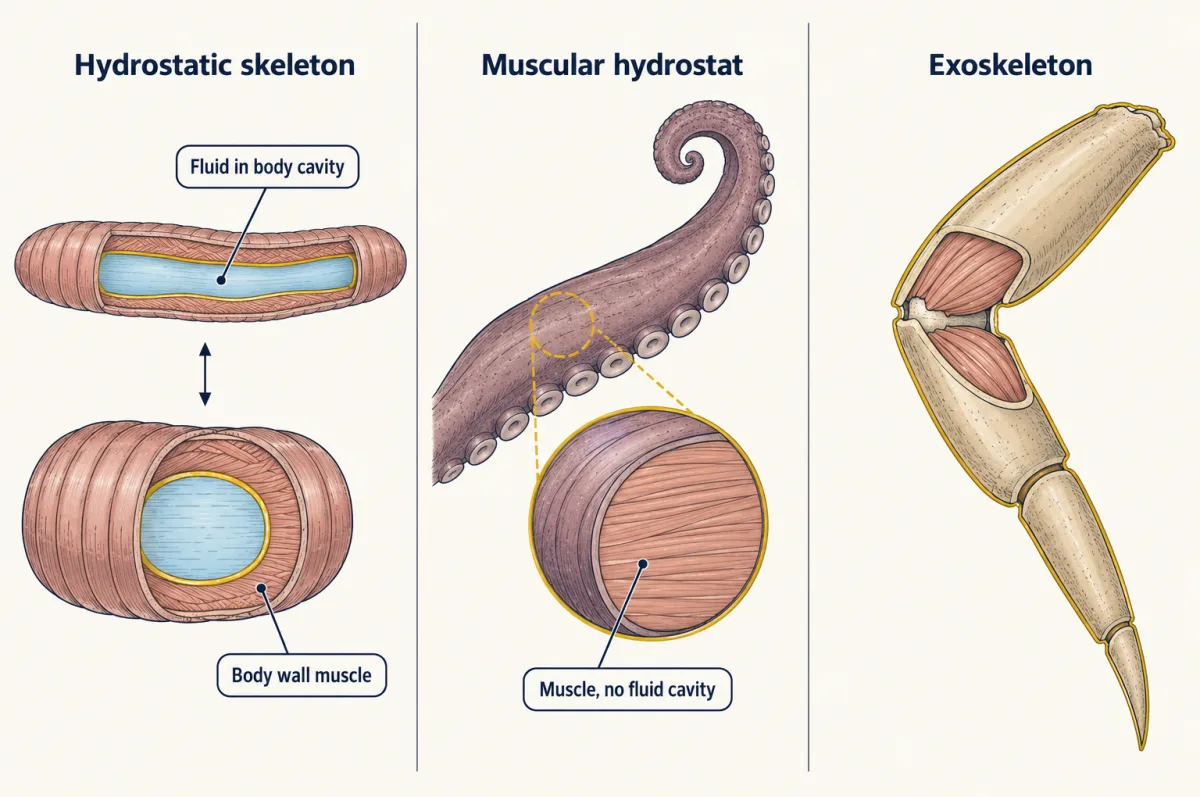
Muscles only pull, so each needs something to pull against: fluid under pressure in an earthworm's body cavity, other muscle at constant volume in an octopus arm or a mammalian tongue, or a hard outer case, as in crabs and insects. AI-generated illustration -
Going deeper
Where this lesson fits
Before thisReview first
- Nervous Control: A First LookThis course · Lesson 7
You need the motor neuron's signal and the neuromuscular junction from there to follow how a nerve impulse starts contraction.
- Respiration and ATPBiology · High school
The two jobs of ATP in the cross-bridge cycle build on how cells make and use ATP.
- Tissues, Organs and HomeostasisThis course · Lesson 6
The lesson compares muscle types as tissues, using what you learned there about tissue types.
Elsewhere on the siteFilms, simulations and method films in other courses
- Grip, Swing, Let GoFilm · Cell Biology
It shows how myosin and other motors turn ATP into steps along a filament.
- Reading an optical trapSimulation · Cell Biology
It lets you read single-motor force and steps, the molecular basis of the sliding you study here.
Suggested by an AI model from the lessons themselves, then checked. How we use AI