Sensory Systems · Skim version
Combining Senses and Predicting Them
Read the full lesson → Skim the whole course →
The guiding idea
Your senses disagree, and some of what they report is only the result of your own movement. How does a nervous system decide which sense to trust, and what to subtract? Subtracting self-generated input is one candidate explanation for why you can hardly tickle yourself, though the full answer is not settled.
A signal is worth what it tells you about the world: the more reliable of two senses counts for more, and some pathways subtract the predictable result of your own movement.
From the film: Which Sense Do You Believe?
- When two senses report one event, each is weighted by its reliability, one over its variance, so the more reliable sense counts for more.
- If vision is blurred until it is less reliable than touch, the combined estimate moves toward touch.
- Part of what you sense is the predictable result of your own movement, and some pathways subtract a prediction of it.
From the film: A Fish That Learns to Cancel Its Own Pulse
- In the electric fish, a copy of the motor command is used to learn a timed negative image of the expected input, which cancels it.
- The negative image was learned, because it followed whatever stimulus had been paired with the command.
- The evidence comes from paralysed fish plus a model built on recordings.
From the film: Only When the Feedback Matches
- In alert monkeys, canal afferents report active and passive turns alike, so the receptors pass self-caused input on.
- In the monkey central vestibular-only neurons tested, the subtraction of active turns ran only while neck feedback matched the prediction.
- Self-produced touch is rated less ticklish than the same touch from outside, and a forward model is one candidate explanation, not a settled one.
-
Count each sense by its reliability
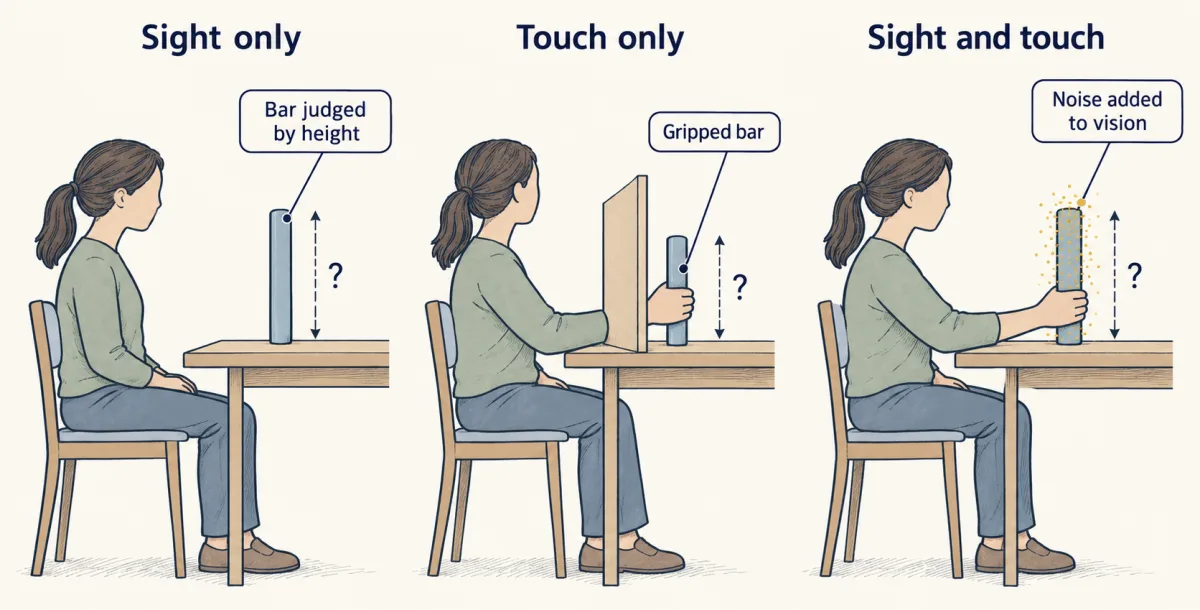
Schematic of the Ernst and Banks bar-height task with four observers. In the real experiment vision came from a random-dot stereogram and touch from force-feedback surfaces; adding noise to the visual dot depths made vision less reliable. Combined judgements were compared with predictions from each observer's single-sense performance. The drawing is simplified. AI-generated illustration -
Subtract what you caused
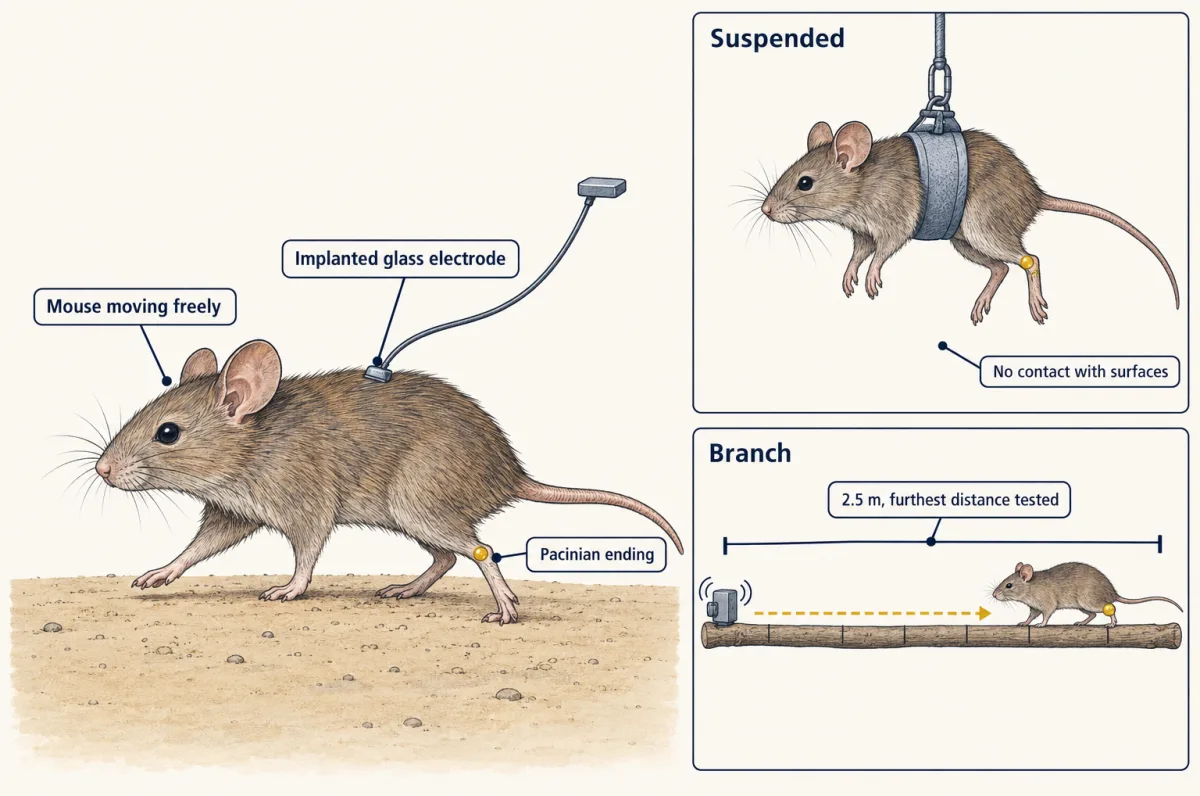
Turecek and Ginty recorded single units identified as Pacinian from freely moving mice. Units responded to the mouse's own movements; five of nine tested units also fired during limb movement while the mouse was suspended with its limbs touching no outside surface. A sensitive unit responded to vibration carried along a branch from 2.5 m, the furthest distance tested, not a measured limit. The conditions are schematic and not to scale. AI-generated illustration -
A fish that learns to cancel its own pulse
-
Only when the feedback matches: the monkey
-
What a person feels: the tickle
-
Mouse cortex: a movement signal and a mismatch signal
-
Going deeper
Where this lesson fits
Before thisReview first
- Meissner and Pacinian Corpuscles: Flutter and VibrationThis course · Lesson 6
The Pacinian afferents recorded in moving mice are explained there, so you know what these receptors normally report.
- Balance: Two Codes for Every Head MovementThis course · Lesson 25
You need its canal afferents and head-rotation coding to follow the monkey cancellation of self-generated turns.
- Five Ways to Turn a Stimulus into a CurrentThis course · Lesson 1
This lesson assumes receptors turn stimuli into currents, and the sensory signals being combined here start from that step.
After thisStudy next
- Restoring Senses: Implants, Prostheses and Optogenetic VisionThis course · Lesson 30
Restored senses must be combined with natural ones and with predictions, which uses the reliability weighting and prediction ideas from here.
Elsewhere on the siteFilms, simulations and method films in other courses
- Adapting to prismsSimulation · Neuroscience
Adapting to prisms shows a learned prediction of movement consequences being recalibrated against sensory error.
Suggested by an AI model from the lessons themselves, then checked. How we use AI