Physiology · Skim version
Lung Mechanics and Surfactant
Read the full lesson → Skim the whole course →
The guiding idea
Fill an excised lung with saline instead of air and it takes far less pressure to inflate. What was the air adding?
What holds the lung open, and what does surfactant change?
-
One breath, two pressure drops
-
Compliance: the slope of the recoil curve
-
What the air adds: surface tension
-
Surfactant lowers tension most when the alveolus is small
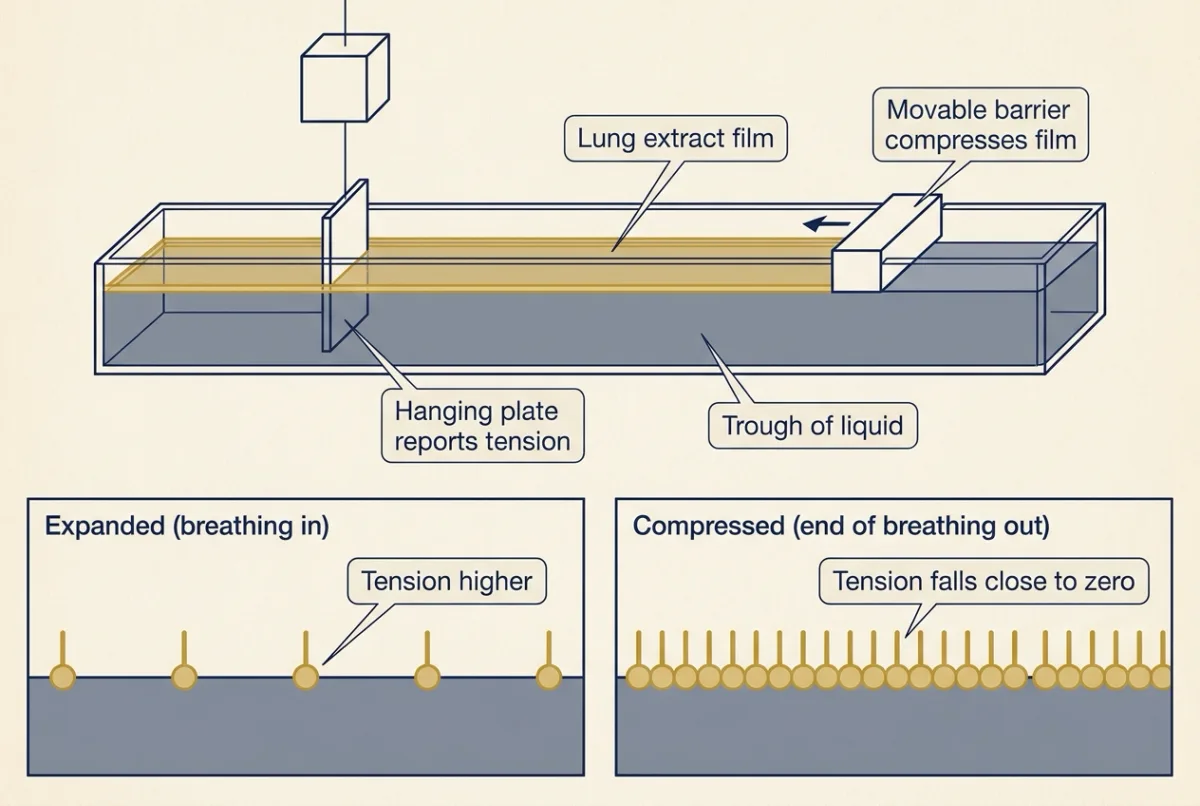
On a surface balance, compressing a film of lung extract lowers its tension, from about 46 to about 10 dynes per cm in Clements's 1957 measurements. Surfactant lowers tension most when the surface is smallest, which in the lung means at the end of a breath out, when the alveoli are smallest. AI-generated illustration -
Reading the balance in the clinic
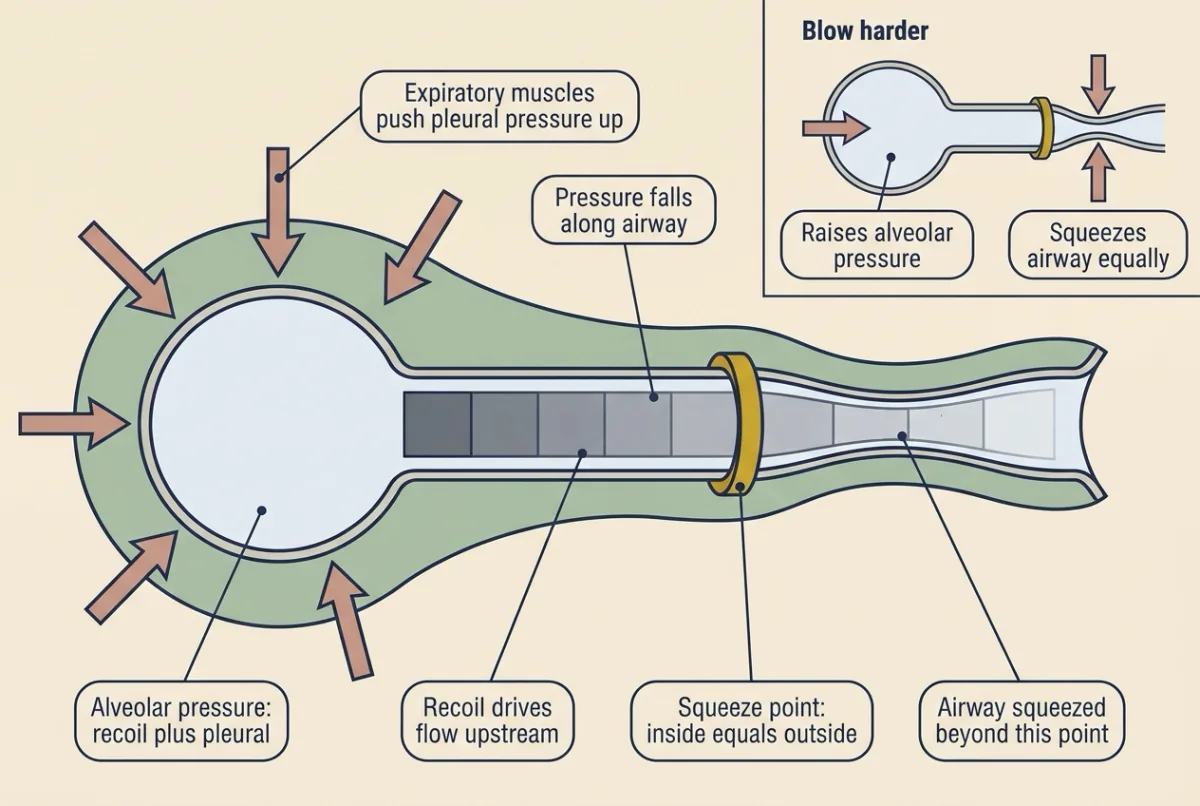
In a forced breath out, pressure inside the airway falls along its length until it matches pleural pressure, and beyond that point the airway is squeezed. Blowing harder squeezes it just as much, so at middle and low volumes flow is set by the lung's recoil and the airways upstream, not by effort (the classic squeeze-point model). AI-generated illustration -
Going deeper
Where this lesson fits
After thisStudy next
- Ventilation, Perfusion and Gas ExchangeThis course · Lesson 13
It builds on this lesson's airflow and alveolar pressure ideas to explain how gas exchange is matched to flow.
- Control of Breathing, Altitude and DivingThis course · Lesson 14
It uses the elastic and resistive work of breathing here to explain how drive picks tidal volume and rate.
- Exercise: The Whole Body at WorkThis course · Lesson 30
It applies breathing work and ventilation limits from this lesson to the whole body under maximal effort.
Elsewhere on the siteFilms, simulations and method films in other courses
- Area, thickness and rateSimulation · Organismal Biology
Air-versus-water exchange surfaces show how area and thickness set gas flow across the lung wall.
- Why a Mouse Needs PlumbingFilm · Organismal Biology
Surface-to-volume scaling explains why a lung needs a large exchange surface made of tiny alveoli.
Suggested by an AI model from the lessons themselves, then checked. How we use AI