Neuroscience · Skim version
Language and Lateralization
Read the full lesson → Skim the whole course →
The guiding idea
Leborgne could say almost nothing beyond one syllable, yet he appeared to follow much of what was said to him. What exactly had broken?
You can say only what reaches the language network of the hemisphere that speaks, by an unbroken route, so the pattern of what fails points to the stretch that most likely broke.
From the film: One Route to Speech
- You can say only what reaches the language network of the speaking hemisphere, by an unbroken route.
- In this simplified sketch, the pattern of what fails on fluency, comprehension, repetition and naming points to the stretch of the route that most likely broke.
- Naming is impaired in almost every aphasia, so it rarely tells the syndromes apart.
- The pattern points to a broken stretch of the route, not to one small patch of cortex.
From the film: Cutting the Bridge
- A key flashed in the left visual field reaches only the right hemisphere, so with the callosum cut it has no route to speech, yet the left hand can find it.
- The visual hemifield matters, not the eye, and each hand is controlled mainly by the opposite hemisphere.
- The disconnected right hemisphere understands some spoken language, so it is mute more often than it is deaf to language.
- The hand-by-field rule has exceptions, and whether the surgery creates two minds is still unsettled.
From the film: Which Side Speaks, and How Sure?
- Language is on the left in most people, but which hemisphere speaks is a probability, not a certainty.
- Left-handedness raises the odds of right-sided language; it does not make it typical.
- The chance that a right-dominant person is left-handed depends on the base rate, so for one person handedness gives odds, not an answer.
-
Three puzzles about speaking
-
One route to speech: four tests find the break
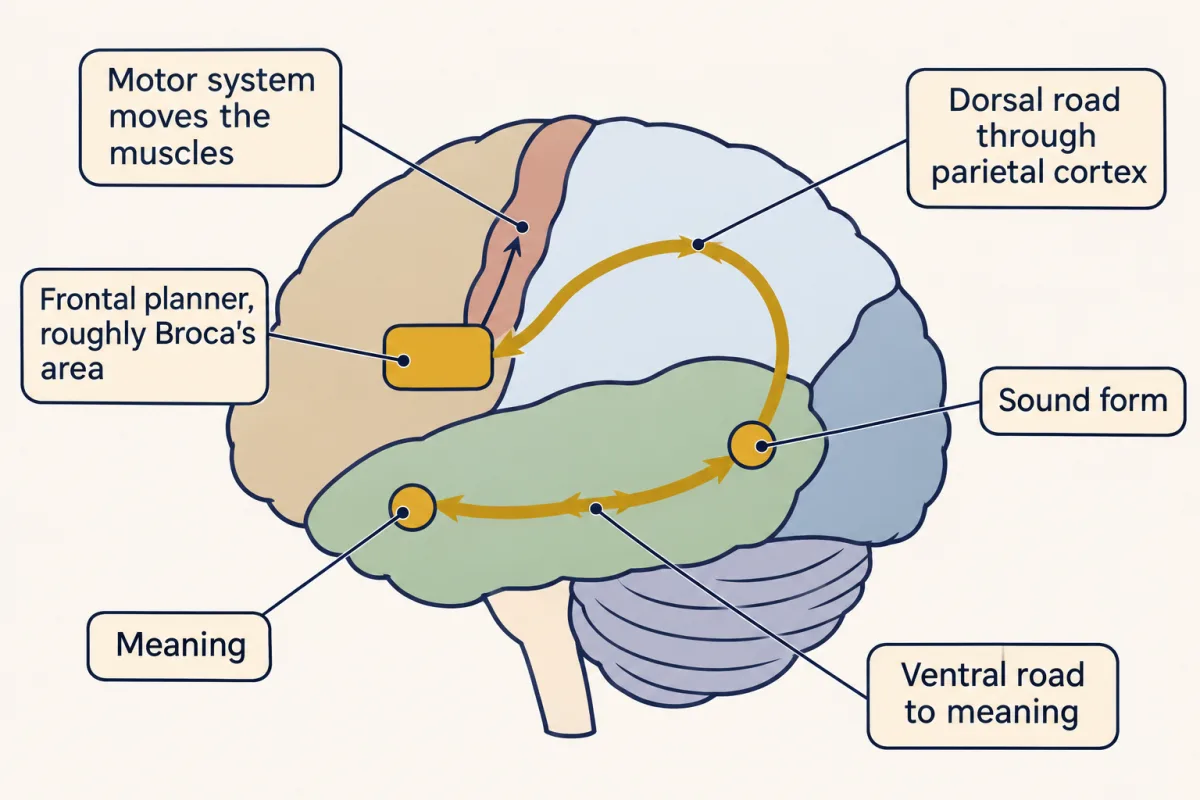
In this simplified sketch, a ventral road leads from a word's sound form to meaning, and a dorsal road arcs through parietal cortex to the frontal planner, which drives the motor system. AI-generated illustration -
Cutting the bridge: split-brain patients
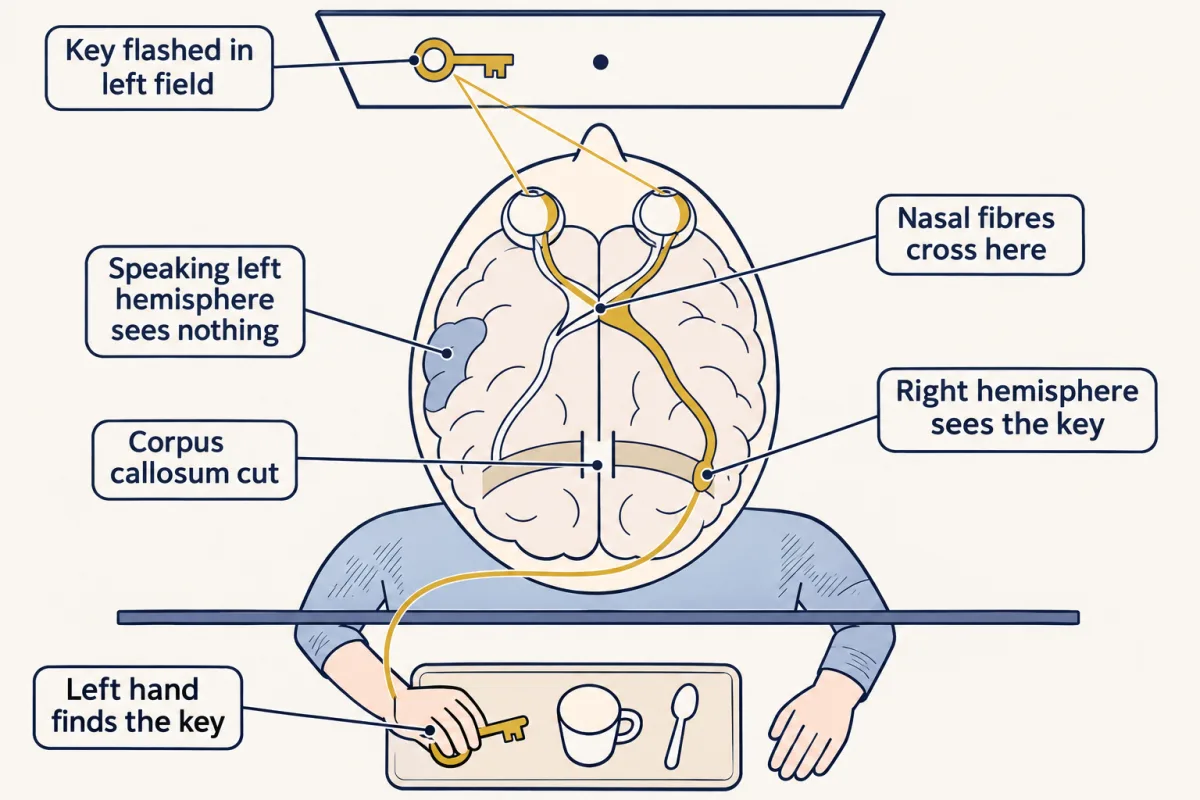
With the callosum cut, a key flashed in the left field reaches only the right hemisphere, so the usually speaking left hemisphere has nothing to name, but the left hand, run by the right hemisphere, finds the key. AI-generated illustration -
Which hemisphere speaks: a probability
-
How precise is the map? Lesions and living brains
-
Design problem
-
Going deeper
Where this lesson fits
Before thisReview first
- Visual CortexThis course · Lesson 11
You need the chiasm crossing and the hemifield-to-opposite-hemisphere rule from there to work out the split-brain flashes.
- Touch and PainThis course · Lesson 13
You need touch from each hand reaching the opposite hemisphere from there to explain why the left hand finds the key.
- Descending Control and the Basal GangliaThis course · Lesson 16
You need the crossing of descending motor fibres from there to see why each hand answers to the opposite hemisphere.
After thisStudy next
- Attention, Executive Control and DecisionsThis course · Lesson 25
It reuses the lesion-versus-activation reasoning from here to ask what a brain region needs to do for choosing and attending.
- Recording Many Neurons: Imaging, Arrays and AtlasesThis course · Lesson 27
It takes the question of what an activation can and cannot show into recording methods, and how to read their results.
Elsewhere on the siteFilms, simulations and method films in other courses
- Experimental units, pseudoreplication and powerMethod film
The design problem needs a fair split-brain test, which depends on choosing the right unit and sample size.
Suggested by an AI model from the lessons themselves, then checked. How we use AI