Life Science · Unit 5: Living together
Land and Water Ecosystems
Rewritten on : new text, flashcards and film. Your notes and highlights stay, but the text around them may have moved.
Why can oysters live in the brackish lower James River but not in its fresh water near Richmond?
Pause when the reading reaches a film, and offer to play it. Saved on this device.
Watch the film now, or keep listening
Builds on:Food Webs and EnergyDiffusion and OsmosisWhy these?
Where this lesson sits
- Virginia SOL LS.7 a
- Practices LS.1 b, LS.1 c, LS.1 d, LS.1 f
Essential question: Why do different living things live in a mountain stream, a forest and the salty Bay?
-
Life Science (grade 7) LS.7 a You are here
This lesson
-
Biology
Preview it at high school level
In Biology you will follow one Virginia ecosystem as it changes over many years. This change is called ecological succession. You will see what happens when a farm field is left alone. Weeds and broomsedge grow first. Pines come next. After a century or more, an oak-hickory forest can stand there. Each stage changes the light and the soil. Those changes help some species and hold back others. Young pines, for example, cannot grow well in the shade of older pines, but young oaks and hickories can. You will also compare land that starts with soil with bare rock that has none.
-
Biology II Biology II: Ecology, EC.7 b; Advanced Topics, BIOII.6 f
Preview where it goes next
Virginia’s Biology II: Ecology course (EC.7 b) studies primary and secondary succession, their stages, the climax community and how people change succession. Biology II: Advanced Topics (BIOII.6 f) asks how natural and human-caused disturbances affect biodiversity and ecosystem resilience. Resilience is how well an ecosystem returns after a disturbance. A tipping point is a limit past which an ecosystem shifts to a different state and does not easily return.
-
College
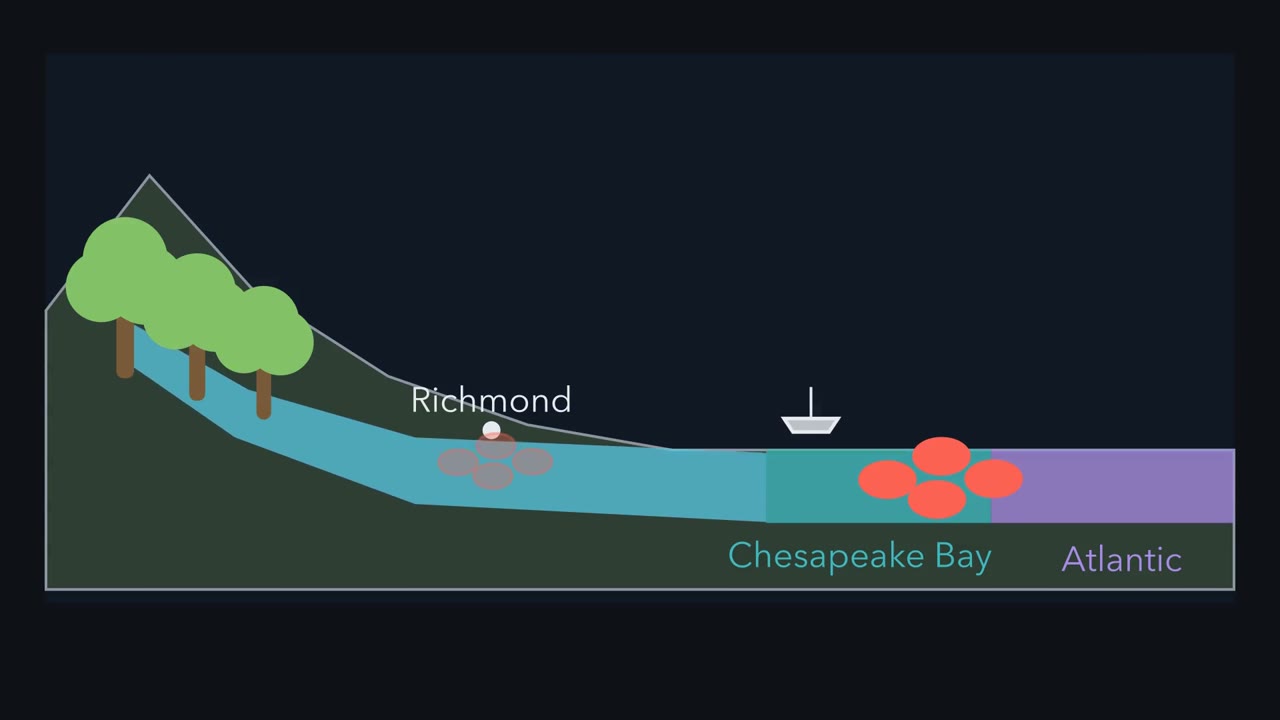 ▶ Watch Two Sides of Every Ecosystem · 3:10
Read the transcript of “Two Sides of Every Ecosystem”
Film transcript: Two Sides of Every Ecosystem
Why can oysters live in the lower James River but not near Richmond? Follow one Virginia landscape from mountain forest to salty Bay, and look for both kinds of clues. Some clues are alive. Others are parts of the surroundings.
An ecosystem includes all living things in a place and their nonliving surroundings. The living side includes plants, animals, fungi, microorganisms, and their interactions. Watch a deer eat acorns while fungi spread through a fallen log. These relationships are biotic factors. The nonliving side includes climate, sunlight, water, soil, air, and nutrients. These are abiotic factors. Rain darkens the soil while sunlight shifts under the tree canopy. Both sides share one place, and changes on either side can matter. Now the forest canopy grows thicker, but everything else stays the same. Less sunlight reaches the forest floor. What do you predict will happen to the small plants below?
The shaded plants grow poorly or disappear from the picture. Light is one condition that can limit where plants survive. Deep or muddy water can block light too. That helps explain why few plants grow on some underwater floors. Climate is the usual pattern of temperature and rainfall over many years. Earth's tilt changes sunlight angle and day length as Earth travels around the sun.
Latitude, elevation, land shape, and human actions also shape climate. Climate is part of the abiotic side. Carry the same paired view across Virginia. A forest is a terrestrial ecosystem on land. A mountain stream is freshwater, with very little salt.
Ocean water is marine and salty. Between them, an estuary mixes fresh river water with salty ocean water. These labels describe surroundings, not empty containers. Organisms must handle those conditions while also finding food and meeting other living things. Living interactions and nonliving conditions help decide what can live where. That rule may explain the oyster puzzle, but we need evidence along the river. No single factor tells the whole story. A suitable condition does not prove an organism was present. A range match is a clue, not a complete answer. Ecosystems also change as conditions, populations, and species change. The next step is to test one condition along the James.
From the film
- Living interactions and nonliving conditions help decide what can live where.
- Biotic factors are living things and their interactions.
- Abiotic factors include climate, sunlight, water, soil, air and nutrients.
- Land, fresh water, estuaries and ocean water provide different conditions.
Use the first film’s two lenses to test the oyster puzzle with a model and field data.
What do you think? Decide before you read.
-
Scientists disagree: Scientists who return to the same places find change. Aerial photos of the Chesapeake Bay show its underwater grass beds grew to about three times their size between 1984 and 2015. Population sizes, the kinds of species and the conditions in a place all shift over time.
What scientists think
Scientists disagree: Scientists who return to the same places find change. Aerial photos of the Chesapeake Bay show its underwater grass beds grew to about three times their size between 1984 and 2015. Population sizes, the kinds of species and the conditions in a place all shift over time.
-
Scientists disagree: Salt, sunlight and temperature help decide which organisms can survive in a place. Eastern oysters, for example, can die when the water stays very low in salt (below about 5 parts per thousand) for a long time. Living things and their interactions matter too.
What scientists think
Scientists disagree: Salt, sunlight and temperature help decide which organisms can survive in a place. Eastern oysters, for example, can die when the water stays very low in salt (below about 5 parts per thousand) for a long time. Living things and their interactions matter too.
-
Scientists disagree: Fresh water and ocean water differ in salt. They often differ in light, temperature and how the water moves, too. Different organisms live in fresh water, in the ocean and in the mixed water of an estuary between them.
What scientists think
Scientists disagree: Fresh water and ocean water differ in salt. They often differ in light, temperature and how the water moves, too. Different organisms live in fresh water, in the ocean and in the mixed water of an estuary between them.
Explore: take a boat down the James
The James starts as fresh water in Virginia’s mountains and reaches the salty Chesapeake Bay at Hampton Roads, near Norfolk. In the simulation, move a sampling boat along that route. A bar shows how salty the water is, and organisms appear or fade. A switch compares a wet spring with summer.
Made up for this sketch: the river positions are not to scale; the spring setting moves the salty water one station down the river; wild celery fits under 1, widgeon grass from 1 to under 5 and eelgrass above 20 (the guide gives the oyster range). The summer numbers are the lesson’s means (Chesapeake Bay Program, June to August 2023, 1 meter below the surface). No tides, no depth layers.
The rule to keep: salinity, an abiotic factor, changes along the river, and each organism fits only where the salinity suits it. The organisms come from guides. Nobody counted them at these stations.
Try this.
- Predict where along the river oysters first appear. Then move the boat downstream from the mountains and check.
- In this sketch, does the salty water move up the river or down in a wet spring? Predict, then switch seasons and test.
- Park the boat mid-river. Predict which organisms live there in each season, then compare.
Read an ecosystem in two parts
- ecosystem
- biotic factor
- abiotic factor
- climate
- terrestrial ecosystem
- freshwater ecosystem
- marine ecosystem
- estuary
- salinity
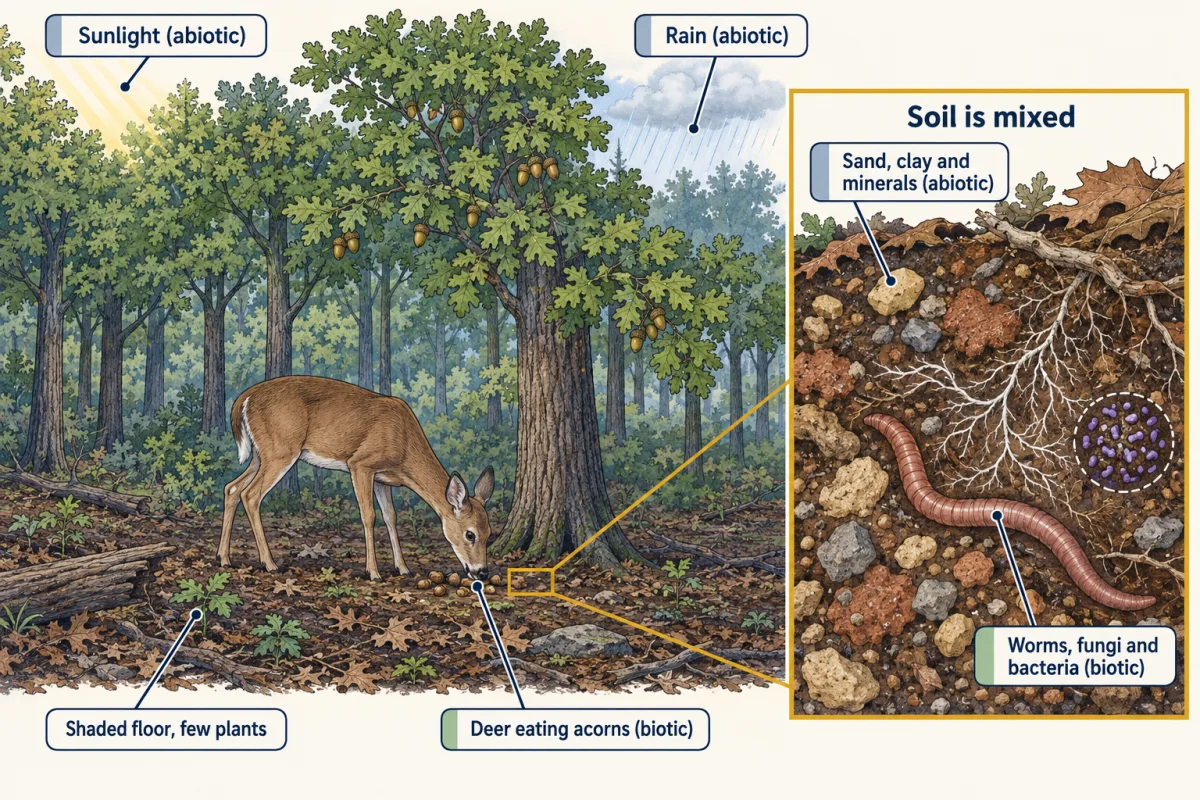
An ecosystem is all the living things in a place together with their nonliving surroundings. The first film sorted its parts in two. A biotic factor is a living part: plants, animals, fungi and microorganisms, and the ways they interact, such as a deer eating acorns. An abiotic factor is a nonliving part. Important examples are climate, sunlight, water, soil, air and nutrients.
Two cases blur that line. Dead parts and wastes of living things are often counted as biotic, as you saw in Food Webs and Energy. Soil is the second case.
Predict. A soil sample contains sand, clay, minerals, worms, fungi and bacteria. Is the whole sample biotic or abiotic?
Check your prediction
It is mixed. The sand, clay and minerals are abiotic. The worms, fungi and bacteria living in it are biotic.
Climate is a long-term abiotic condition
The first film named the causes of climate, the usual pattern of temperature and precipitation (rain and snow) in a place over many years.
Earth’s axis is tilted about 23.4 degrees. That tilt, not Earth’s changing distance from the sun, is the main reason Virginia has hot summers and cold winters.
Other features change climate from place to place. Locations farther from the equator usually receive less direct sunlight and are colder. Topography, the shape of the land, can make one side of a mountain wet and the far side dry.
Predict. Two Virginia sites are measured on the same summer day. One is on a high mountaintop; the other is on the coast. Which is usually cooler?
Check your prediction
The high mountaintop is usually cooler, because air usually cools as elevation rises. Being slightly closer to the sun does not make it warmer.
People change climate too. Burning fossil fuels adds carbon dioxide, a nonliving gas that traps heat, to the air.
Climate, population sizes and the kinds of species all change over time, so ecosystems change too. A later lesson, Adaptations for Survival, shows how living things fit their places.
Compare land, fresh water and salt water
The first film placed three broad groups of ecosystems across Virginia. A terrestrial ecosystem is on land, such as a forest or a field. A freshwater ecosystem has water with very little salt, such as a mountain stream, a lake or the upper James. A marine ecosystem has salty ocean water. Salinity is the amount of salt dissolved in water. An estuary, such as the Chesapeake Bay, is a mixing zone where fresh river water meets salty ocean water. Its salinity is in between, and it shifts with rain and season.
The table compares four settings, from a Virginia forest to the open ocean. These are broad patterns, not rules for every place.
| Abiotic factor | Terrestrial (Virginia forest) | Freshwater (mountain stream) | Estuary (Chesapeake Bay) | Marine (open ocean) |
|---|---|---|---|---|
| Salt | Little in most soils | Very little, under about 0.5 parts per thousand | In between; changes with rain | High, about 35 parts per thousand |
| Sunlight | Blocked by tree leaves | Reaches the bottom of shallow, clear water | Fades fast in muddy water | Fades with depth |
| Temperature | Changes a lot by season | Cool, often shaded | Changes by season | Changes less |
| Water movement | Rain and runoff | Flows one way, downhill | Tides and river flow mix | Waves and currents |
| Soil | Main source of nutrients | Rocks and gravel on the bottom | Mud on the bottom | Sand and mud far below |
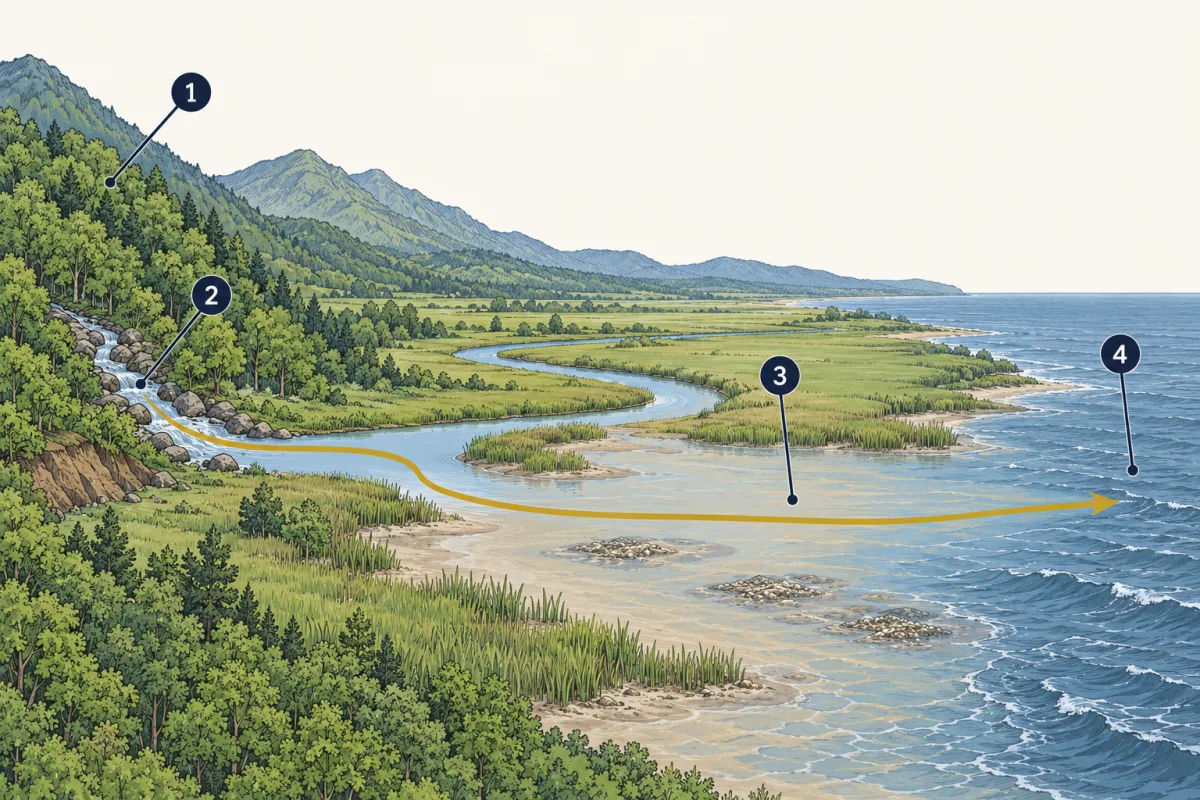
- terrestrial ecosystem
- freshwater ecosystem
- estuary
- marine ecosystem
- terrestrial ecosystem
- blank
- blank
- marine ecosystem
Word bank: estuary, freshwater ecosystem
- blank
- blank
- blank
- blank
Check your labels
- terrestrial ecosystem
- freshwater ecosystem
- estuary
- marine ecosystem
Salt is the sharpest difference in the table, from under 0.5 to about 35 parts per thousand. The second film follows that one difference down a real route, the James.
Read the transcript of “Following Salt Down the James”
Film transcript: Following Salt Down the James
The first film separated living interactions from nonliving conditions. Can one nonliving condition predict where oysters might survive? Return to the same Virginia landscape. Follow salt from the upper James River to the mouth of the Bay.
Salinity is the amount of salt dissolved in water. The upper James is fresh, while ocean water is salty. In the Chesapeake estuary, river water and ocean water mix. Salinity usually rises toward the Bay mouth, but the mixing zone can move. A sampling boat starts at the upper tidal James. At each station, a probe measures the water below the surface. Each stop adds a point to the same river path. Watch the points climb as the boat moves toward the Bay. Now place an oyster beside the boat. Where along this fresh-to-salty path should oysters first find suitable water? Make a prediction before the boat moves again.
The oyster first fits the brackish lower river, not the fresh upper river. Eastern oysters can die when water stays very low in salt for a long time. Wild oyster reefs grow in the lower James, where the water is mixed. The measured station means make the gradient visible. Low values sit upstream, and higher values sit near the Bay mouth. The difference between two stations must be calculated, not guessed from spacing. The lesson table lets you subtract exact values and test the oyster range. Range matches are not sharp borders. Widgeon grass can fit every station listed. The oyster's range overlaps the eelgrass stations near the Bay mouth. The crews measured water; they did not count organisms at those stations.
Suitable salinity suggests habitat; it does not prove an organism was there. Salinity also shifts with rain and season. The boundary slides as fresh and salt water keep mixing. A station's value can change even though the river and Bay remain in place. One summer sample is a snapshot, not a permanent border. Salinity is powerful evidence, but it is only one condition.
Light, temperature, water movement, predators, and food can matter too. Living interactions and nonliving conditions help decide what can live where. The strongest explanation connects the pattern to both sides of the ecosystem. Use the station data to test that rule, with limits.
From the film
- Living interactions and nonliving conditions help decide what can live where.
- Fresh river water mixes with salty ocean water in an estuary.
- Salinity usually rises toward the Bay mouth, but it shifts with rain and season.
- Suitable salinity suggests habitat; it does not prove an organism was there.
Use salinity data from the James
Chesapeake Bay Program crews measure water at the same stations about once or twice a month. The table gives the means of one summer’s samples, from the upper tidal James to the Bay mouth. Salinity is in practical salinity units (PSU). In Bay data, 1 PSU is about the same as 1 gram of salt in 1,000 grams of water.
As the second film warned, the last column shows possible habitat. Nobody counted these organisms at the stations, and the ranges overlap.
| Station | Place | Samples | Mean salinity (PSU) | Example whose range includes this salinity |
|---|---|---|---|---|
| TF5.5 | Upper tidal James | 3 | 0.09 | Wild celery |
| RET5.2 | Swann’s Point | 3 | 1.32 | Widgeon grass |
| LE5.1 | Near Red Buoy 36 | 3 | 4.53 | Widgeon grass |
| LE5.2 | Buoy C12-13 | 3 | 11.54 | Eastern oyster |
| LE5.3 | James River Bridge | 3 | 15.39 | Eastern oyster |
| LE5.4 | Hampton Roads | 3 | 20.67 | Eelgrass |
| CB8.1 | Between the James mouth and Thimble Shoals | 6 | 23.06 | Eelgrass |
| CB7.4 | Chesapeake Bay Bridge-Tunnel | 6 | 25.78 | Eelgrass |
Source: Chesapeake Bay Program DataHub, water samples taken 1 meter below the surface, June to August 2023 (Virginia DEQ and Old Dominion University). We calculated the means. The organisms come from Chesapeake Bay Program species guides. Each row gives one example; widgeon grass can live at every station listed.
- Describe the trend in salinity from TF5.5 to CB7.4.
- A Chesapeake Bay Program guide says salinity from 10 to 28 is good for eastern oysters. Oysters can die if it stays below 5 for a long time. Which stations fall in the good range, and which fall below 5?
Check question 2
Good range: LE5.2 through CB7.4 (11.54 to 25.78 PSU). Below 5 in these summer means: TF5.5, RET5.2 and LE5.1. A summer mean alone does not show that the water stays that low for a long time.
Predict. LE5.4 measured 20.67 PSU and TF5.5 measured 0.09 PSU. Is the difference closer to 2 PSU or 20 PSU?
Check your prediction
Subtract: 20.67 − 0.09 = 20.58 PSU, close to 20 PSU. Adding would answer a different question.
- As the water moves toward the Bay, salinity blank.
- Oysters fit station blank because its salinity, blank, is between 10 and 28.
- One reason this data cannot prove oysters live there is blank.
Claim, evidence, reasoning
Make a claim that answers the essential question: why do different living things live in different parts of the James and the Bay? Use the salinity table.
Start with: Different organisms live along the James partly because blank changes from place to place.
Start with: Mean summer salinity rose from blank PSU at TF5.5 to blank PSU at CB7.4, and oysters fit the stations from blank to blank.
Start with: Salinity is an abiotic factor. Each organism can live only where salinity is blank, so blank.
Compare with a model answer
Different organisms live along the James partly because salinity, an abiotic factor, changes along the river. In summer 2023, mean salinity rose from 0.09 PSU at TF5.5 to 25.78 PSU at CB7.4. Oysters fit stations LE5.2 to CB7.4, where salinity was between 10 and 28, and not the low-salt upper stations (TF5.5 to LE5.1). One limit: these are a few summer samples from one year at 1 meter deep. Nobody counted oysters, and rain or tides can change salinity.
Saved in this browser only.
Design problem
Brine shrimp are tiny animals sold as dried eggs for fish food. Plan a fair test of how salinity affects how many brine shrimp eggs hatch.
Predict. If salt level is the only condition you change, which cup is the control, and why do you need repeated trials?
Saved in this browser only.
One way to do it
- Question: How does the amount of salt in water affect how many brine shrimp eggs hatch?
- Independent variable: salt per liter of water: 0, 10, 20, 30 and 40 grams.
- Dependent variable: number of hatched shrimp counted in a 1-milliliter sample after 48 hours.
- Constants: the same amount of the same bottled water, same kind of salt, the same small scoop of eggs, same temperature, same light and same cup size.
- Control: the cup with no salt shows what happens in fresh water.
- Trials: three cups at each salt level. Find the mean for each level.
- Safety: wear goggles, wash your hands, use eggs from a store, and do not pour shrimp into a stream or pond.
If hatching changes a lot from one salt level to another, salinity affects this one stage of the brine shrimp life cycle. In the wild, brine shrimp live in salt lakes that are much saltier than seawater. A cup is a model, not a real salt lake.
Evaluate: check your thinking
Back to the opening puzzle. Oysters can die in water that stays very low in salt for a long time. So the fresh water near Richmond is poor oyster habitat, and their reefs grow in the brackish lower James. Living interactions such as predators also help decide where reefs grow. And a salinity match alone does not prove an oyster is there.
Science practices you used: predicting and testing with a model, reading a data table, finding a difference, making a claim from evidence, and planning a fair test with a control.
Your notes
Select any text in the lesson to highlight it or add a note to it. Your highlights and notes are saved in this browser and collected in your notebook.
This browser is not letting the site save anything (a private window or strict privacy settings), so highlights and notes will be lost when you leave the page.
How we measure it
Water-quality monitoring stations
Crews return to the same marked spots in the James River and the Bay many times a year and measure the water about 1 meter below the surface. A probe can estimate salinity from how well the water carries electricity, so the same spot can be compared from month to month and year to year.
Aerial surveys of underwater grasses
Scientists photograph the shallow Bay from airplanes and map the beds of underwater grasses. Comparing the maps from many years shows whether the grass beds are shrinking or spreading.
Where this lesson fits
Before thisReview first
- Food Webs and EnergyThis course · Lesson 12
It first counts dead parts and wastes as biotic, which this lesson uses when sorting living and nonliving parts.
- Diffusion and OsmosisThis course · Lesson 5
You need to know how water and salt move across membranes to see why too little salt harms an oyster.
Elsewhere on the siteFilms, simulations and method films in other courses
- Set Up: Backyard Habitat HuntFilm · Biology Together
A close look at a small patch shows the living things and conditions that make one place a home.
- We All Live DownstreamFilm · Biology Together
It shows how rain runs downhill into a river, the fresh water that flows toward the Bay.
- Where the Bay's Oxygen GoesFilm · Biology
It follows how conditions like oxygen and nutrients change along the Bay and decide what lives there.
Suggested by an AI model from the lessons themselves, then checked. How we use AI
Finish line
Test yourself
8 questions
Practice and MCAT-style, with explained answers.
Next · Lesson 21
Adaptations for Survival
What happens to a snowshoe hare that is still white when the snow melts early?
Continue →