Life Science · Skim version
Inside a Cell
Read the full lesson → Skim the whole course →
The guiding idea
Why is a heart muscle cell crowded with mitochondria, while a fat cell is mostly one big drop of fat?
A cell is one team of parts: every life job uses several parts at once, and cells with different jobs often hold their parts in different amounts.
From the film: One Cell, Many Jobs, Shared Space
- An organelle is a small part inside a cell that does a special job.
- Every life job, such as replacing a worn-out protein, uses several parts working together.
- If the mitochondria stop, many jobs slow down, not just energy use.
- Cells with different jobs often hold their parts in different amounts. A part's size alone does not tell you a cell's job.
From the film: Counting Dots to Measure a Cell
- Scientists lay an even grid of dots over a picture of a thin cell slice and count the dots on each part.
- Over many fairly chosen pictures, the share of dots on mitochondria estimates the share of the cell's volume they fill.
- Mitochondria filled about a fifth to over a third of heart muscle cells in ten kinds of mammals.
- In white fat cells from chicken embryos, fat droplets filled most of the space, and mitochondria less than 1%.
- These measurements show a pattern across cells with different jobs, not proof of what causes it.
-
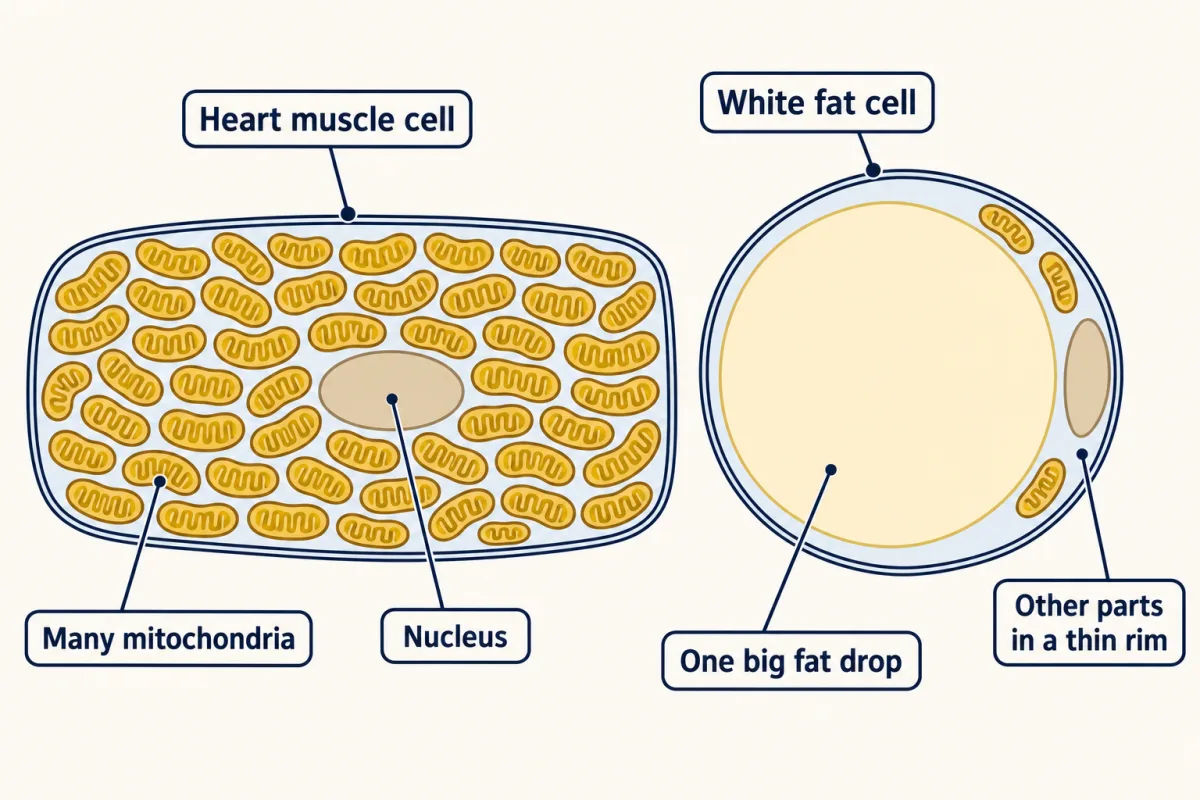
Mitochondria fill a large share of a heart muscle cell; one fat drop fills most of a white fat cell. The two share many kinds of parts, in very different amounts. AI-generated illustration -
Explain: the parts and their jobs
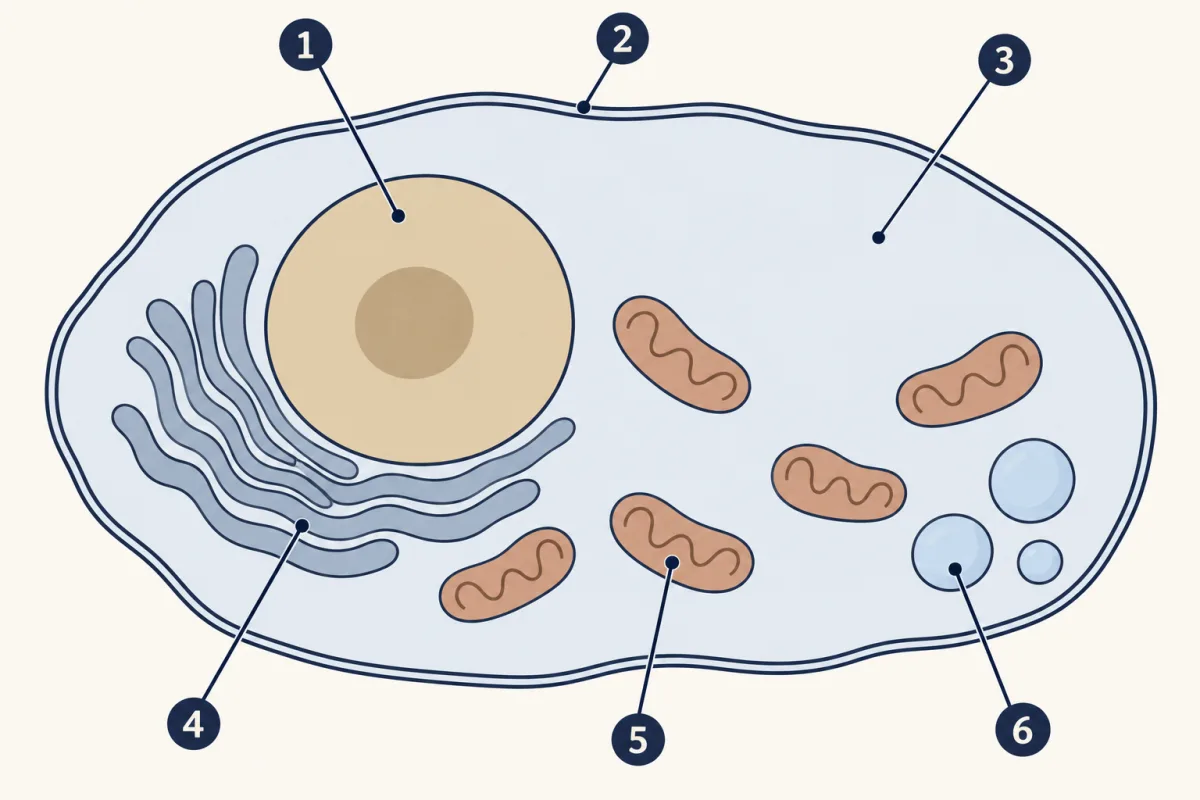
- nucleus
- cell membrane
- cytoplasm
- endoplasmic reticulum
- mitochondria
- vacuole
-
Explore: switch off one part of a cell
-
Explain: the parts work as a team
-
Elaborate: same parts, different amounts
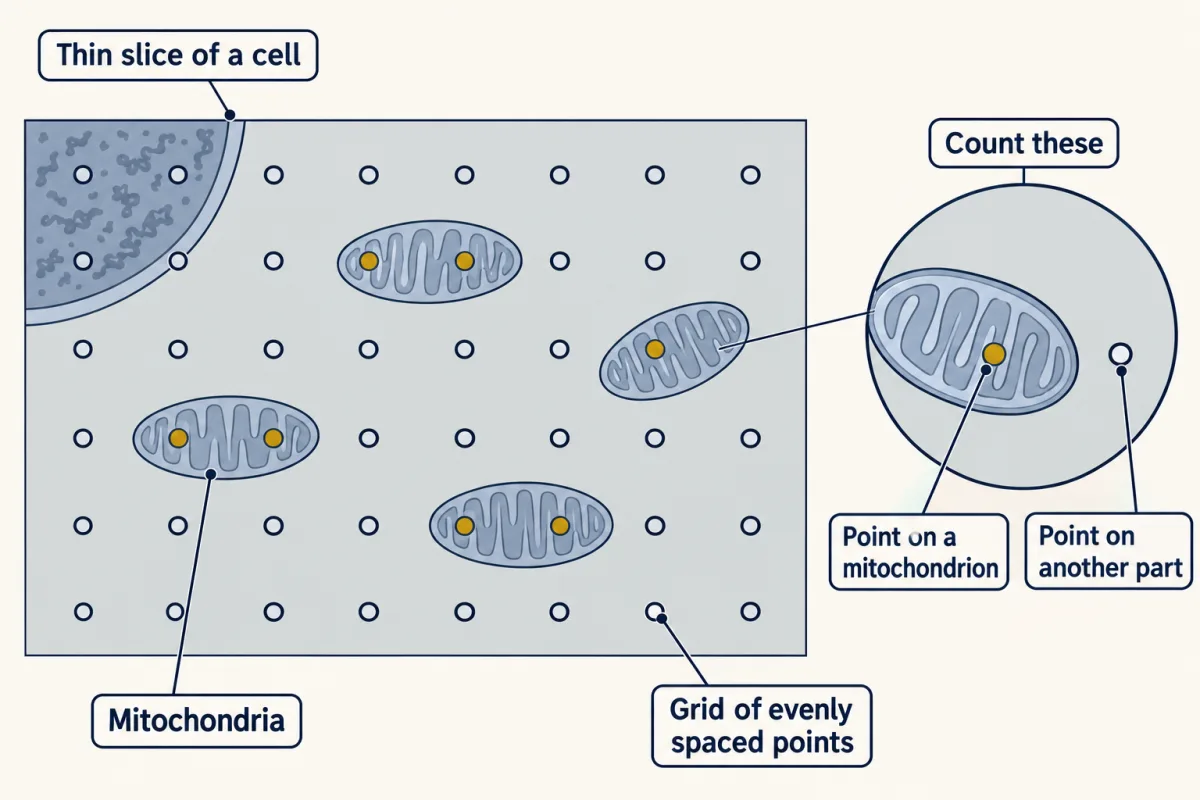
The counting rule your grids will use: the share of points that land on mitochondria estimates the share of the cell's volume they fill. AI-generated illustration -
Evaluate: check your thinking
-
Going deeper
Where this lesson fits
Before thisReview first
- Cells Are EverywhereThis course · Lesson 1
It introduces cells as the basic units of living things, which this lesson opens up to look at their parts.
After thisStudy next
- Plant Cells and Animal CellsThis course · Lesson 3
It uses the organelles you just met to show what plant cells add, like the cell wall and chloroplasts.
- Diffusion and OsmosisThis course · Lesson 5
It takes the cell membrane's job of controlling what enters and leaves and explains how water and gases cross.
- Releasing Energy from FoodThis course · Lesson 10
It takes the mitochondria's job of releasing energy from food and shows how cellular respiration does it.
Elsewhere on the siteFilms, simulations and method films in other courses
- One Cell, Many JobsFilm · Biology
It shows how a single cell does every life job using its own parts.
- Division of labourSimulation · Biology
It lets you see cells sharing out jobs among their parts.
Suggested by an AI model from the lessons themselves, then checked. How we use AI