Developmental Neuroscience · Skim version
What Makes the Human Brain Big
Read the full lesson → Skim the whole course →
The guiding idea
Your cortex is only about twice as thick as a mouse's. Why is its surface roughly a thousand times larger?
The human brain is about three times the size of a chimpanzee's, yet it is built from the same main classes of cell, in the same layers, by the same kinds of progenitor.
From the film: Multiply, Don't Add
- Multiply, don't add: a division that makes two progenitors adds a progenitor that keeps dividing, so repeated rounds compound.
- In the radial unit model, extra founder doublings multiply the number of columns, so the cortex gains area.
- Nearly all of the gain in the human cortex went into area, not thickness.
From the film: A Second Place to Double
- Outer radial glia keep a fibre but have no process reaching the ventricle, and can divide far from it.
- In macaque, at least, they can be a second site of doubling.
- Fibres that diverge as they climb favour spreading neurons sideways, into area, rather than thickness.
From the film: Testing the Rule in Genes and Time
- Human-specific genes such as ARHGAP11B and NOTCH2NL were tested in mouse, marmoset and organoids, not in a developing human brain.
- Neurogenesis lasts longer in humans, and extra time allows more rounds if cell cycles do not lengthen.
- Slow human neuron maturation shapes connections, not neuron number, so it lies outside the rule.
-
A bigger sheet, not a thicker one
-
More columns, not a thicker cortex
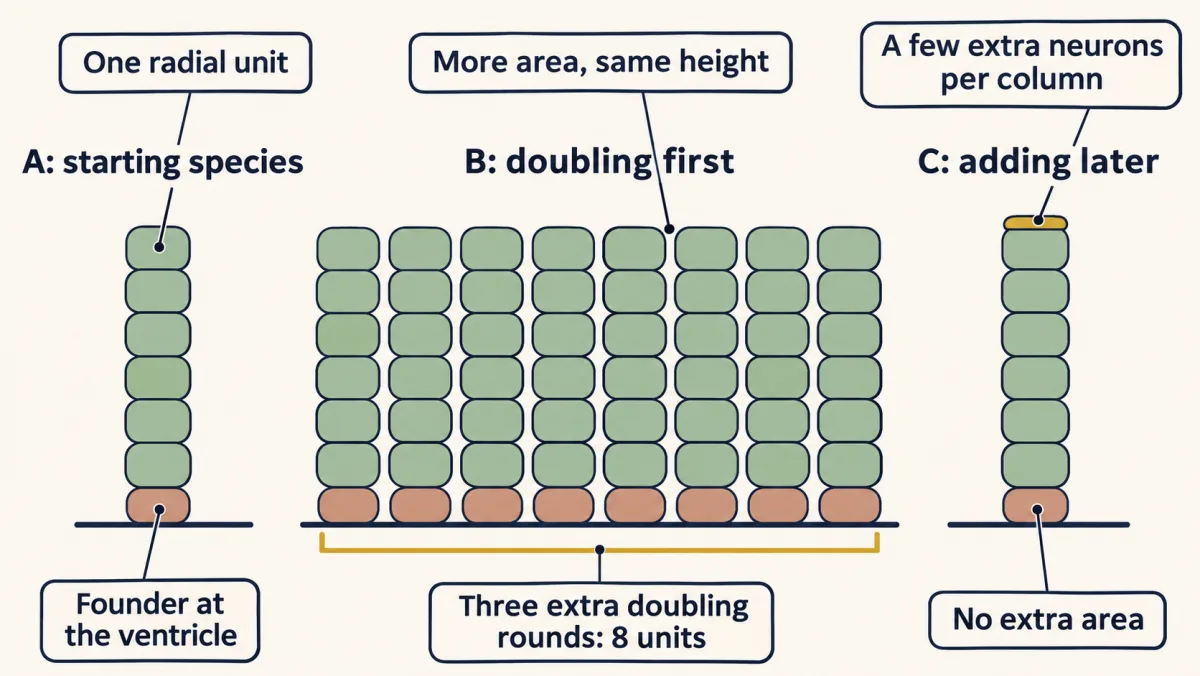
In the radial unit model, extra doubling rounds before the switch multiply founders, and each founder starts its own column, so the sheet gains area at the same height. Extra neuron-making divisions after the switch only add a few neurons to each column. If you want area, change the founder phase. AI-generated illustration -
A second place to double
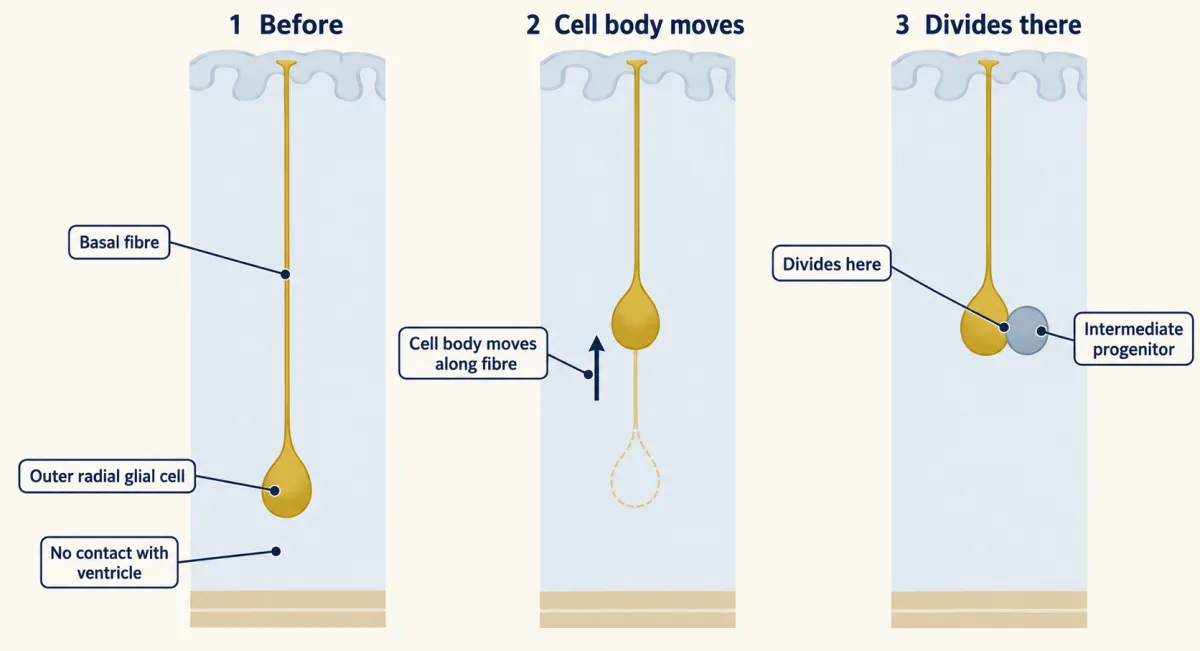
One example of outer radial glial division, based on live imaging of human fetal cortex by Hansen and colleagues (2010). A cell with a basal fibre and no ventricular contact moves its cell body toward the brain surface before dividing. Here, one daughter retains the fibre and the other becomes an intermediate progenitor. Other daughter outcomes occur; basal radial glia vary in shape, and not every division is preceded by this movement. AI-generated illustration 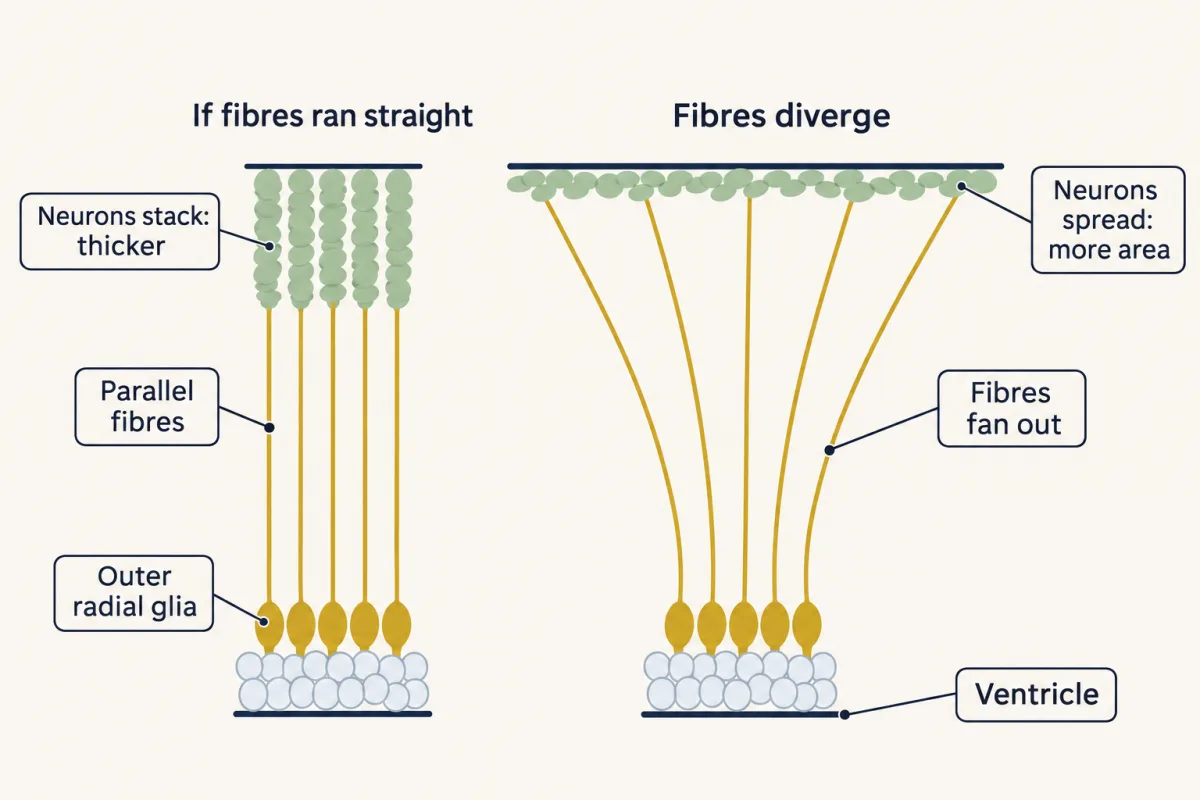
If outer radial glial fibres ran straight, their extra neurons would stack onto existing columns and thicken the cortex. Instead the fibres diverge as they climb, so the neurons that climb them can spread sideways, which favours growth in area. AI-generated illustration -
Genes that only humans have
-
Taking longer: development on a slower clock
-
Putting it together
-
Going deeper
Where this lesson fits
Before thisReview first
- The Ventricular Zone: Radial Glia as Stem CellsThis course · Lesson 13
Radial glia as stem cells that switch from doubling to neuron-making divisions is the starting point for the radial unit model here.
- Birth Order and Fate: Temporal Identity and the Inside-Out CortexThis course · Lesson 16
Birth order setting layer position, youngest on top, underlies the idea that one column of neurons stacks above one progenitor patch.
- Radial Migration: Climbing the Glial LadderThis course · Lesson 17
Neurons climbing radial glial fibres is what ties each column of neurons to the patch of progenitors that made it.
After thisStudy next
- Brains in a Dish: Stem Cells and OrganoidsThis course · Lesson 51
Human, chimpanzee and gorilla organoids are a main test system for the founder-phase and gene explanations met here.
Elsewhere on the siteFilms, simulations and method films in other courses
- Copy First, Then ShareFilm · Life Science
Shows the basic idea that new cells come only from existing cells dividing, which the doubling rule depends on.
- Lineage tracingMethod film
The doubling and outer radial glia arguments rest on following all descendants of marked progenitors.
Suggested by an AI model from the lessons themselves, then checked. How we use AI