Developmental Neuroscience · Skim version
Feeding the Axon: Glia as Metabolic Partners
Read the full lesson → Skim the whole course →
The guiding idea
The brain is about 2 percent of your weight and uses about 20 percent of your resting energy. Who delivers the fuel to the far end of an axon?
Whoever wraps an axon helps feed it, and the firmest evidence is for oligodendrocytes, the myelinating glia of the brain and spinal cord.
From the film: Who Feeds the Far End?
- An axon spends energy without pause on ion pumping, can lie far from its cell body, and is mostly covered by myelin.
- So the axon must make its ATP locally, and the cell that wraps it is placed to help.
- The evidence is clearest for oligodendrocytes and for long-term upkeep, and it is help, not the only supply.
From the film: A Glial Cell That Stops Respiring
- Mice lacking PLP or CNP made close to normal myelin yet had axons that swelled and degenerated with age, so glia seem to give axons more than insulation.
- Oligodendrocytes that have made their myelin can live on glycolysis alone, and adult brain axons were spared over the months studied.
- The lactate seen under anesthesia fits glia making more than they burn, but the experiment never traced where it went.
From the film: Cut the Export Line
- Blocking MCT1 killed motor neurons in glucose-starved spinal cord slices, and adding lactate rescued them.
- Deleting MCT1 only in oligodendrocyte lineage cells left young mice normal, but axons degenerated and myelin thinned as they aged.
- These experiments infer the transfer of fuel and none traces it, and the astrocyte shuttle remains a hypothesis with partial support.
-
An axon has a supply problem
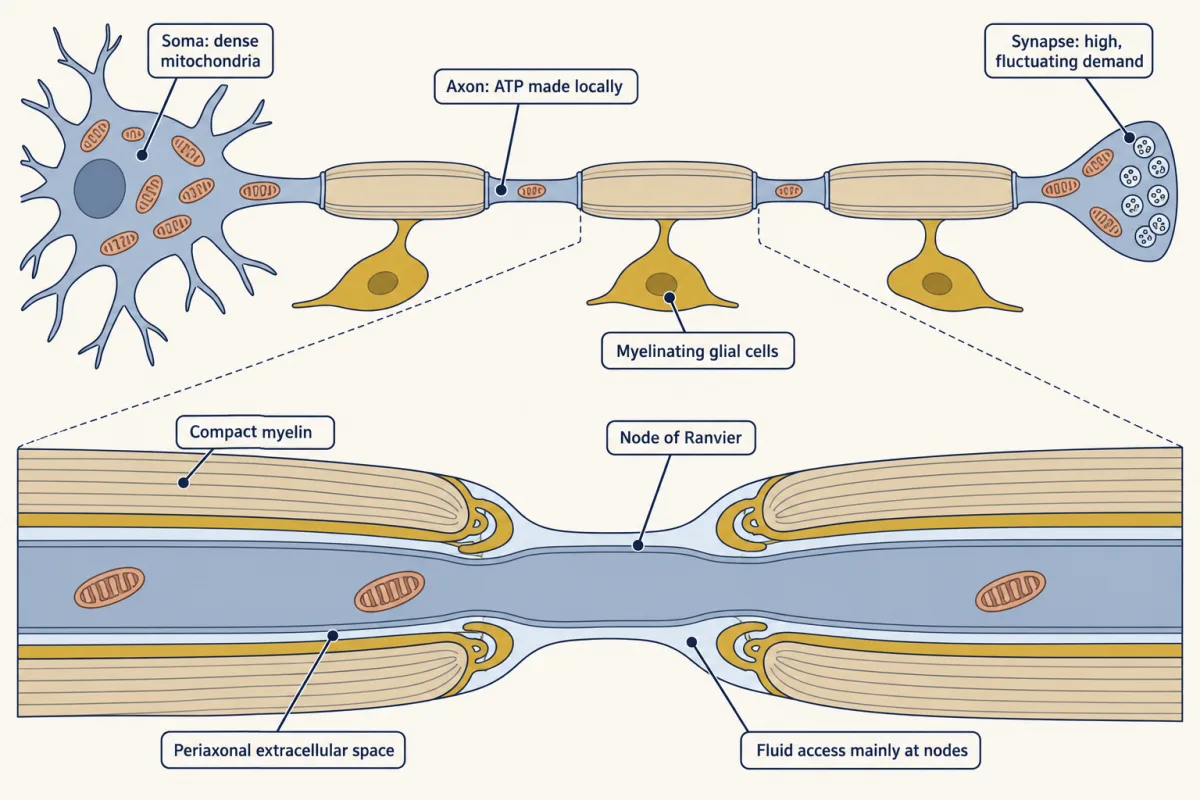
Each part of a neuron has a different supply problem: the soma has mitochondria close at hand, the long axon must make ATP locally, and the synapse has a high, fluctuating demand. Compact myelin limits direct access to surrounding fluid mainly to the nodes, but a thin extracellular space remains beneath myelin. Myelinating glial processes lie close to the axon at individual segments, making these cells candidate suppliers. AI-generated illustration -
Just enough chemistry
-
Myelin that looked fine, axons that did not
-
Cut the export line
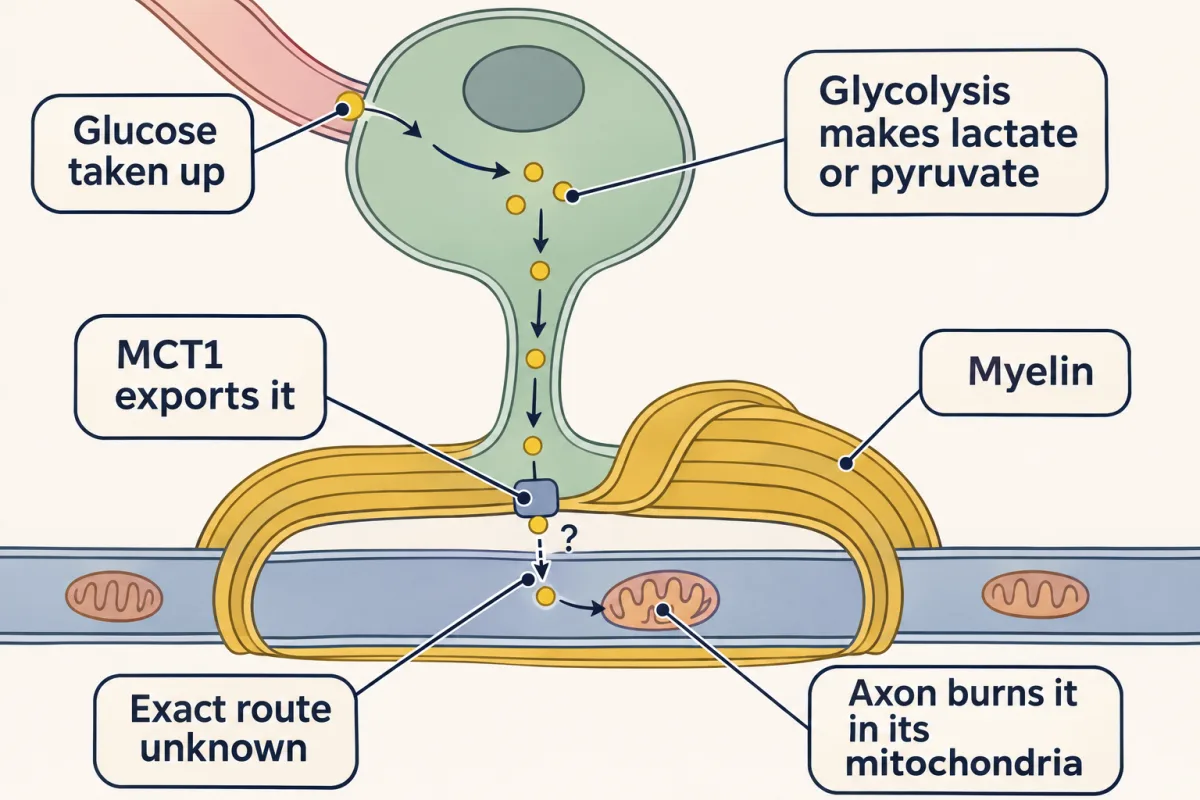
The picture that fits the experiments: an oligodendrocyte runs glycolysis and exports lactate or pyruvate through MCT1, and the axon burns it in its own mitochondria. The exact route from glial cytoplasm to axon, and how much of the axon's ATP depends on it, are still unknown. AI-generated illustration -
Astrocytes: a contested second candidate
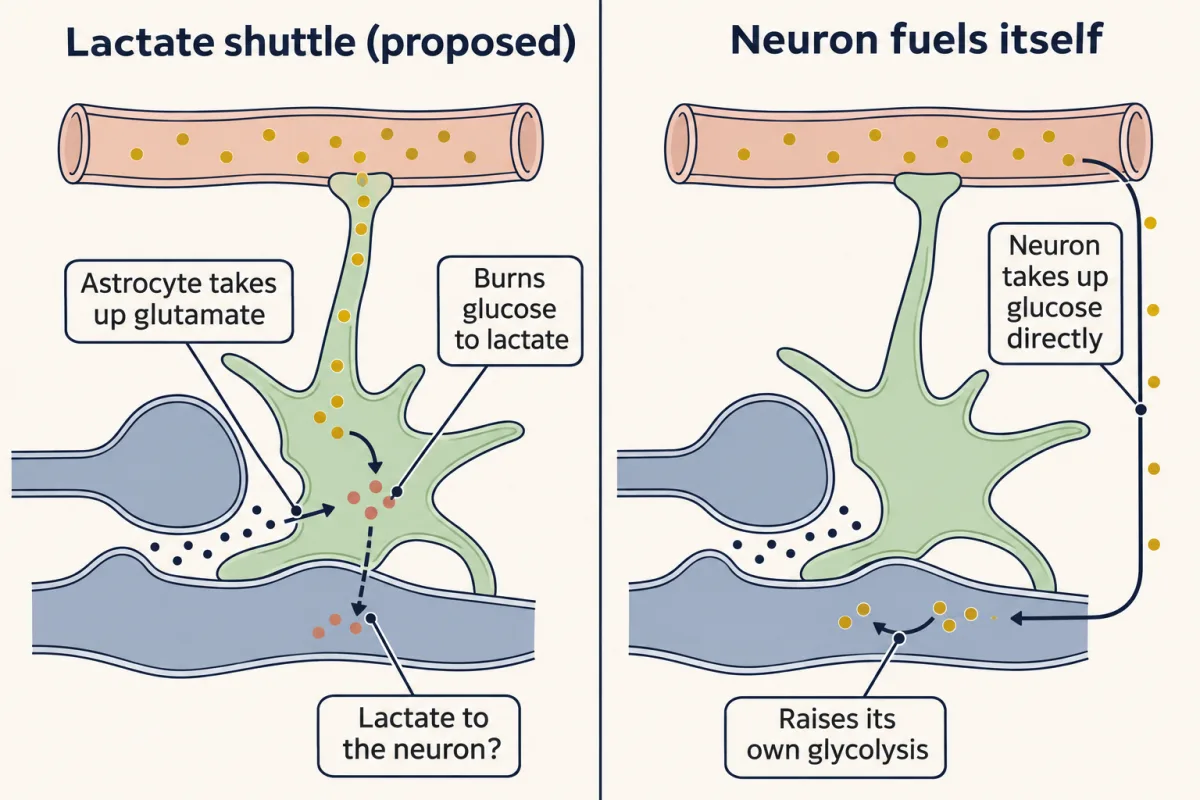
Two readings of how an active synapse is fuelled. In the proposed astrocyte-neuron lactate shuttle, glutamate uptake drives the astrocyte to burn glucose to lactate, which it passes to the neuron; in the alternative, stimulated neurons raise their own glycolysis. Neurons can use glucose directly; how much of their fuel comes through astrocytes is still contested. AI-generated illustration -
After injury: when glial metabolism changes
-
Putting it together
-
Going deeper
Where this lesson fits
Before thisReview first
- Myelination: Wrapping the Axon So the Signal JumpsThis course · Lesson 44
You need to know how glia wrap axons in myelin and what nodes of Ranvier are to see why the axon is hard to supply.
- Where Glia Come FromThis course · Lesson 43
It introduces oligodendrocytes and astrocytes, the glial cells whose feeding role this lesson tests.
After thisStudy next
- Injury and Regeneration: Why the Brain Does Not RegrowThis course · Lesson 46
It takes up what happens to cut axons and the glia around them, which this lesson's injury section builds on.
Elsewhere on the siteFilms, simulations and method films in other courses
- Radioactive and stable isotope tracersMethod film
Both experiments here only infer the fuel transfer, and labelled atoms are how you would actually trace lactate from glia into axons.
- Small Space, Big ChangeFilm · Neuroscience
It shows how glia handle the extracellular space around neurons, the setting in which glial support for neurons works.
- A Room With No Way OutFilm · Biochemistry
It shows how a cell's supply of a substrate depends on delivery against clearance, and how a missing step causes a lysosomal disorder.
Suggested by an AI model from the lessons themselves, then checked. How we use AI