Small Space, Big Change
Read the transcript of “Small Space, Big Change”
Film transcript: Small Space, Big Change
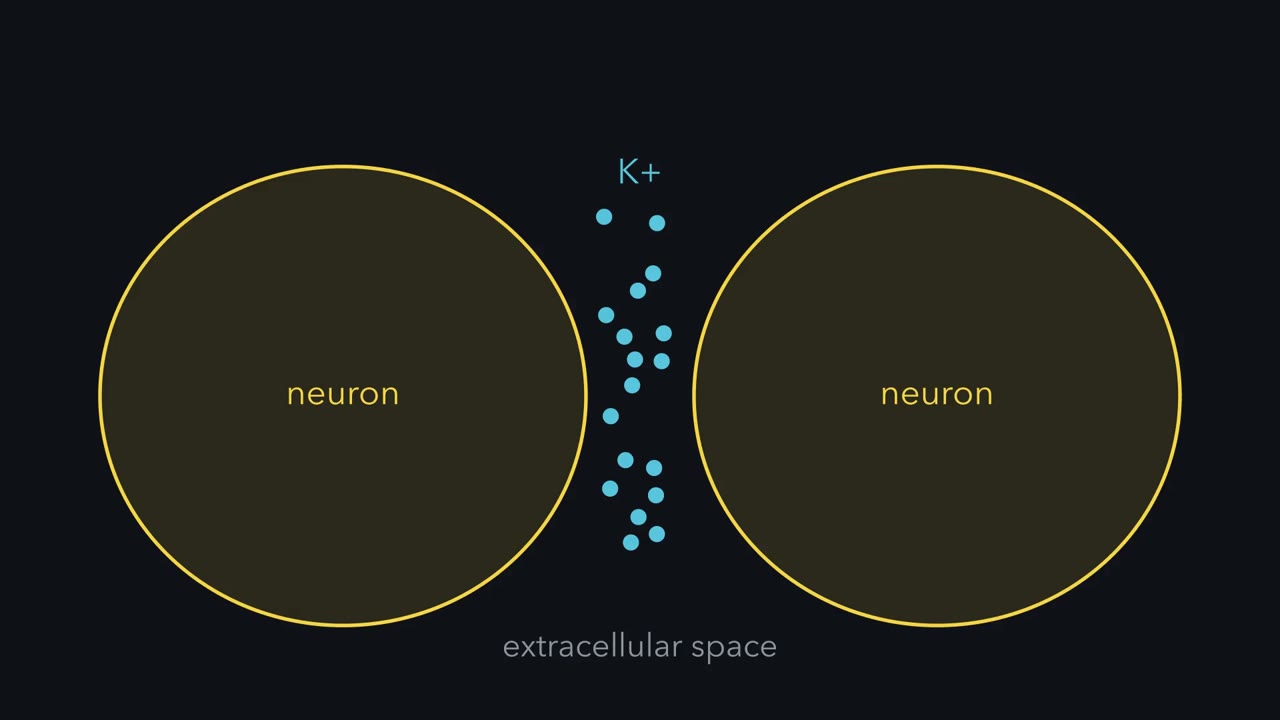
Every spike ends with potassium leaving the neuron. Where does all that potassium go? Into the gaps between brain cells. Those gaps are narrow. Together they are only about a fifth of the tissue. Inside a neuron, potassium is high. Outside, it is low. A burst of firing lets some potassium out. Which concentration changes more, inside or outside? And which change matters more for the voltage?
In proportion, the outside, by a wide margin. Take a simple model: the space outside is a fifth of the tissue, and the firing neurons fill a third of the space inside. Then the same potassium changes the outside concentration about one and a third times as much as the inside one. the outside starts low. One extra mM raises it by a third. Losing 0.75 mM inside changes it by about half a percent. Potassium's equilibrium potential, E_K, depends on the ratio of outside to inside. In this model, the outside change moves it about 60 times as much as the inside change. In cat cortex, strong repetitive stimulation raised outside potassium to a ceiling of about 10 mM.
At that ceiling, E_K sits about 32 mV more positive than at rest. Does the neuron's resting potential move that far too? Less far, but the same way. In a simple model, it moves about half as far. A resting neuron is mostly, but not only, permeable to potassium. Sodium pulls on its voltage too. A modest rise brings the neuron closer to threshold, so it fires more easily. More firing releases more potassium. That loop can feed a seizure.
A large, sustained rise can do the opposite. Sodium channels inactivate, and the neuron can stop firing. So here is the rule. Small space outside, big change outside. A little released potassium is a big change outside, in proportion, and a tiny one inside. So in models like this one, E_K's shift comes mostly from outside.
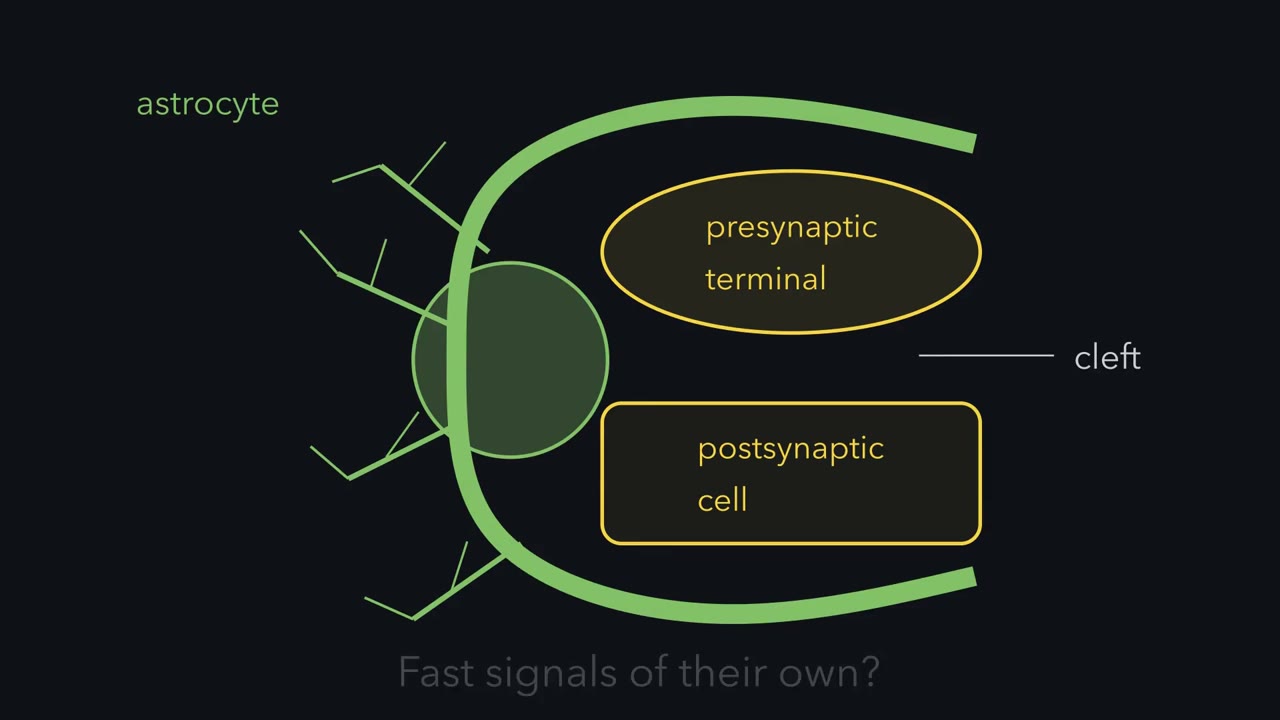
So a neuron's resting potential depends on cells that keep clearing that space.
Let potassium pile up outside neurons during seizure-like firing and E_K can move by more than 30 mV. Who cleans it up?
Continue in the lesson: Neurons and Glia at Work →
2:50 · Free, with captions and a transcript. The lesson has the full text, the questions and the sources.
More films from this lesson
How this film was made. Narration: an AI narrator voice (Kokoro, af_heart) reading narration written from this lesson's text. Animation: AI-generated in code (Manim) by Claude, a schematic with no drawn molecular structures. Captions come from the narration script. See something wrong? Report it.