Biology Together · Unit 6: Food chains, soil and decomposers
Who Eats Whom?
Rewritten on : new text and film. Your notes and highlights stay, but the text around them may have moved.
Why does a hawk need grass? Picture cards and a ball of yarn show how the food in a meadow and in the Bay connects.
Three real-life stories behind this activity, about 2 minutes aloud, or read them below.
The film, 3 minutes, and the safety notes, for the grown-up to look at before the activity.
The hands-on part, done with a child: about 30 minutes.
Pause when the reading reaches a film, and offer to play it. Saved on this device.
Watch the film now, or keep listening
That is the end of the reading
This idea at other levels
An activity for ages 5 to 10 about food webs. Next, for an older child: Food Webs and Energy (grade 7).
See every levelHide the levels
Food webs and energy flow
Energy passes from the sun to plants to the animals that eat them, with less left at each step.
Taught at four levels: ages 5 to 10, grade 7, high school and college core.
College, the core · the level you chose
Three doors for every joule, and why the 10% rule is rough.
Ecology and Evolution · about 21 min · film 3:05 · 3 practice questions
High school · the level you chose
Lindeman's Minnesota lake budget: heat and undigested matter shrink each step.
Biology · about 40 min · film 3:37 · Virginia BIO.8b
Grade 7 · the level you chose
Why the Bay holds many small fish and few ospreys: an energy pyramid.
Life Science · about 40 min · film 3:31 · Virginia LS.5 b, LS.5
Ages 5 to 10 · the level you chose
Who Eats Whom? · this lesson
Picture cards and yarn: pull one card and feel the web tug.
Biology Together · about 30 min · film 3:09 · Virginia 3.5 b, 4.3 a, 4.3 b, 4.3 c, 4.7 c
Play the ladder · 4 films, about 14 min, from grade 7 to college core. Each film waits for you to press play.
Next door to food webs
- PhotosynthesisWhere the energy at the bottom of every food web comes from.Nearest lesson: What Do Plants Need? (ages 5 to 10)
- Decomposers and decayDecomposers take what every level drops and send the matter round again.Nearest lesson: Rot Detectives (ages 5 to 10)
Short versions inside this lesson
The grade 7 version · about 1 minute to read
In grade 7 Life Science, children build an energy pyramid. They learn that each animal uses most of the energy in its food just to live, so only a small part passes on to whatever eats it. That is why the Chesapeake Bay can hold huge schools of small fish but far fewer ospreys. They also sort the living and nonliving parts of an ecosystem.
The plainest version · about 1 minute to read
Every living thing needs food. Plants make their own food from sunlight, air and water. A grasshopper eats the grass. A frog eats the grasshopper. A snake eats the frog, and a hawk can eat the snake. The arrow points to the one doing the eating. When something dies, mushrooms and tiny living things break it down.
Find an idea: every idea, searchable
Which lessons teach an idea, and the notes on each level, were written by AI models from the lessons and checked by a second model. A person has not yet read every one. How we use AI
About this activity what is in it
Builds on:What Do Plants Need? (read)Why these?
Rewritten on : new text and film. Notes and highlights stay, but the text around them may have moved.
Before you start
- Hands-on time
- About 30 minutes
- Where
- Indoors or outdoors
- Ages
- 5 to 10, with an easier and a harder version below
- Grown-up
- Stay with your child the whole time. You do any cutting, and you watch the yarn during the web game.
What you need
- 12 to 18 index cards or squares of paper
- Crayons or markers
- A ball of yarn or string
- Scissors (for the adult)
- Tape or paper clips
- A clear space on the floor or a table
- Paper and a pencil, or the printed observation sheet below
Virginia science standards SOL 3.5 bSOL 4.3 aSOL 4.3 bSOL 4.3 cSOL 4.7 c
In this activity. You and your child make picture cards for a Virginia meadow food chain and a Chesapeake Bay food chain, line them up with arrows, then join them into a web with a ball of yarn.
The film
 ▶ Watch Who Eats Whom? A Parent Guide · 3:09
Read the transcript of “Who Eats Whom? A Parent Guide”
Film transcript: Who Eats Whom? A Parent Guide
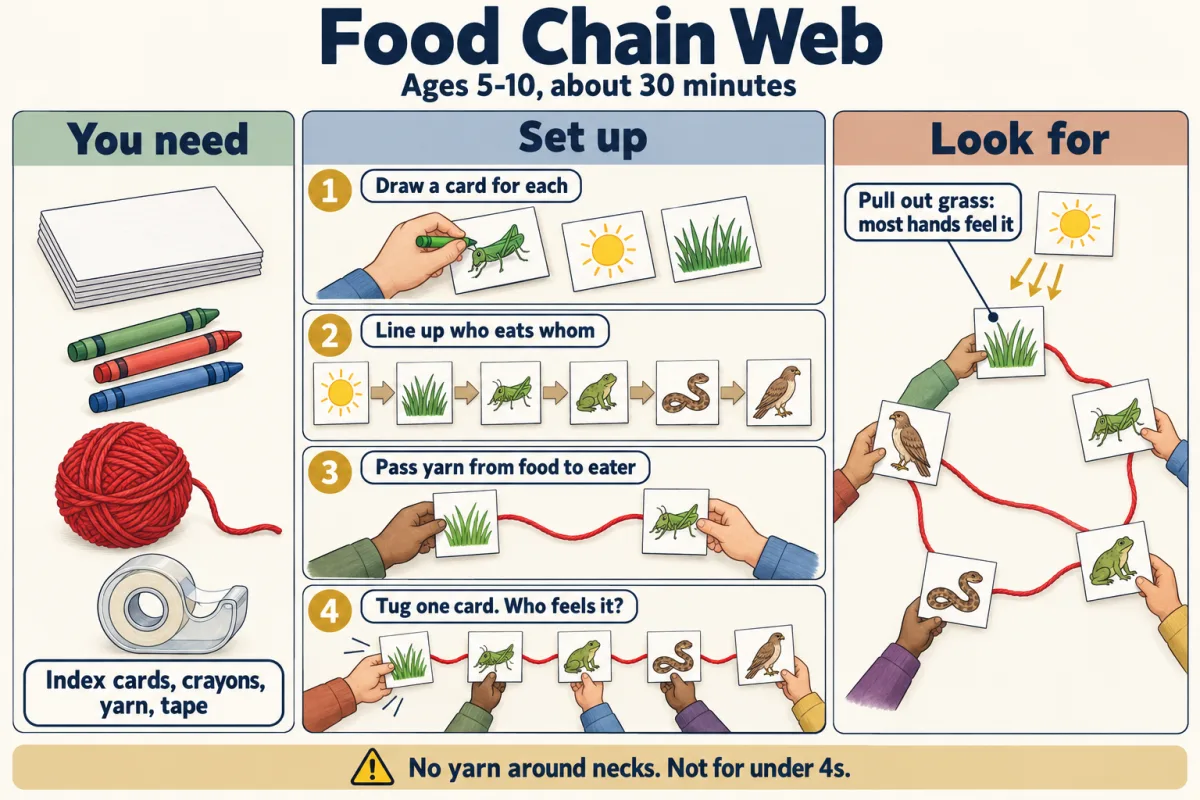
Why does a hawk need grass? In about thirty minutes, picture cards and yarn let your child see the answer. They practice looking closely, sorting living things, and testing a guess by hand. Gather twelve to eighteen index cards or paper squares, crayons or markers, and a ball of yarn. You also need tape or paper clips, a clear floor or table, and scissors just for you. Review the yarn safety rules before you start. Draw cards for sun, grass, grasshopper, frog, snake, and hawk. Line them up in that order. Ask, "Where does the grass go when the grasshopper eats it?" Point the arrow toward the grasshopper. The first arrow shows sunlight reaching the grass.
Grass makes food using sunlight. Animals are consumers. Mushrooms break down dead material. For the Bay chain, draw sun, phytoplankton, zooplankton, and menhaden, in that order. From menhaden, point an arrow to striped bass and another to osprey. Add rabbit, mouse, fox, mushroom, and earthworm cards. Each person holds one to three cards. Start at grass and pass yarn from food to eater. Link living cards to mushroom and earthworm too. The overlapping chains make a food web. Have the snake holder give one gentle tug. Ask anyone who feels it to raise a hand. Now look at the grass card. Ask, "If we take out the grass, who loses a food link first?"
Take out the grass card. Trace the links to grasshopper, rabbit, and mouse first. Then follow their links to other animals. The yarn shows which cards connect. Place a tadpole near producers. Most tadpoles eat algae and plant bits. Adult frogs eat insects. Stay with your child the whole time and do all the cutting.
Hold yarn loosely. Keep it off necks. Never wrap it tightly around fingers or wrists. Hand the ball over. Stay still while holding yarn. Clear yarn and loose cards before anyone moves. If you work outside, wash hands with soap and water afterward. Yarn, string, tape, paper clips, marker caps, and small crayon pieces can be choking hazards. Keep them away from children under four. Call nine one one if choking. Through this game, your child practices asking what happens next and checking a guess against real links. By the end, one gentle tug shows why a hawk still needs sunlight and grass.
Before you start
- Hands-on time
- About 30 minutes
- Where
- Indoors or outdoors
- Ages
- 5 to 10, with an easier and a harder version below
- Grown-up
- Stay with your child the whole time. You do any cutting, and you watch the yarn during the web game.
What you need
- 12 to 18 index cards or squares of paper
- Crayons or markers
- A ball of yarn or string
- Scissors (for the adult)
- Tape or paper clips
- A clear space on the floor or a table
- Paper and a pencil, or the printed observation sheet below
Virginia science standards SOL 3.5 bSOL 4.3 aSOL 4.3 bSOL 4.3 cSOL 4.7 c
The big idea
A food web is made of overlapping food chains. Your child can sort living things, predict which cards are linked, and follow the yarn to check.
Say it together: “Plants use sunlight, air, and water to make their own food. The first arrow shows sunlight reaching grass or algae. After that, each arrow points from food to the living thing that eats it.”
Children already know everyday meals. A bird pulls up a worm. A cat stalks a mouse. This activity turns those scenes into a chain and then an overlapping food web.
Every chain here starts with the sun. Producers are living things, like grass and algae, that make their own food using sunlight. Consumers eat other living things: some eat plants, some eat animals, and some eat both. Decomposers, such as mushrooms and bacteria, break down dead plants and animals.
What to do
- Make the land cards. Draw six cards: sun, grass, grasshopper, frog, snake, and hawk. Write each name under the picture.
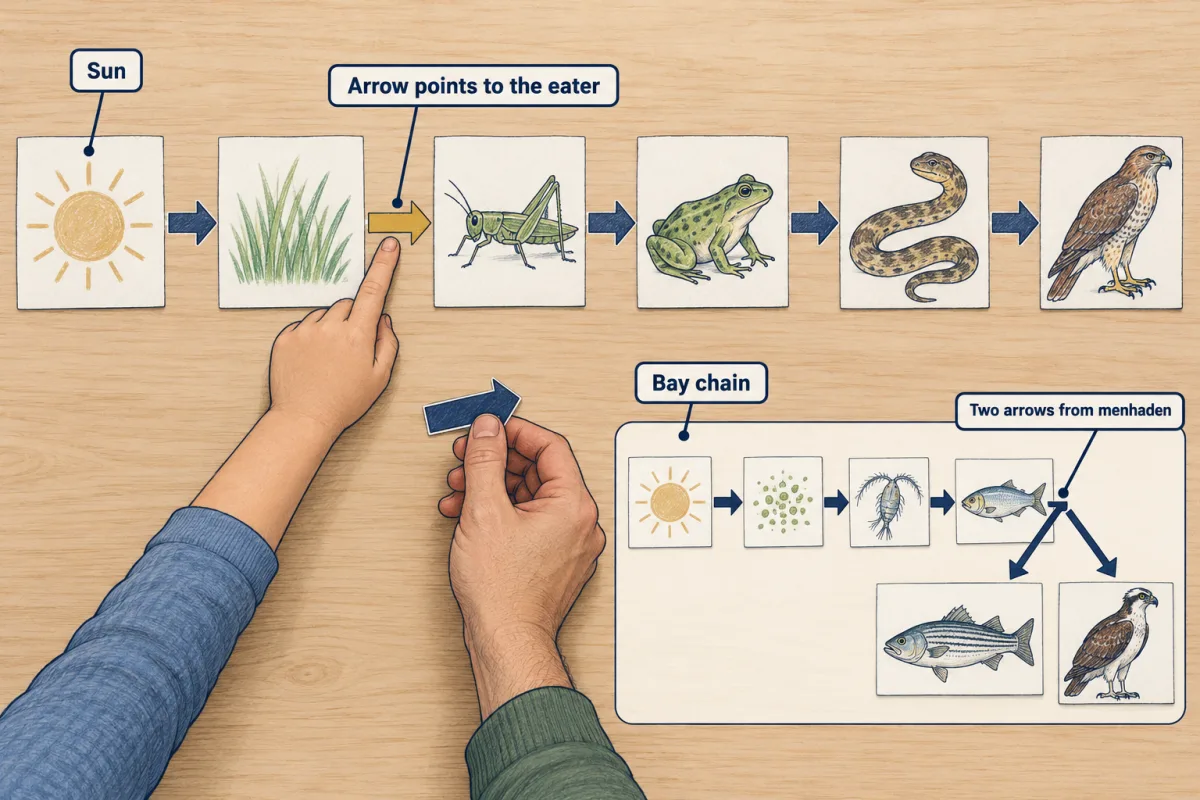
- Work one pair first, then line up the chain. Lay down only grass and grasshopper. Ask, “Where does the grass go when the grasshopper eats it?” Place a paper arrow pointing to the grasshopper. Your child will notice the arrow points into the eater. Then ask, “Who eats whom next?” Let your child finish lining up sun → grass → grasshopper → frog → snake → hawk. Draw paper arrows together and put one between each pair.
- Make the Bay chain. Draw sun, phytoplankton (tiny floating algae using sunlight), zooplankton (tiny floating animals), menhaden (a small fish that strains plankton from the water), striped bass, and osprey. Line up sun → phytoplankton → zooplankton → menhaden. Ask, “What if two animals eat the same fish?” Your child will notice two arrows split from menhaden: one to striped bass and one to osprey.
- Predict before building the web. Add five cards: rabbit, mouse, fox, mushroom, and earthworm. Ask, “Who eats the rabbit? What happens to a dead leaf?” Let your child guess first.
- Build the yarn web. Each person holds one to three land cards. Start at grass and pass yarn from food to eater: grass to grasshopper, rabbit, or mouse (mice eat seeds); grasshopper to frog; frog to snake or hawk; mouse to snake, fox, or hawk; rabbit to fox or hawk. Last, run yarn from living cards to mushroom and earthworm, since every living thing dies in the end. Your child will notice several strands meet in one hand. With a class, give each child one card in a circle.
- Predict, then pull one out. Ask, “What do you think will happen if the snakes are gone? Who will feel the tug?” The snake holder gives one small tug; anyone who feels it raises a hand. Before you remove the grass card, ask, “Who loses a food link first? Who might be affected next?” Then remove it and trace the links together. Your child will see every land animal here depends on plants. Yarn shows who is linked, not whether a group will grow or shrink.
- Place the tadpole card. Draw a tadpole and ask, “Does a tadpole eat what a frog eats?” Most tadpoles graze on algae and plant bits in water; adult frogs eat insects and other small animals. Put the tadpole near the producers.
- Two-question debrief. Ask, “Where did the energy in our web start?” (The sun.) Then ask, “Which way does the arrow between grass and grasshopper point, and why?” (To the grasshopper, because it gets energy from the grass it eats.)
Questions to ask while you do it
Ask your child to guess first, then check.
- “I wonder where the grass gets its food. Does it eat?”
- “Which way should the arrow point? Where does the food end up?”
- “What do you think will happen to the frogs if all the grasshoppers disappear?”
- “If the hawks were gone, what might happen to the snakes and the mice?”
- “I wonder what eats the osprey’s leftovers, or a fish that dies.”
- “Which card do you think everyone needs? Let’s follow the yarn and see.”
What children often think
-
A child might say “The arrow points to what gets eaten.”
You could try Ask, "Where does the grasshopper end up after the frog eats it?" Then trace the path with a finger. Arrows in a food chain point to the eater, because they show where the food and its energy go.
-
A child might say “Plants get their food from the soil.”
You could try Ask what a plant on a windowsill would need if it had no sunlight. Plants take water and a few nutrients from soil, but they make their food from air and water using sunlight.
-
A child might say “The hawk is the most important because it’s the biggest.”
You could try Ask, "If the grass were gone, who would lose their food? Who would lose food after that?" Trace it card by card. Big animals matter, but every animal in the web depends on producers like grass and algae.
-
A child might say “If the hawk disappears, everything is fine.”
You could try Ask, "Who did the hawk eat? What could happen to them?" With fewer hawks, mice and snakes may grow in number for a while. That can change other cards in the web too.
-
A child might say “Snakes are mean because they eat frogs.”
You could try Ask how the snake gets its food. A snake hunts because it needs to eat, just like a frog eating a grasshopper. Predators are part of a healthy web, not bad guys.
Why it works
The cards make energy flow visible. Producers capture energy from sunlight and store it in their bodies. Each eater gets some of that energy, but uses most of it to live and move. Birds and mammals, like the hawk, also use it to stay warm. That is why a meadow holds far more grasshoppers than hawks.
The web also shows that most animals eat more than one thing. A red fox eats mice, rabbits, fruits, and seeds. When one food runs short, a fox can eat more of another. Changes still spread, though, and scientists cannot always predict which way.
The tadpole shows that an animal’s role, its niche, can change as it grows. Most tadpoles eat algae and plant material, and some eat other food too. Adult frogs eat mostly insects. In the Bay, the osprey only joins the web part of the year. It arrives in early spring and heads south in late summer.
Easier and harder
Ages 5 to 7
Use only the six land cards and skip the Bay chain. Let your child trace arrows with a finger before using tape. Lay the cards on the floor in a circle and run yarn between them. Ask one question per card: “What does this one eat?”
Ages 8 to 10
Use both chains and all extra cards. Have your child label each living card producer, consumer, or decomposer (the sun is nonliving). Ask them to note which consumers eat only plants, only animals, or both. Play “what if” three times, changing one card each time. Have them write a prediction first, then use the tug test to check links. Remember, yarn shows who is connected, not whether a group will grow or shrink.
If it doesn’t go as planned
If the yarn tangles, lay the cards on a table and connect them with pencil lines or strips of tape instead. If your child gets stuck on arrow direction, act it out: they are the frog, you hand them a paper “grasshopper,” and the arrow points to them. In a small family, each person can hold three or four cards.
Observation sheet
Here is what two filled-in rows look like before your child tries their own:
| Living thing | What does it eat? | What eats it? | Producer, consumer or decomposer? |
|---|---|---|---|
| Grass | Makes its own food (sunlight, air, water) | Grasshopper, rabbit | Producer |
| Frog | Grasshopper (insects) | Snake, hawk | Consumer |
Observation sheet
Who eats whom?
NameDate
Draw each chain. Make the arrows point to the eater.
| Living thing | What does it eat? | What eats it? | Producer, consumer or decomposer? |
|---|---|---|---|
When we took away one card, this happened:
stemhop.com · Biology Together
For teachers: Virginia standards
Virginia’s grade 3 standard asks children to build a food chain and point the arrows correctly. In grade 4, children build food webs for places near them and see how a frog’s food changes as it grows. Food pyramids are not part of the grade 4 standard.
The three stories, told aloud Side Hops: three stories that go with this lesson Side Hops
Three playful ways to talk about food chains at home
1:51 · Narration: an AI narrator voice (Kokoro, af_heart).
Read the transcript
Hi there! Before you build the yarn web together, here are three easy ways to make those picture cards come alive, with no quiz feeling at all. First, when your child draws the menhaden card, pull a kitchen strainer out of the drawer and swish it through a bowl of water. A menhaden eats a bit like that. It strains tiny floating plankton out of the Bay water. Tiny floating algae use sunlight to make food. In fact, the ocean produces about half of the oxygen made on Earth, mostly thanks to tiny floating living things like these. Then striped bass and ospreys eat the menhaden, and the sun's energy keeps moving along. Second, try a guessing game about backyard birds. Ask your child how many caterpillars Carolina chickadee parents catch to raise just one nest of babies. Kids love tossing out wild numbers like ten or a million. Cheer every guess, then share the real answer: about nine thousand caterpillars, gathered over about sixteen days, for a single nest. Then wonder together where all those caterpillars got their own food. Third, on your next walk, stay right beside your child and look at the low leaves of an oak or a maple, eyes only, hands off insects and unknown plants. Spot little holes or notched edges? Many of those are bites from hungry insects. Oak trees, all the kinds together, feed more than five hundred kinds of caterpillars, so oaks are busy feeding a crowd. And a grasshopper can eat about half its body weight in green plants a day. Those nibbled leaves are your neighborhood food chain, right there in action. Have fun!
The idea underneath them. You and your child make picture cards for a Virginia meadow food chain and a Chesapeake Bay food chain, line them up with arrows, then join them into a web with a ball of yarn.
Your notes
Select any text in the lesson to highlight it or add a note to it. Your highlights and notes are saved in this browser and collected in your notebook.
This browser is not letting the site save anything (a private window or strict privacy settings), so highlights and notes will be lost when you leave the page.
Where this lesson fits
Before thisReview first
- What Do Plants Need?This course · Lesson 7
Your child needs to know plants use sunlight to make their own food, which is why every chain starts with the sun.
After thisStudy next
- Rot DetectivesThis course · Lesson 22
It shows decomposers at work, the mushroom and earthworm part of the web, and what happens to dead things.
- Soil ShakeThis course · Lesson 23
It looks at the soil that dead plants and animals break down into, and soil is where the web's leftovers end up.
Elsewhere on the siteFilms, simulations and method films in other courses
- The Leaf Pile That Stops GrowingFilm · Life Science
It shows producers, consumers and decomposers linked in one ecosystem, like the cards and yarn here.
Suggested by an AI model from the lessons themselves, then checked. How we use AI
Those are the stories. The idea under them is the one the lesson builds.
That is the film. The rest of the activity is the fun part.
The rest of the activity is here when you want it.
Finish line
Test yourself
4 questions
Questions to talk over together.
Next · Lesson 22
Rot Detectives
Where does a rotten apple go? Sealed jars let a child watch decomposers at work without opening a lid.
Continue →Rewritten on : new text and film. Notes and highlights stay, but the text around them may have moved.