Cell Signaling · Skim version
Drugs Against a Part
Read the full lesson → Skim the whole course →
The guiding idea
About five hundred human kinases hold ATP in nearly the same pocket. How do you drug just one?
A targeted drug acts on one named part of a signalling pathway.
-
A decoy in the receptor: fit without the push
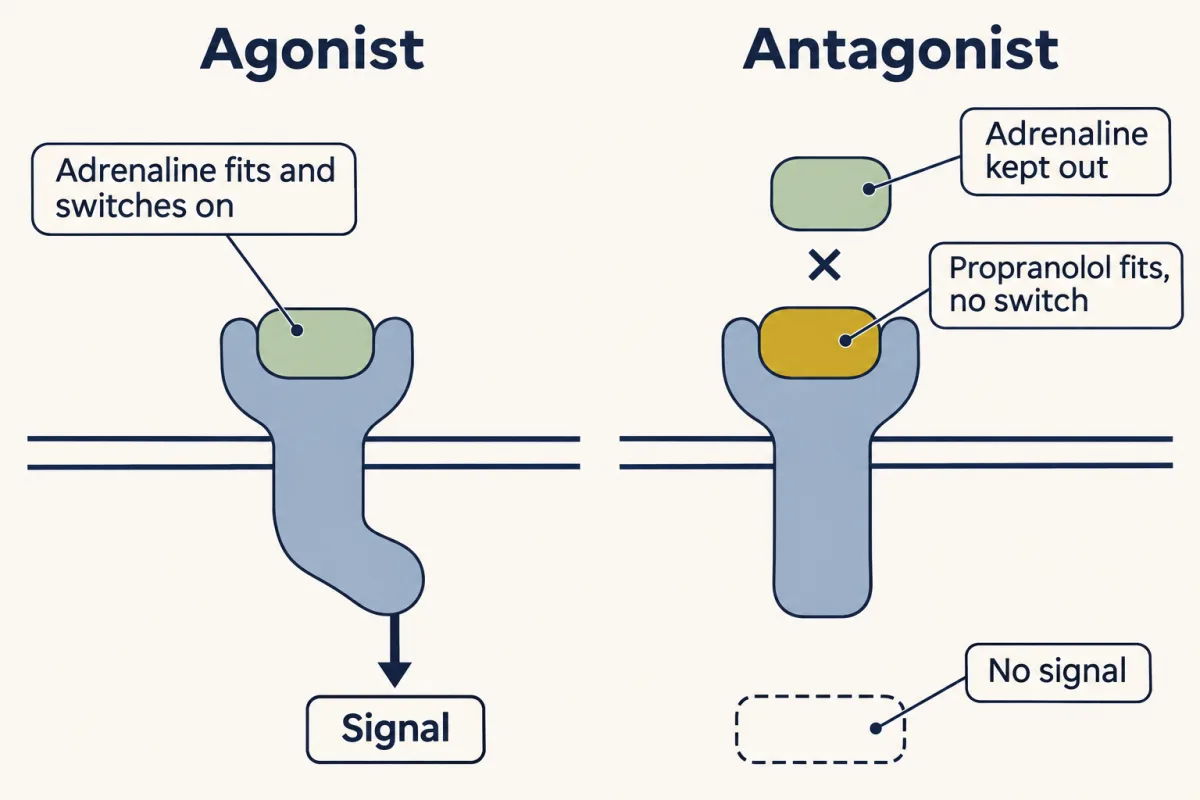
Fitting a receptor and switching it on are separable. An antagonist such as propranolol sits in the receptor's own site without switching it on, and while it is there adrenaline cannot get in. AI-generated illustration -
One pocket, five hundred kinases: “Highly Conserved— target for lots of drugs”
-
When the drug stops working: one residue changed
-
The target nobody could hit: a bond to the mutation itself
-
Outside, inside, beside: the sorting, and what the network does next
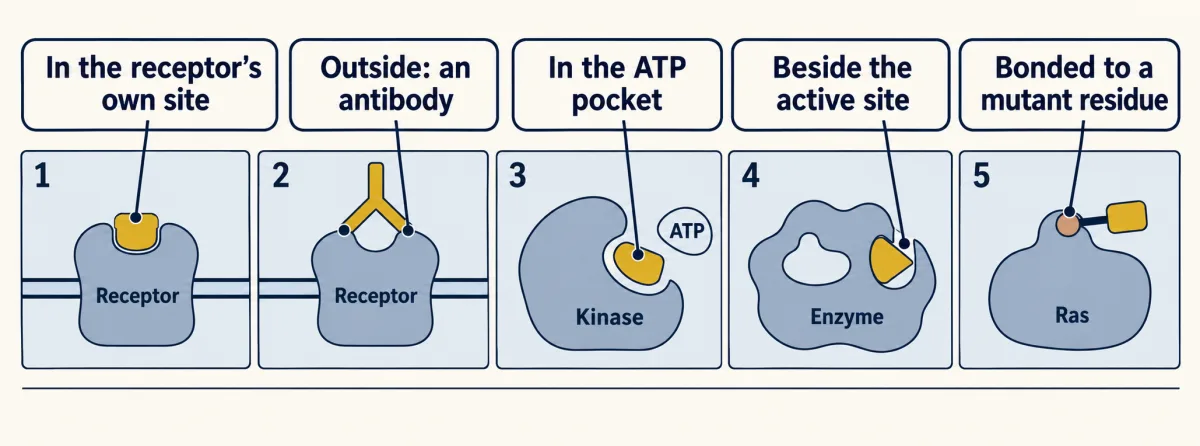
Five ways targeted drugs bind: a receptor's ligand site, a receptor's outer surface, a kinase's ATP pocket, a site beside the active site, and covalent attachment to a mutant residue. The categories overlap: sotorasib binds a pocket beside the nucleotide site of K-Ras G12C and also bonds cysteine 12. AI-generated illustration 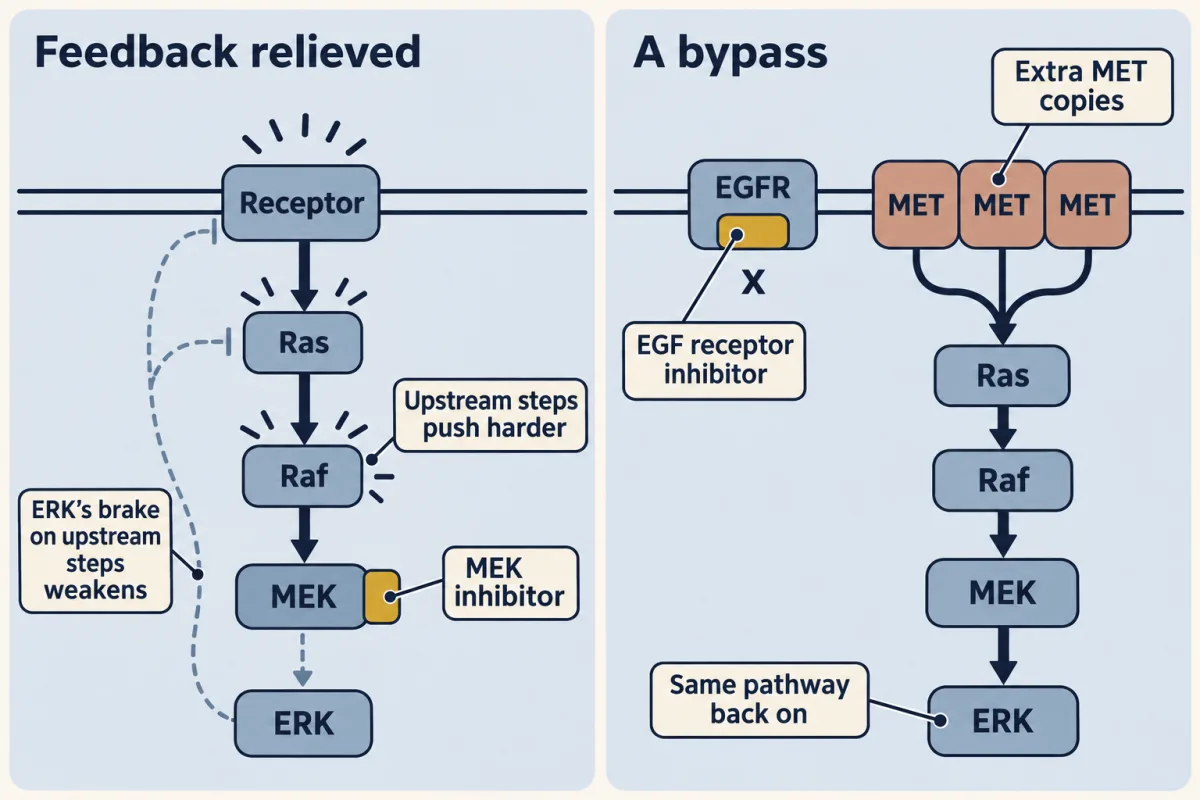
Wherever a drug lands, the network answers. Blocking MEK relieves ERK's negative feedback, so upstream steps push harder and the pathway can partly switch itself back on; in some lung cancers treated with an EGF receptor inhibitor, extra copies of MET switch the same pathways on again. AI-generated illustration
Where this lesson fits
Before thisReview first
- Binding: Affinity, Occupancy and Dose–ResponseThis course · Lesson 3
Affinity versus efficacy is what lets an antagonist fit a receptor without switching it on.
- Phosphorylation: Kinases and PhosphatasesThis course · Lesson 6
Imatinib binds ABL in its switched-off shape, which this lesson uses without re-teaching.
- GTPase Switches: The TimerThis course · Lesson 7
You need how Ras holds GTP and cycles to see why it was called undruggable.
After thisStudy next
- How We Know: Detecting a SignalThis course · Lesson 43
Showing which kinase a drug hits, and that it works, rests on the detection methods taught there.
Elsewhere on the siteFilms, simulations and method films in other courses
- Lower the Ridge, Not the ValleysFilm · Biochemistry
This is not a valid id; omitted.
Suggested by an AI model from the lessons themselves, then checked. How we use AI