Cell Signaling · Skim version
How We Know: Detecting a Signal
Read the full lesson → Skim the whole course →
The guiding idea
How do you measure one molecule among a trillion, and then show which kinase did the work?
Every claim in this course rests on a measurement, and each method can prove only so much.
-
Measuring almost nothing: let the hormone compete with a labelled copy
-
Seeing one protein among thousands: sort by size, then ask an antibody
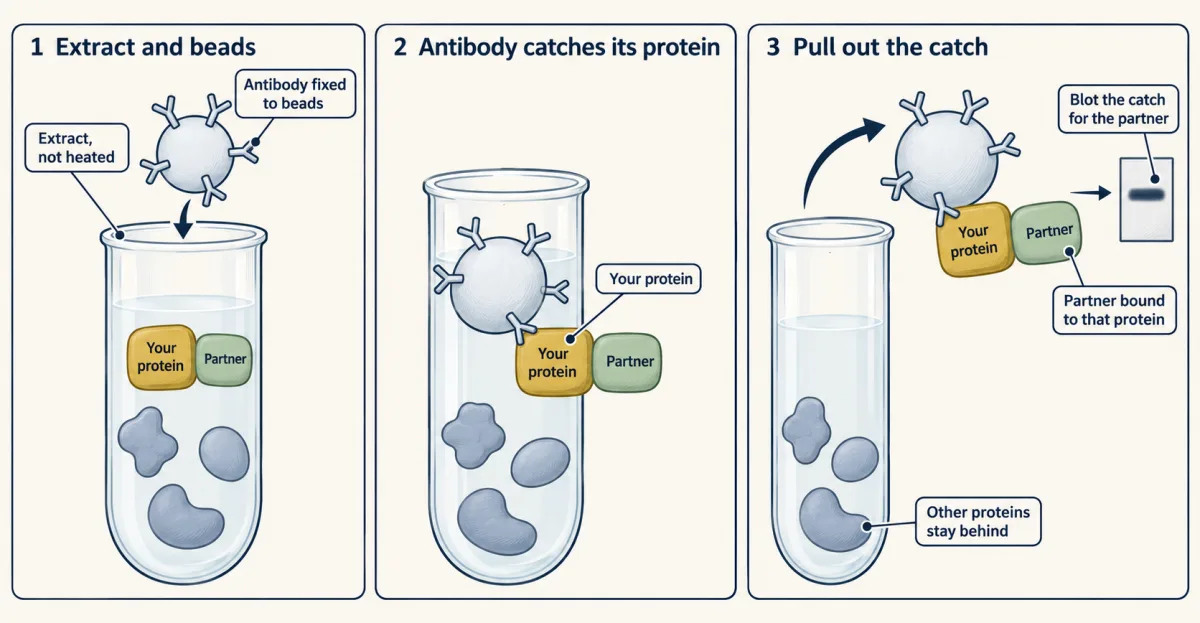
Immunoprecipitation uses an extract that has not been heated. An antibody fixed to beads pulls its protein out of the mixture, and a partner bound to that protein comes out with it. AI-generated illustration -
”How do we determine where the protein is modified?” Weigh the pieces
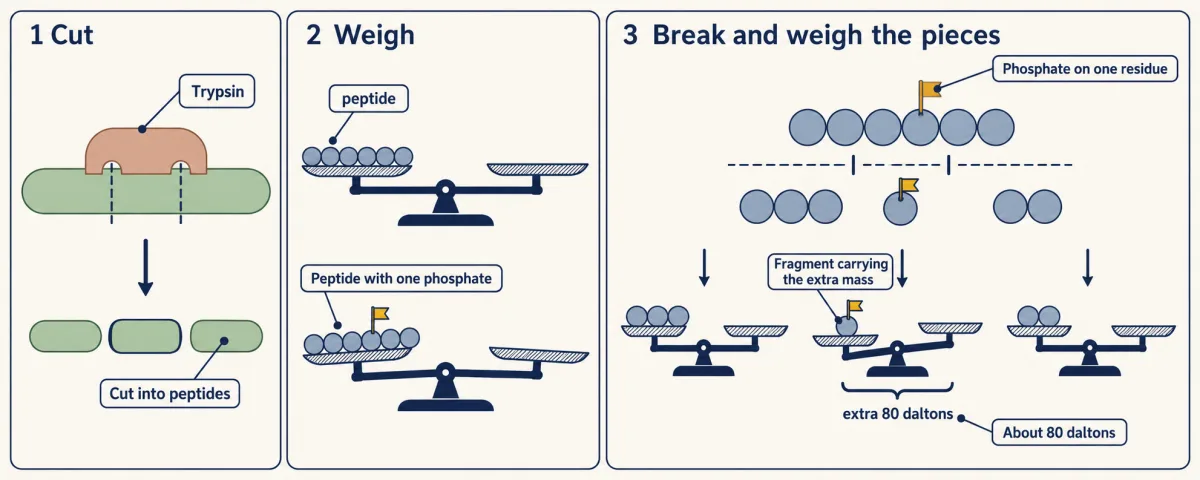
Cut the protein with trypsin, weigh a peptide, then break it and weigh the fragments. A phosphate adds about 80 daltons. When the fragments distinguish the candidate residues the site can be placed; otherwise two or three residues may remain possible. AI-generated illustration -
Which kinase? Give one kinase an ATP of its own
-
What an inhibitor proves, and what “necessary” and “sufficient” mean
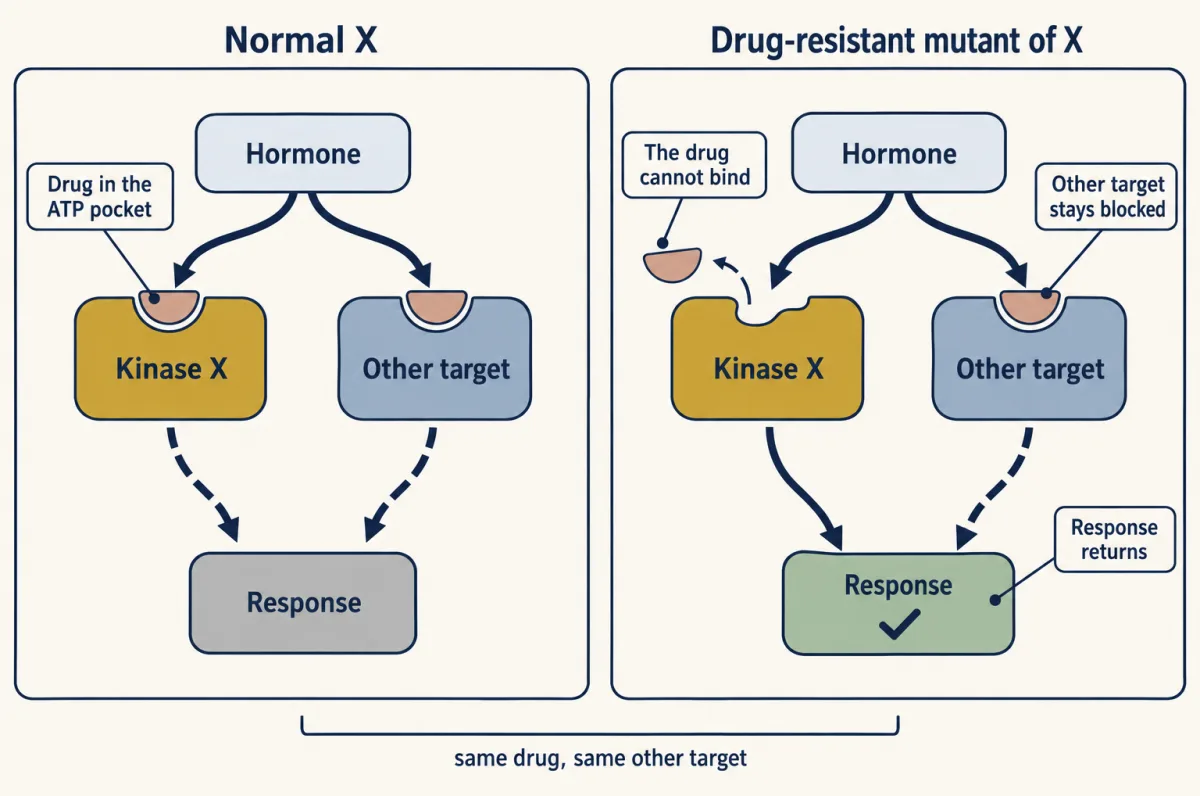
A mutant of X that the drug cannot bind tests the drug's effect. If the response returns while other targets stay blocked, the drug was acting through X. Arrows are schematic; the rescue does not order the other targets or show a direct link from X to the response. AI-generated illustration -
Going deeper
Where this lesson fits
Before thisReview first
- Binding: Affinity, Occupancy and Dose–ResponseThis course · Lesson 3
Competition between labelled and unlabelled hormone follows the binding and occupancy rules taught there.
- Phosphorylation: Kinases and PhosphatasesThis course · Lesson 6
You need to know what kinases and phosphatases do and how phosphosites are tested before judging the evidence here.
- Finding a Signal: NGF, EGF and the BioassayThis course · Lesson 2
Bioassays measure what a hormone does; this lesson contrasts that with counting hormone by antibody.
After thisStudy next
- Hacking the Cell: Reporters, Actuators and Genetic ToolsThis course · Lesson 44
Blots average millions of cells, and reporters and actuators let you watch or start a signal in one living cell.
Suggested by an AI model from the lessons themselves, then checked. How we use AI