Genetics and Molecular Biology · Skim version
Complex Traits, Heritability and GWAS
Read the full lesson → Skim the whole course →
The guiding idea
If height is 80 percent heritable, does that mean 80 percent of your height came from your genes?
For complex traits, population patterns partition variation and flag regions, not causes.
From the film: Heritability Is About Variation
- Heritability describes variation in a population and environment, never a person.
- Many small Mendelian effects plus environmental differences can make a continuous trait.
- Narrow-sense heritability uses additive variance; broad-sense heritability uses all genetic variance.
- Changing environmental variance can change heritability even when no DNA changes.
From the film: A GWAS Hit Is a Starting Point
- A GWAS peak marks an associated region, not a proven cause.
- Linkage disequilibrium lets a noncausal SNP tag a nearby causal variant.
- Fine-mapping, colocalization and editing build the case; a person-level effect needs separate evidence.
- A polygenic score must be tested outside its GWAS; accuracy can drop where LD and allele frequencies differ.
-
The idea: many small Mendelian effects add up to a curve
-
Heritability: a ratio of variances in one population
-
Scanning the genome: association, tags and a threshold
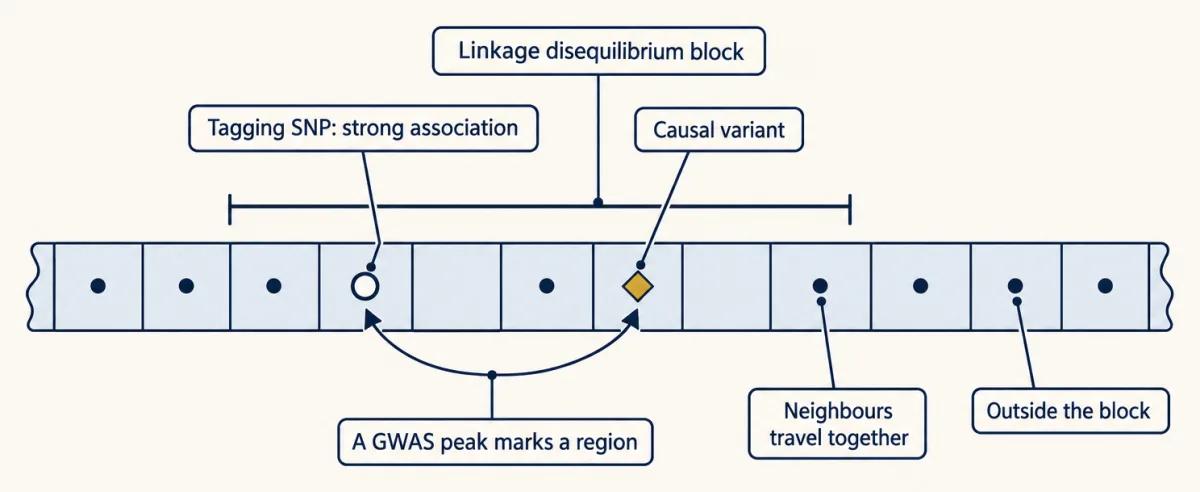
Neighbouring variants travel together on a stretch of chromosome for many generations. Because of linkage disequilibrium, a SNP that does nothing can show a strong association by tagging a causal variant nearby, so a GWAS peak marks a region. AI-generated illustration -
From a hit to a mechanism
-
Polygenic scores, portability and the weight of history
Where this lesson fits
Before thisReview first
- Probability, Crosses and the Chi-Square TestThis course · Lesson 3
You need to multiply and add probabilities over independent allele draws to see why many loci give a bell curve.
- Population Genetics: Hardy-Weinberg and Evolutionary ForcesThis course · Lesson 25
Allele frequencies and what changes them underlie variance partitioning, linkage disequilibrium and why scores transfer poorly between groups.
- Extending Mendel: Dominance, Multiple Alleles and Gene InteractionThis course · Lesson 4
Dominance, gene interaction and incomplete penetrance are the sources of the non-additive variance partitioned here.
After thisStudy next
- Molecular EvolutionEcology and Evolution · College: the core
This course's variants and allele frequencies carry on into how sequence differences build up between species.
- How to Test an Evolutionary ExplanationEcology and Evolution · College: the core
It takes heritable variation further, asking when selection on a trait counts as evolution.
Elsewhere on the siteFilms, simulations and method films in other courses
- Experimental units, pseudoreplication and powerMethod film
Choosing the true unit and sample size matters when planning an association study and judging its significance threshold.
Suggested by an AI model from the lessons themselves, then checked. How we use AI