Life Science · Skim version
Cells Are Everywhere
Read the full lesson → Skim the whole course →
The guiding idea
How can a drop of pond water look empty to your eyes and still be full of living things, all made of cells?
A microscope makes things look bigger, picture size = real size × magnification, and most people can make out something only when it looks bigger than about 100 µm.
From the film: The Size Test
- Most people can make out a thing only when it looks bigger than about 100 µm, a tenth of a millimetre. That limit is the eye line.
- Most cells are about 1 to 100 µm across, so most are too small to see without help.
- A microscope makes things look bigger: picture size = real size × magnification.
- At 400x, a school microscope lifts most cells past the eye line. You see their shapes if the lens shows them clearly and they stand out.
From the film: A Theory Built in Steps
- In 1665 Robert Hooke saw tiny boxes in a thin slice of cork. They were the empty walls of dead cells.
- Leeuwenhoek's careful records showed that seeing nothing does not prove nothing is there.
- By about 1840, scientists had found cells in many plants and animals, strong evidence for the first part of the theory.
- Later work, including work published in the 1850s, showed that new cells form when a cell divides, not from a clear fluid. The theory dropped the wrong idea and kept the rest.
-
How small is too small to see?
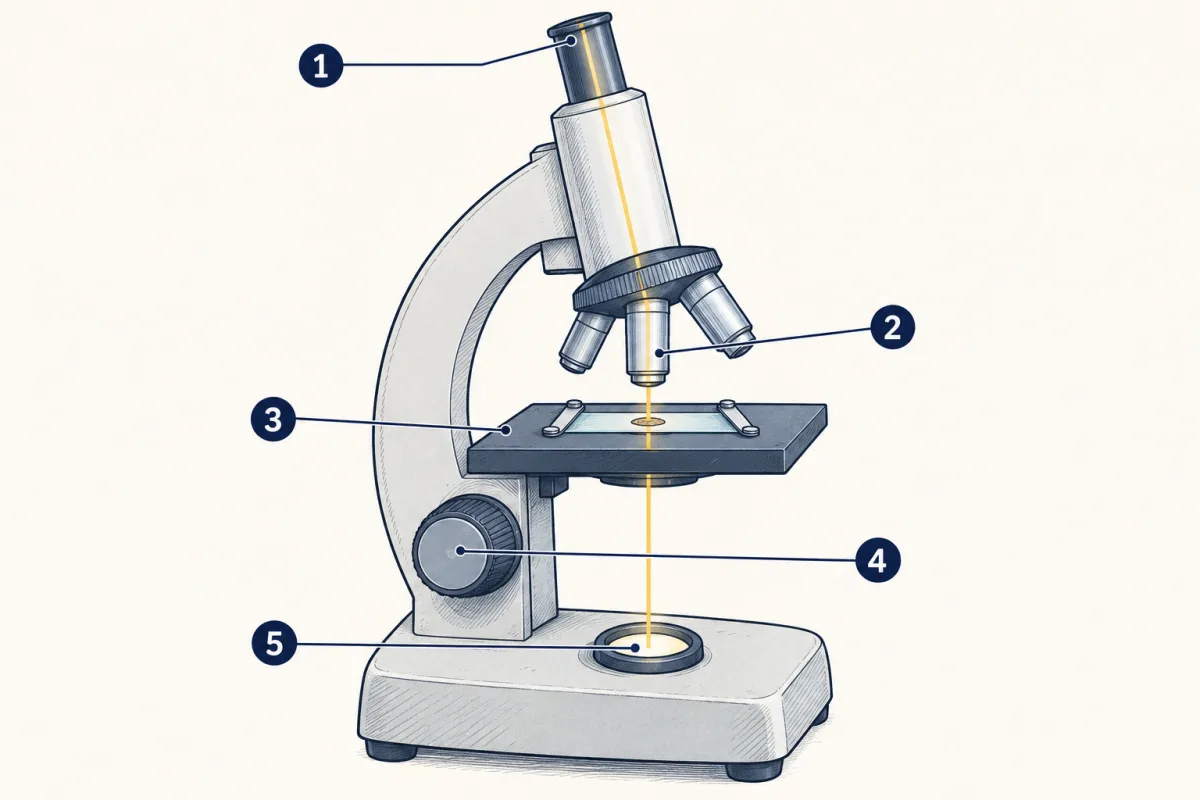
- eyepiece
- objective lenses
- stage
- focus knob
- light source
-
Explore: zoom into a drop
-
What the microscope showed: living things are made of cells
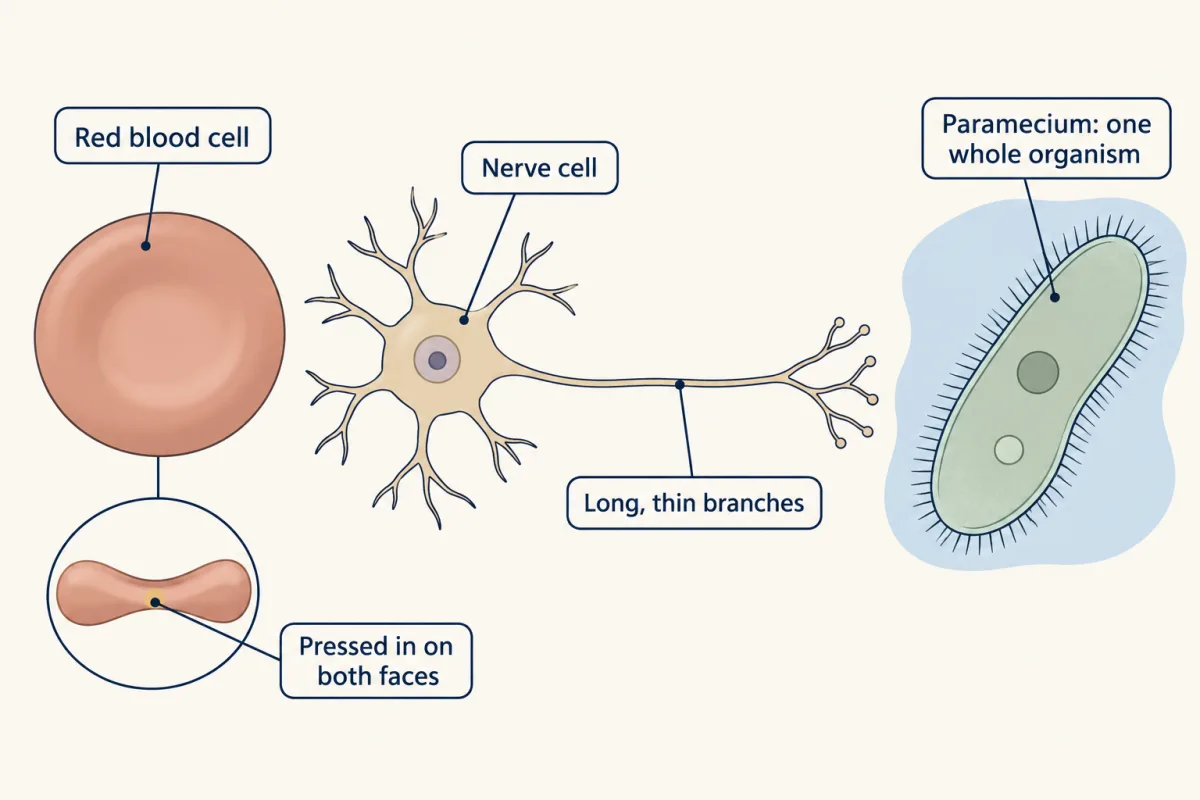
Cells come in many shapes and sizes, depending on their job and the organism they belong to. These cells are not drawn to the same scale. AI-generated illustration -
What makes it a theory
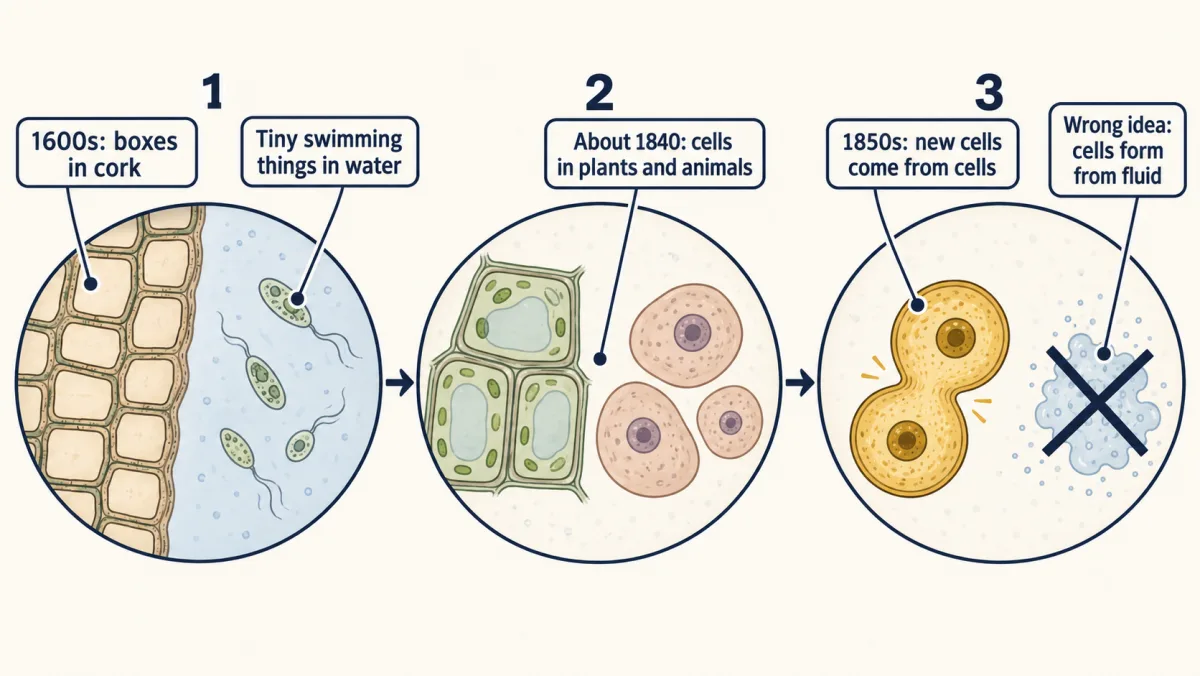
The cell theory grew in steps of evidence from better microscopes, and the last step corrected it. AI-generated illustration -
Where light runs out
-
How big are cells?
-
Evaluate: check your thinking
-
Going deeper
Where this lesson fits
Before thisReview first
- Alive or Not?Biology Together · Ages 5–10, with a grown-up
You need to know what living things do before asking whether a tiny speck in pond water is alive.
After thisStudy next
- Inside a CellThis course · Lesson 2
It takes you inside the cell to the organelles this lesson only mentions.
- How Cells DivideThis course · Lesson 4
It shows how one cell becomes two, the evidence for the third part of the cell theory.
- From Cells to OrganismsThis course · Lesson 6
It sorts living things into one-celled and many-celled and shows how cells share jobs in a body.
Elsewhere on the siteFilms, simulations and method films in other courses
- What a Microscope Can ShowFilm · Biology
It shows magnification and resolution, which set how small a thing a light microscope can show.
Suggested by an AI model from the lessons themselves, then checked. How we use AI