Cell Biology · Skim version
Designing a Cell Biology Experiment
Read the full lesson → Skim the whole course →
The guiding idea
Stretched cells glow green. What would it take to show that stretch made them divide?
A cell biology experiment earns trust only when its prediction, endpoint, independent unit and controls are fixed before the data arrive.
From the film: Before the Data Arrive
- In shared-dish cell experiments, lock the prediction, endpoint and independent unit before the data arrive.
- For division claims, track cells to division instead of counting green cells.
- When treatment is applied to a whole dish, the dish is the experimental unit.
- A SuperPlot keeps cell variation visible while comparing independent runs.
From the film: Ruling Out the Dull Explanations
- A good control matches the treatment in every step except the one being tested.
- Unstretched devices are assembled, mounted and imaged identically, with matched medium and vehicle.
- A pathway readout such as TOPdGFP asks whether Wnt medium engaged beta-catenin-dependent transcription.
- Scorers fix thresholds before analysis and score blind; strain is measured, and devices are not merged.
- A blank damage marker means something only if a positive control shows the assay detects damage.
-
Make the models disagree
-
Read the endpoint before interpreting it
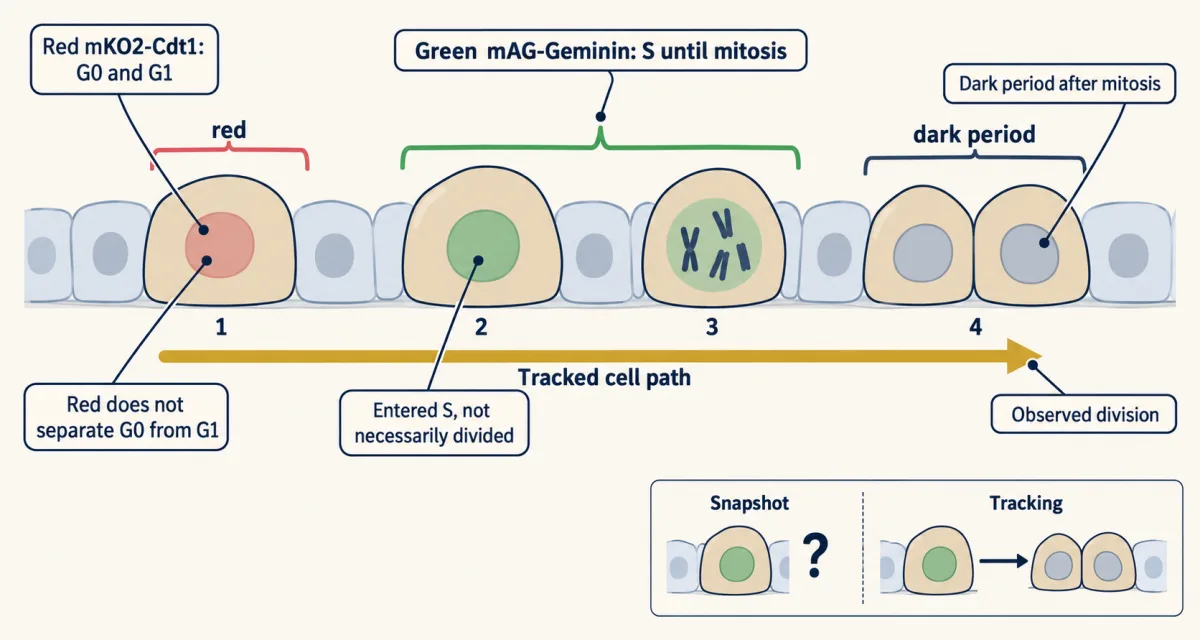
Only tracking one cell from red through green to two daughters shows completion; a green snapshot shows entry into S. AI-generated illustration -
Read repeatability at the independent-unit level
-
Controls that rule out the boring explanations
-
Putting it together
-
Going deeper
Where this lesson fits
Before thisReview first
- Experiments That Distinguish MechanismsThis course · Lesson 3
You need its logic of making two models predict different results before designing a test between them.
- Cyclin-CDK Control of the Cell CycleThis course · Lesson 17
The Fucci and EdU endpoints here assume you know G1, S, G2 and mitosis and how cells enter each.
- Microscopy and Quantitative ImagesThis course · Lesson 2
Counting nuclei and scoring images blind rests on how quantitative images are made and read.
Elsewhere on the siteFilms, simulations and method films in other courses
- Chi-square tester: do these counts fit the ratio?Simulation · Genetics and Molecular Biology
Chi-square testing shows how real counts scatter around a prediction, which helps you set a threshold in advance.
- Chi-square testMethod film
It gives a worked test of whether counts differ from a prediction by more than chance.
Suggested by an AI model from the lessons themselves, then checked. How we use AI