Why a Bar Beats a Spot
Read the transcript of “Why a Bar Beats a Spot”
Film transcript: Why a Bar Beats a Spot
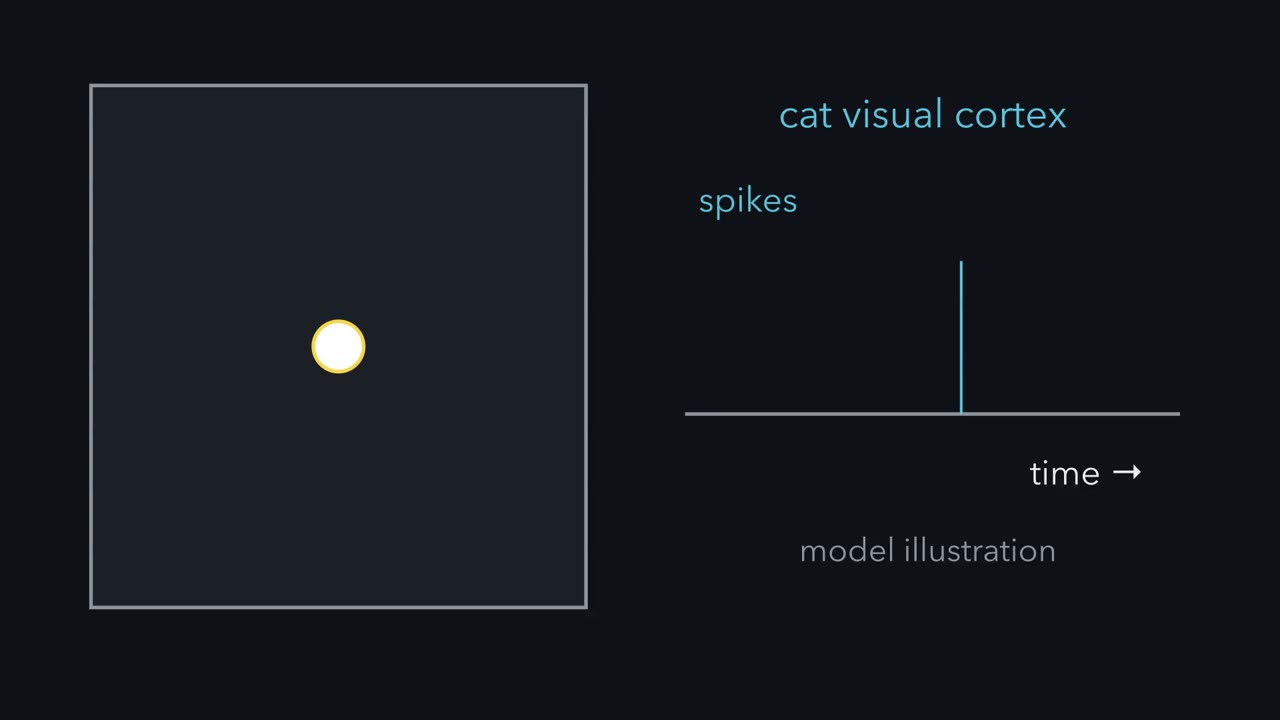
Spots of light often did little in cat visual cortex. So why would a bar at the right angle do better? David Hubel and Torsten Wiesel recorded single cells in the visual cortex of anaesthetized cats. An electrode just outside one cell counted its spikes, while light was projected onto a screen. Spots often did little. A slit or bar of light at the right angle drove some cells hard. For cells that answered small spots, they mapped the field spot by spot. In the cells they called simple cells, the field split into ON and OFF subregions. The subregions are long and narrow, side by side. A common layout is a narrow ON strip with an OFF strip on each side.
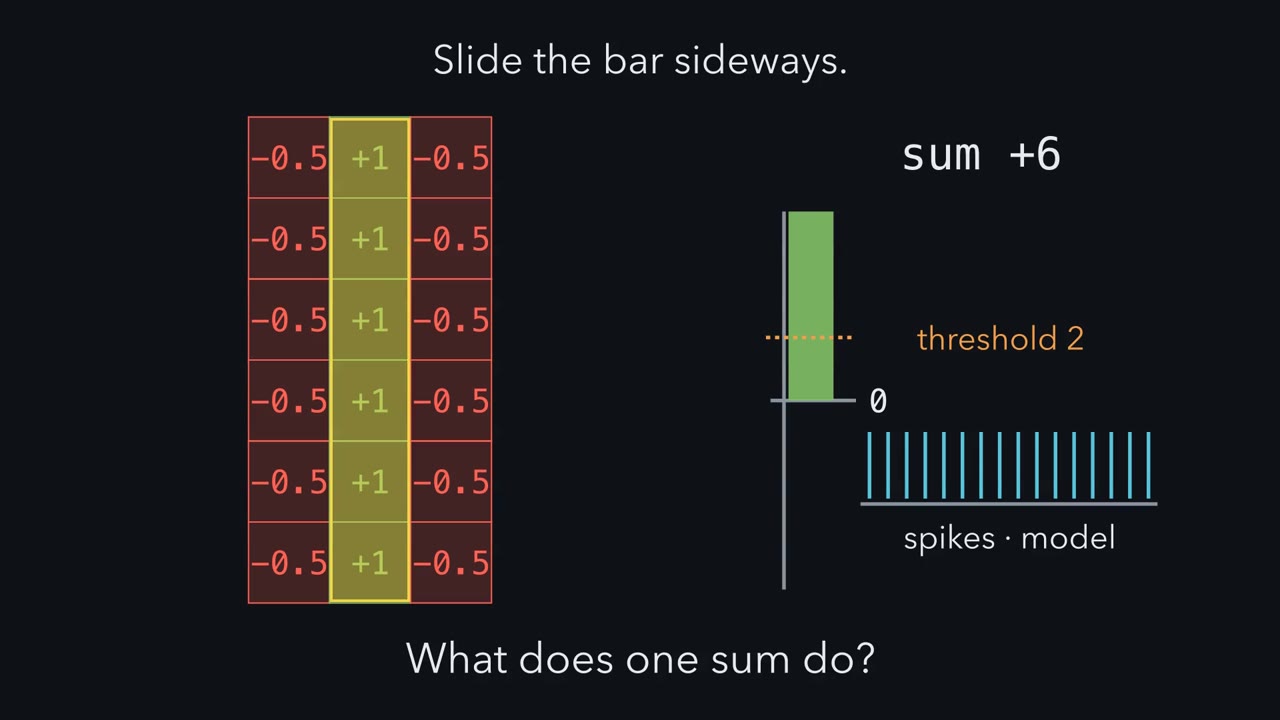
Picture the field as a grid of squares with made-up values. Plus and minus are balanced, as they roughly are in many real simple cells. Which will win: a small spot on the ON strip, or a bar lying along it? The bar wins by a wide margin. It lands on plus all along the strip. The spot collects only a little. This made-up cell fires only when the sum clears its threshold. The spot falls short. That is one reason spots often did little in cortex. Now turn the bar. It leaves the ON strip and lands on both OFF flanks, and the sum falls to near zero. Now light the whole field at once. What does the cell do?
Plus and minus cancel, so diffuse light does little. A bar along one OFF strip gives a negative sum. This toy cell is already silent. A cell with spontaneous firing would slow down. So orientation selectivity is not a separate property. To a first approximation, it comes from the shape of the field. Make the strips longer but keep them just as narrow. Now the sum falls faster as the bar turns, so tuning is sharper. The threshold sharpens tuning further. Measured spike tuning is narrower than the field's sum alone predicts. How might such a field be built? Hubel and Wiesel suggested geniculate cells with ON centres in a row, all exciting one cortical cell.
That cell gets an elongated ON strip. Their surrounds could add OFF flanks, and OFF-centre cells beside the row could strengthen them. They offered this as a suggestion. Recordings in the 1990s supported the aligned input. Exactly how the flanks are built is less settled. So a bar beats a spot because it collects plus all along the ON strip. A spot collects only a little.
Cut one optic nerve and one eye goes blind. Cut one optic tract and both eyes lose the same half of the world. Why the difference?
Continue in the lesson: Visual Cortex →
3:02 · Free, with captions and a transcript. The lesson has the full text, the questions and the sources.
More films from this lesson
How this film was made. Narration: an AI narrator voice (Kokoro, af_heart) reading narration written from this lesson's text. Animation: AI-generated in code (Manim) by Claude, a schematic with no drawn molecular structures. Captions come from the narration script. See something wrong? Report it.