Pass On the Surprise
Read the transcript of “Pass On the Surprise”
Film transcript: Pass On the Surprise
When you turn your own head, why does the reflex that steadies your head not fight you? That reflex treats head motion as a disturbance. Your own turn would look like one. Does the ear tell the two apart? In alert monkeys, canal afferents responded to both. So any cancelling must happen in the brain. Roy and Cullen recorded vestibular-only neurons, thought to drive the neck reflex that steadies the head. The brain has two clues to a self-made turn. One is the motor command, which predicts the neck's feedback. The other is the neck's actual sense of stretch. Pause and predict. A passive turn. An active turn with matching neck feedback. An active turn with mismatched feedback.
Which ones drive the neuron strongly? The passive turn did. So did the active turn with mismatched feedback. Only the matched active turn was cancelled. In this made-up example, nearly all of the response is cancelled. This is not the ear switching off. The afferents kept firing. This muting may help keep the head-steadying reflex from opposing a turn you intend. It does not mean you stop sensing your own head movements. A prediction must stay right. Brooks and colleagues recorded neurons in a cerebellar output nucleus, the rostral fastigial nucleus. Their monkeys turned their heads against a resistive load. As the animals adapted, these neurons' vestibular sensitivity fell.
When the load was suddenly removed, it rose again. These are recordings. They show what the neurons did, not that they caused the learning. Finally, a vestibular implant stimulates the canal branches of the nerve when both ears have lost their signal. It varies its pulses to represent head rotation. It does not recreate the nerve's two natural channels, and it sends no otolith signal. In eight adults, some balance measures improved. Hearing in the implanted ear fell in all but one. A cohort this small shows feasibility and a trade-off, not that the device works for everyone. The nerve reports motion on two channels. Where neck feedback matches the prediction, these head-posture neurons pass on mainly the surprise.
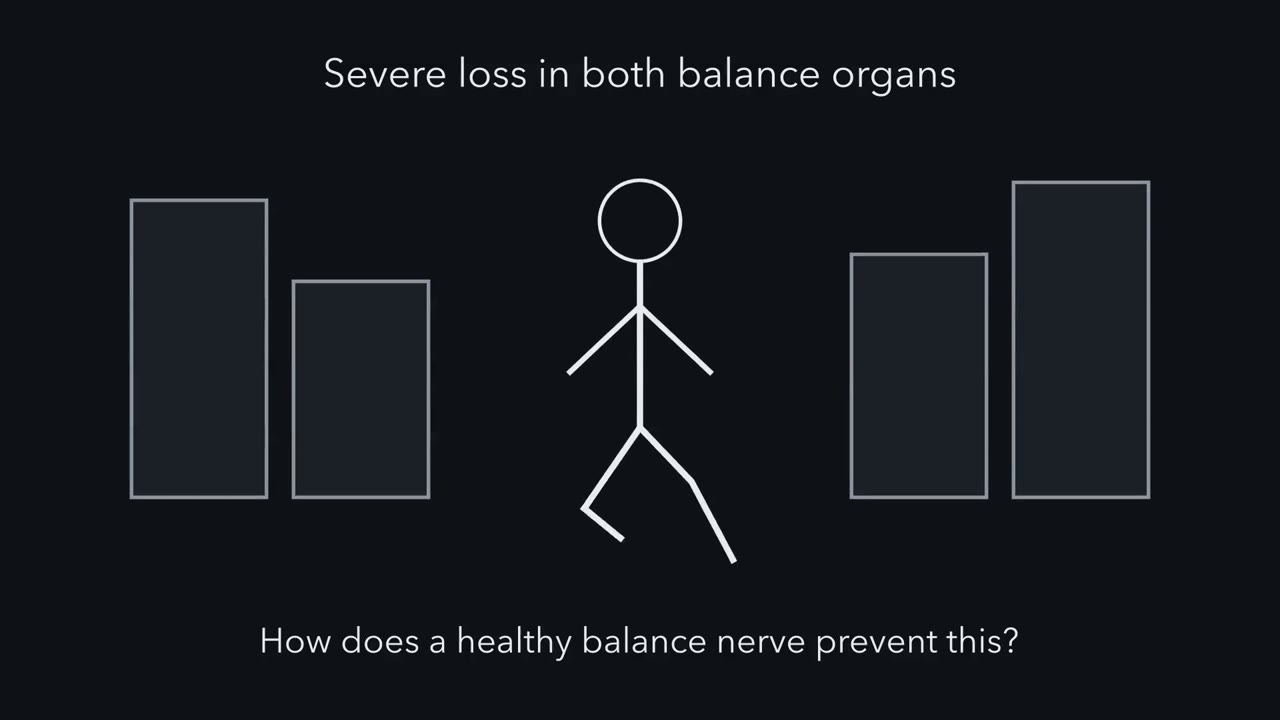
People with severe loss in both balance organs can see the world bounce as they walk. Yet in monkeys, head-motion neurons go largely quiet for a turn the animal makes itself, which may keep the head-steadying reflex from fighting it. How does one nerve report motion fast and precisely, yet let the brain set your own turns aside?
Continue in the lesson: Balance: Two Codes for Every Head Movement →
2:38 · Free, with captions and a transcript. The lesson has the full text, the questions and the sources.
More films from this lesson
How this film was made. Narration: an AI narrator voice (Kokoro, af_heart) reading narration written from this lesson's text. Animation: AI-generated in code (Manim) by Claude, a schematic with no drawn molecular structures. Captions come from the narration script. See something wrong? Report it.