Forty Microseconds: What a Fast Number Measures
Read the transcript of “Forty Microseconds: What a Fast Number Measures”
Film transcript: Forty Microseconds: What a Fast Number Measures
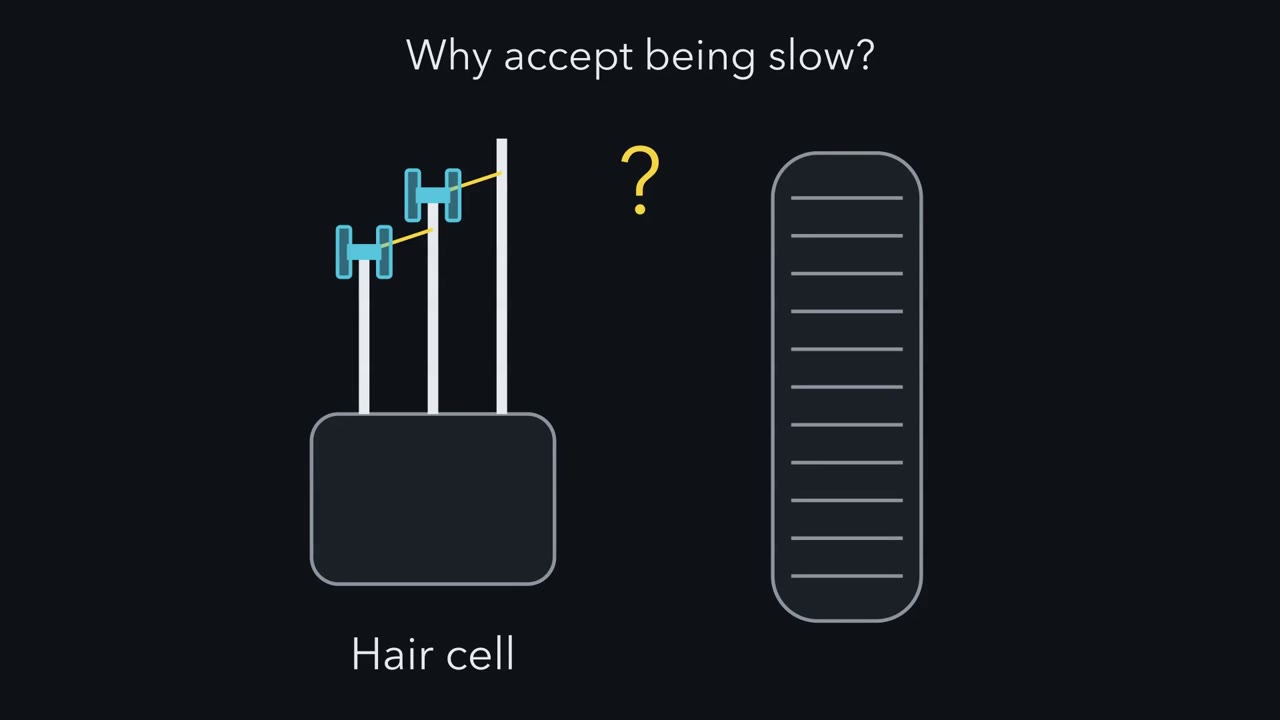
Could an enzyme step fit inside 40 microseconds? First, you need to know what that number measures. In 1979, Corey and Hudspeth moved the hair bundles of a bullfrog sacculus, in a dish. They recorded the transepithelial microphonic. That is the summed electrical response across the whole sheet of cells. The epithelium's own electrical time constant slows that signal. So the recorded delay is longer than the true one. After correcting for it, the delay was 40 microseconds, at 22 degrees Celsius. Predict. Suppose an enzyme had to make a chemical messenger between the bundle and the channel. Could the response begin that fast?
Only with great difficulty. Over a gap of nanometres, free diffusion can be fast. But that alone does not say how soon the messenger finds and binds a channel. Making it is tight too. In a simple constant-rate model, one enzyme at 4,000 turnovers a second makes, on average, only 0.16 molecule. That is about a 15 percent chance of making even one. Many enzymes could make more. To test a messenger mechanism, we would need its enzyme numbers, activation and binding rates, geometry, and the messenger level that changes the current. This is a model check, not a result of the 1979 experiment. Now, what the number is not. It is not the opening time of one channel.
And it is not a mouse number. Channel speed was measured directly later. Ricci and colleagues found time constants as short as about 50 microseconds, in turtle hair cells. So in turtle hair cells, channels do open on this time scale. The 1979 number simply measured something else. Four kinds of number are often merged. A tissue response latency is the delay of a whole population of cells. A channel activation time constant is how fast current rises in a patch or cell. A molecular gain counts output events per input event. And a behavioural latency runs from stimulus to movement, through conduction, spinal circuits and muscle. Speed can be compatible with a candidate channel.
But speed alone does not identify it. So before you compare two speeds, ask whether they are the same kind of number.
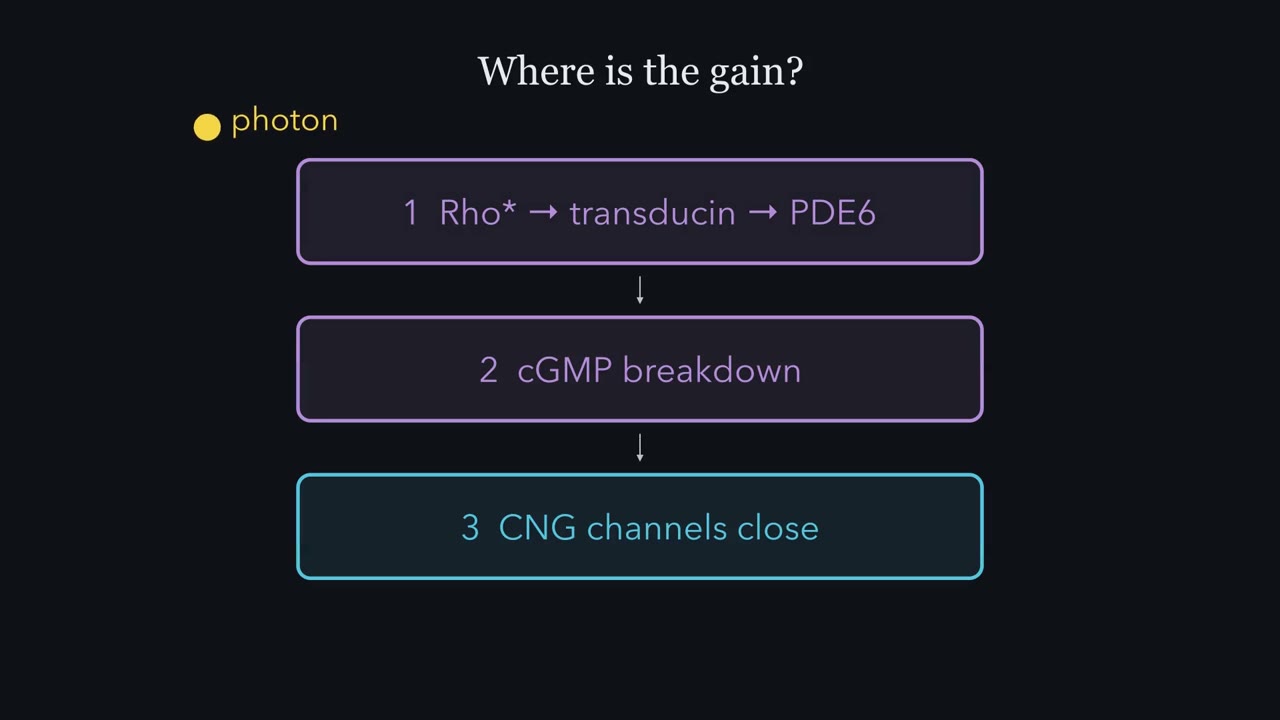
In turtle hair cells, transduction channels can activate with a time constant as short as about 50 microseconds. A rod's response to one photon takes of order a tenth of a second or more to peak, yet the rod can report that single photon. Why would a sensory cell accept being slow, and what exactly does a quoted speed measure?
Continue in the lesson: Five Ways to Turn a Stimulus into a Current →
2:48 · Free, with captions and a transcript. The lesson has the full text, the questions and the sources.
More films from this lesson
How this film was made. Narration: an AI narrator voice (Kokoro, af_heart) reading narration written from this lesson's text. Animation: AI-generated in code (Manim) by Claude, a schematic with no drawn molecular structures. Captions come from the narration script. See something wrong? Report it.