Films · Developmental Neuroscience
Two Maps from One Retina
Read the transcript of “Two Maps from One Retina”
Film transcript: Two Maps from One Retina
Does an axon read an address in its own receptor level, or its rank among the others? In a normal animal, both readings put the axons in the same order. To tell them apart, change some axons but not their neighbours. In 2000, Arthur Brown, Greg Lemke and colleagues built such a mouse. Isl2 is a gene switched on in about half of the retinal ganglion cells, scattered across the retina. They inserted the receptor EphA3 into that gene. Mouse ganglion cells do not normally make it. Now neighbours at every point in the retina differed.
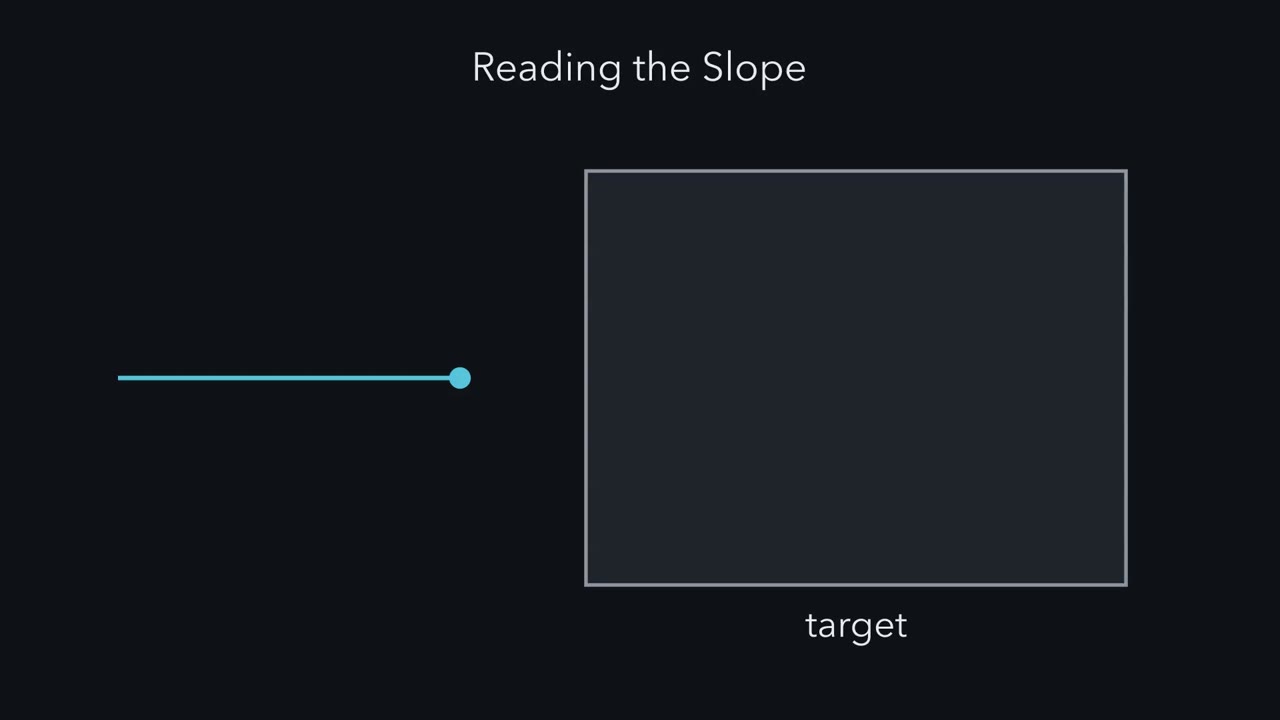
Use the toy numbers. The knock-in adds four units, so knock-in axons carry five to seven. Their unchanged neighbours carry one to three. First, the absolute reading, a fixed threshold. Where do the knock-in axons go, and their unchanged neighbours?
In the toy, the knock-in axons crowd toward the front. The unchanged axons keep exactly their normal places. Now the relative reading, in its simplest form: pure rank. Where does each group go? Every knock-in axon outranks every unchanged one. So knock-in axons take the front half, and unchanged axons the back. In mice with two copies of the knock-in, Brown and colleagues found two orderly maps. Look at the unchanged axons. Nothing about them was altered, yet they ended somewhere new. An absolute reading cannot produce that. Their place depended on the other axons.
So is the amount of ligand irrelevant? Try a thought test. Lower the ephrin-A everywhere, say by half. What does each reading predict now? The fixed threshold says the map shifts back. Pure rank says nothing moves, because no rank has changed.
Real mice with one working copy of each of two ephrin-A genes kept a normal main zone. But in some animals, temporal axons also formed an extra patch further back. Pure rank cannot give that. The amount of ligand affects how accurately axons map.
So neither toy is the whole story. In mouse and chick, the slope sets the scale. Comparison among axons sets who goes where. Slopes help lay out the coarse map. Correlated activity in the retina helps sharpen it, partly at the same time. That is the next unit.
The takeaway: an axon's place is a rank, set against a slope.
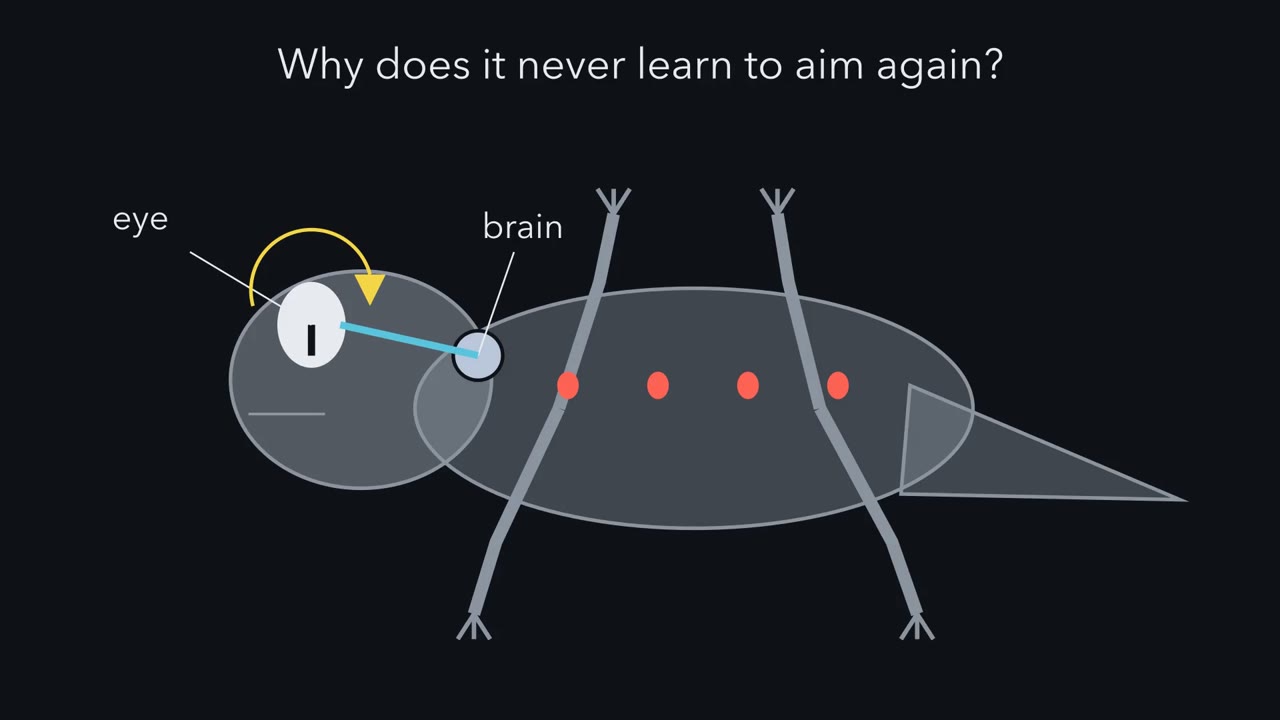
Turn a newt's eye upside down, let the nerve regrow, and it turns its head down toward a lure held above it. Why does it not learn?
Continue in the lesson: Topographic Maps: Sperry's Eye and Eph Gradients →
3:13 · Free, with captions and a transcript. The lesson has the full text, the questions and the sources.
More films from this lesson
How this film was made. Narration: an AI narrator voice (Kokoro, af_heart) reading narration written from this lesson's text. Animation: AI-generated in code (Manim) by Claude, a schematic with no drawn molecular structures. Captions come from the narration script. See something wrong? Report it.