Films · Developmental Neuroscience
Reading the Slope
Read the transcript of “Reading the Slope”
Film transcript: Reading the Slope
If Sperry was right, the target itself carries a cue. Can we ask an axon to read it? In 1987, Friedrich Bonhoeffer's group built a striped carpet. Membranes from the front and back of chick tectum lay in alternating narrow lanes. A strip of retina lay across them, so each growing axon met border after border. Where will axons from the temporal retina grow?
Temporal axons grew along the front lanes and stayed off the back ones. Nasal axons grew on both. On either membrane alone, both grew well. So the back membrane was not simply a poor surface. Now heat the back membranes first. What will the temporal axons do?
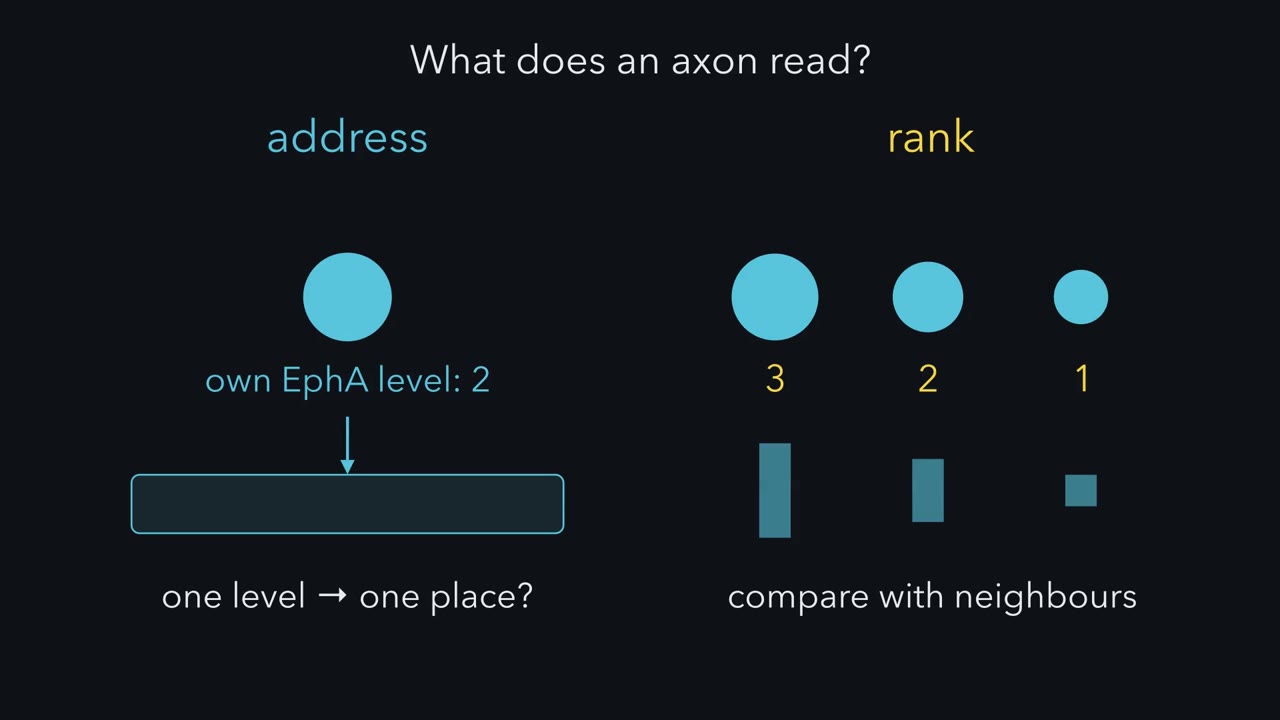
The avoidance vanished. An attractant on the unheated front lanes would have kept it. So the cue is a heat-sensitive repellent at the back of the tectum. In 1995, one paper found a repellent at the back of the tectum, now called ephrin-A5. A second paper mapped the gradient of ephrin-A2, which had been cloned the year before. Ephrin-A rises from front to back across the tectum. Its receptor, EphA, runs the opposite way, high in temporal retina. Why does more receptor mean ending at the front? Take toy numbers. Repulsion is the receptor level times the local ligand. Each axon enters at the front and grows back. It keeps its branches where the repulsion reaches the limit.
Three axons carry low, middle and high receptor. Which reaches the limit first? The axon with the most receptor hits the limit first, at the front edge. The axon with the least ends at the back. One correction. In chick and mouse, axons first overshoot their zone, then sprout side branches. Ephrin-A keeps branches from forming and surviving behind the right zone. The overshooting part is later removed. So where an axon stops means where it keeps its branches, its termination zone. The takeaway: more receptor, less ligand. In the toy, two opposite slopes put the axons in order.
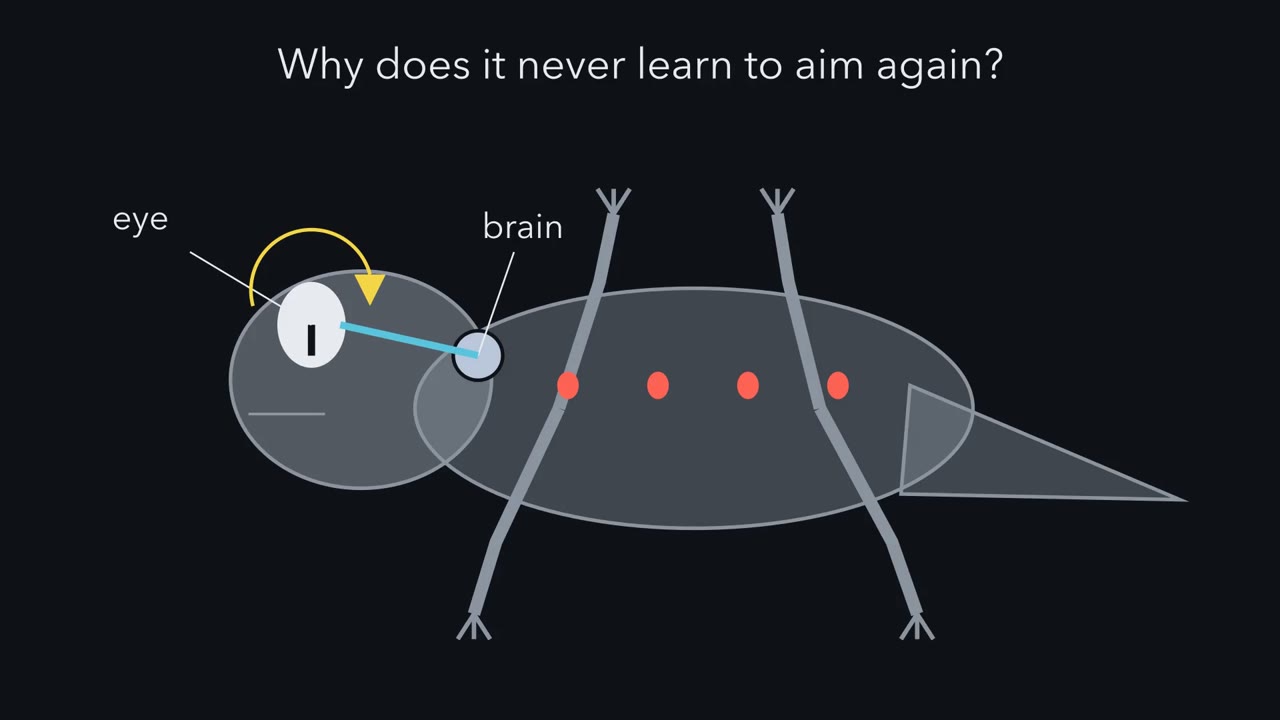
Turn a newt's eye upside down, let the nerve regrow, and it turns its head down toward a lure held above it. Why does it not learn?
Continue in the lesson: Topographic Maps: Sperry's Eye and Eph Gradients →
2:50 · Free, with captions and a transcript. The lesson has the full text, the questions and the sources.
More films from this lesson
How this film was made. Narration: an AI narrator voice (Kokoro, af_heart) reading narration written from this lesson's text. Animation: AI-generated in code (Manim) by Claude, a schematic with no drawn molecular structures. Captions come from the narration script. See something wrong? Report it.