Narrow at Threshold, Broader with Strength
Read the transcript of “Narrow at Threshold, Broader with Strength”
Film transcript: Narrow at Threshold, Broader with Strength
Does each taste fibre carry one taste, or must the brain read a pattern across many fibres? If each fibre listened only to cells of one taste, it would be a labelled line. Its activity would mean one taste. In anaesthetized mice, Barretto and colleagues imaged geniculate ganglion neurons while tastants flowed over the tongue.
Most responding neurons were strongly activated by only one of the tested tastes. One class did not fit. Some neurons responded to both bitter and sour. Two ideas. Maybe the neuron gets input from both sour and bitter cells. Or it listens only to bitter cells, and acid also activates them. The authors silenced the sour cells. Under each idea, what should happen to the bitter-sour neurons?
Sour-only responses disappeared. But the bitter-sour class was still there. And when bitter responses were blocked instead, the bitter-sour class disappeared. So the authors concluded that acid drives these neurons through bitter cells. For these neurons, the fibre reports the cell, not the chemical. Now the counter-weight. Wu and colleagues compared low and higher concentrations. Tuning broadened as concentration rose. Of the neurons tested at both strengths, most became more broadly tuned at the higher one. So narrow or broad? Imaging usually calls a neuron responsive when its signal crosses a fixed threshold. Picture a neuron with a full input from its main cell type, and a weak one from a second.
Each input saturates as concentration rises. These numbers are made up, to show the logic. At low strength, does the weak input cross the threshold? And at high strength? At low strength, the main input crosses, and the weak one stays below. The neuron looks narrow. At high strength, the weak input climbs past the line. The same neuron now looks broad.
In this model, a weak input of weight 0.2 never reaches the threshold of 0.25. Whenever the main response crosses that threshold, the neuron responds to one taste in this panel only. So in the model, neurons with different weak inputs differ. Some broaden and some do not. Wu found most broadened, but not all. Those data fit the model, but they do not show which neurons have weak inputs.
If responses were counted against the neuron's own best, and all inputs rose alike, breadth would not change. So narrow depends on the panel, the concentration and the criterion. The two laboratories' results need not conflict.
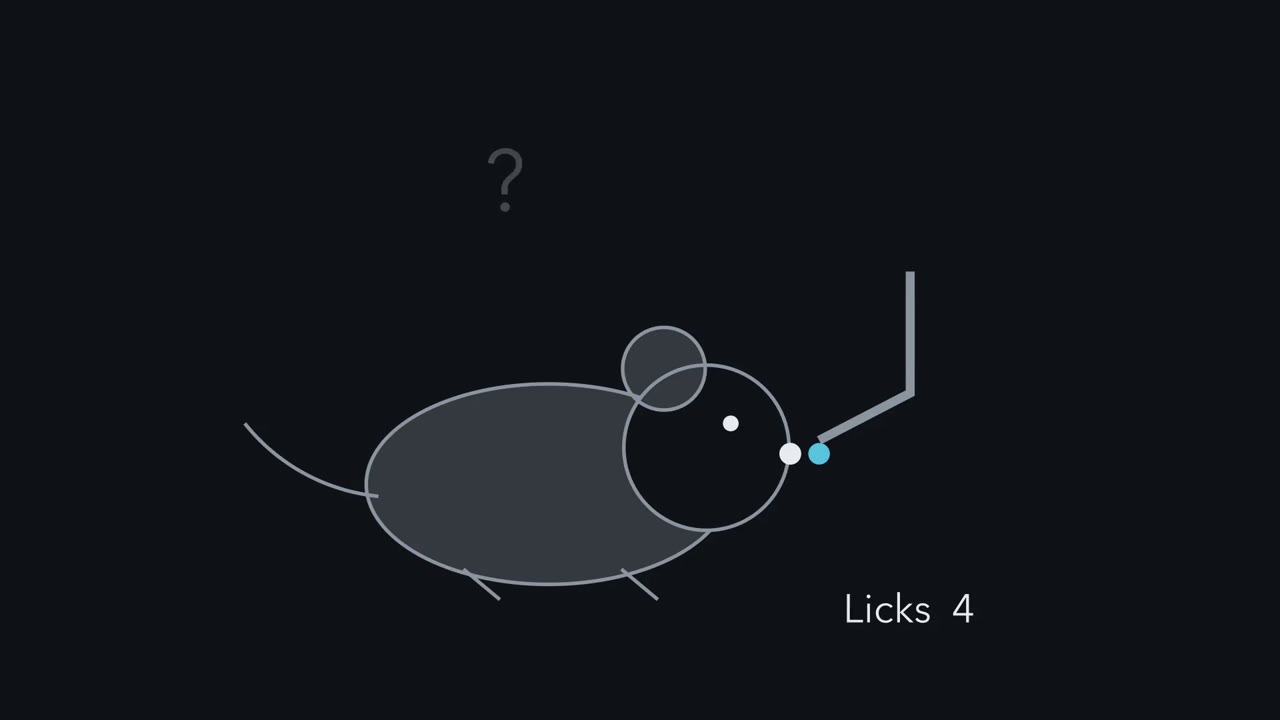
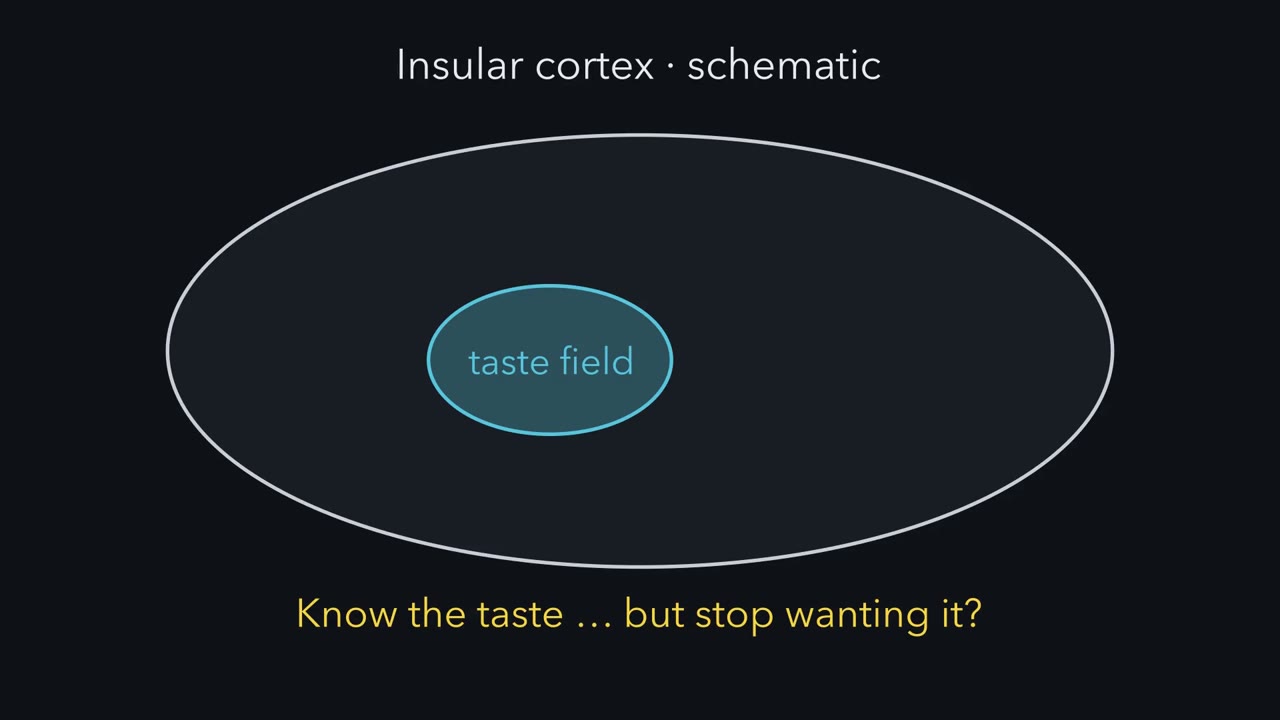
A mouse licks sugar water and keeps licking. Which taste does its brain register, and how much does the mouse want it? Are those one signal or two, and where can they be pulled apart?
Continue in the lesson: Taste from Tongue to Cortex →
3:19 · Free, with captions and a transcript. The lesson has the full text, the questions and the sources.
More films from this lesson
How this film was made. Narration: an AI narrator voice (Kokoro, af_heart) reading narration written from this lesson's text. Animation: AI-generated in code (Manim) by Claude, a schematic with no drawn molecular structures. Captions come from the narration script. See something wrong? Report it.