Films · Developmental Neuroscience
Staying in the Lane
Read the transcript of “Staying in the Lane”
Film transcript: Staying in the Lane
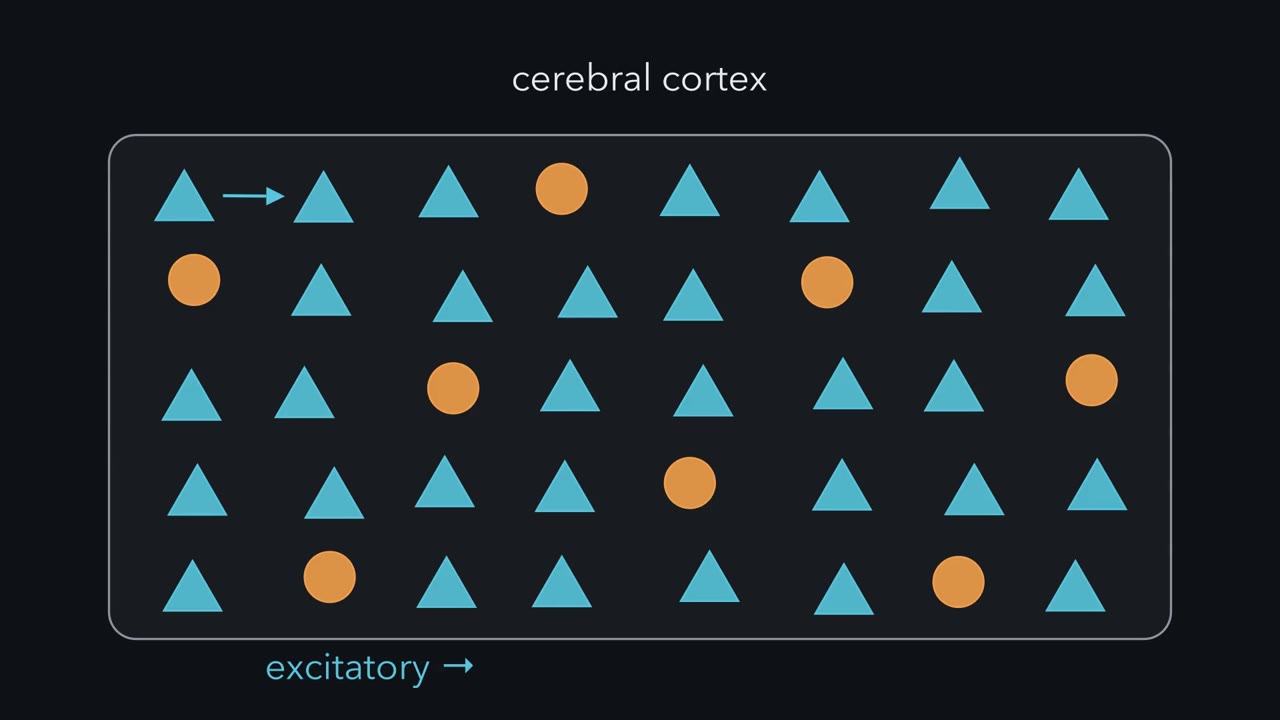
Inside the cortex, why don't interneurons dive into the cortical plate at once? Picture the young cortical wall. Under the meninges, the brain's covering, lies the marginal zone. Below it is the cortical plate. Deeper still are the intermediate zone and the subventricular zone. Interneurons travel in two streams. One runs in the marginal zone, the other deep in the subventricular and lower intermediate zones. Both lanes are lined with a chemokine, a small secreted protein first known for steering immune cells. It is called CXCL12. The meninges make it above. Dividing precursors of projection neurons make it below. The interneurons carry its receptor, CXCR4.
In a chamber assay, precursor cells moved toward CXCL12 placed on one side. Spread evenly on both sides, it gave no extra crossing of the membrane. In this assay, extra crossing needed a difference in concentration. Now take the receptor away. Where do the interneurons end up?
In 2008, two groups blocked or deleted the receptor in mice. The interneurons left their streams and entered the cortical plate early. And they spread less widely across the cortex. Many late-born cells that entered early ended up too deep, though not all did.
Early entry and narrow spread can come from one defect, not two. If cells spent the same time in the lane, moving more slowly would narrow the spread, but they would not enter early. If they leave the lane sooner, they spread less and enter early. That matches the mutants. Normal cells must leave too. Embryonic interneurons gathered near beads soaked in the chemokine. Interneurons from newborn mice did not. So to leave a lane, a cell may stop answering the signal. That compares ages, not single cells. It fits the idea but does not prove it. The cortical plate also makes Neuregulin-3. It attracts interneurons that carry its receptor, ErbB4. How the two are coordinated is still being worked out.
Then the cells turn into the plate, toward their layer. Born outside the cortex, steered by what the cell can read. In the lanes, chemokine signalling helps hold a cell in place.
In a mouse embryo, most of the neurons that will inhibit the cortex are born outside it.
Continue in the lesson: Tangential Migration: Interneurons and the Long Way Round →
2:54 · Free, with captions and a transcript. The lesson has the full text, the questions and the sources.
More films from this lesson
How this film was made. Narration: an AI narrator voice (Kokoro, af_heart) reading narration written from this lesson's text. Animation: AI-generated in code (Manim) by Claude, a schematic with no drawn molecular structures. Captions come from the narration script. See something wrong? Report it.