Films · Developmental Neuroscience
Does the Defect Travel with the Cell?
Read the transcript of “Does the Defect Travel with the Cell?”
Film transcript: Does the Defect Travel with the Cell?
How do you work out where a neuron came from, and what it needs for the trip? There are three ways to ask. Follow the cells out. Remove the source. Or swap tissue, and see which one the defect follows. First, follow. In 1996, dye placed in the lateral eminence of cultured rat embryos marked cells that reached the cortex. But dye fades, and it does not say what a cell becomes. A genetic label fixes that. Cells that switch on Nkx2.1, mostly in the medial eminence, turn on a reporter. Every descendant keeps the reporter, even after the gene turns off. In mature mouse cortex, many marked cells are inhibitory interneurons. Second, remove. In 1997, Stewart Anderson, John Rubenstein and colleagues cut mouse cortex away from the ventral forebrain.
The isolated cortex ended up with fewer cells containing GABA. They also used a knockout, a mouse with a gene disrupted in every cell. They disrupted both Dlx1 and Dlx2. These genes encode transcription factors made in the subpallium. In the mutant cortex, which neurons go missing?
The inhibitory ones. No migration from the ventral forebrain into the neocortex was detected, and few cells contained GABA. The pyramidal neurons were still made. Their progenitors do not need these genes. But a knockout lacks the genes in every cell. Is the fault in the travellers, or in the road? In 2001, the same group answered with grafts. They placed labelled pieces of eminence into forebrain slices, crossing normal and mutant tissue both ways. A normal piece in a mutant slice, or a mutant piece in a normal slice. Which fails to migrate?
Normal cells migrated into the cortex of mutant slices. Mutant cells failed to migrate into the cortex of normal slices. The defect travelled with the cells. So whatever these genes do for the trip, they do it inside the travelling cells.
The swap shows where the need lies, not how the genes act. For Dlx, the swap gives a clear answer. The defect travels with the cell.
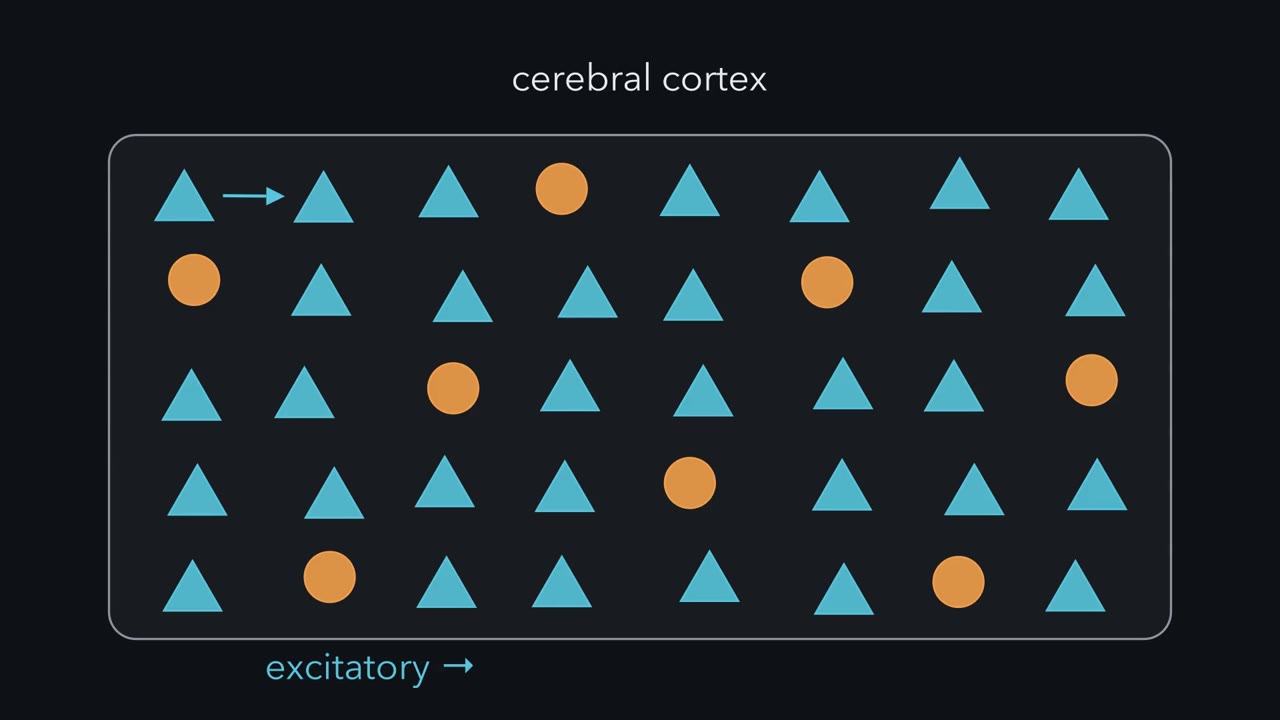
In a mouse embryo, most of the neurons that will inhibit the cortex are born outside it.
Continue in the lesson: Tangential Migration: Interneurons and the Long Way Round →
2:56 · Free, with captions and a transcript. The lesson has the full text, the questions and the sources.
More films from this lesson

How this film was made. Narration: an AI narrator voice (Kokoro, af_heart) reading narration written from this lesson's text. Animation: AI-generated in code (Manim) by Claude, a schematic with no drawn molecular structures. Captions come from the narration script. See something wrong? Report it.