Press play to start at .
Pulses and Persistence: How Timing Sets Fate
From the film
- How a stress signal unfolds over time helps decide cell fate.
- After gamma irradiation, single cells fire p53 in discrete pulses of fixed average size, more of them at higher doses, which out-of-step averaging blurs into a smooth wave on a blot.
- In one cell line, holding p53 steady with an MDM2 blocker shifted cells from recovery toward senescence, and at equal total p53 steady p53 still drove senescence genes harder.
- In the endoplasmic reticulum, stress sensors first favour repair by lowering load and adding chaperones, then shift toward death-promoting signals if stress persists.
Read the transcript of “Pulses and Persistence: How Timing Sets Fate”
Film transcript: Pulses and Persistence: How Timing Sets Fate
Tap a sentence to play from there.
- 0:02 In the first film, removing a restraint let a stress responder climb fast.
- 0:09 Once p53 rises, how does a cell choose between repair and permanent arrest?
- 0:15 Does heavier damage simply turn p53 up like a dimmer dial?
- 0:20 To find out, researchers watched one living cell at a time.
- 0:24 Grind millions of irradiated cells onto a blot, and p53 rises and fades, at most with a ripple. That dish average looks like a dial.
- 0:36 Film single living cells instead, and p53 fires separate pulses of fixed average height and width. Higher doses add more pulses on average, not taller ones.
- 0:49 Why did the blot hide those pulses?
- 0:52 Because cells pulse out of step.
- 0:55 An average equals the sum divided by the cell count.
- 0:59 Suppose four cells each peak at 80, one after another.
- 1:04 At any hour, 80 plus 0 plus 0 plus 0, divided by 4, equals 20.
- 1:10 Out-of-step flashes blend into a low, smooth wave.
- 1:15 Those pulses follow gamma rays that break both strands.
- 1:19 Do cells actually read that pulsing shape over time?
- 1:24 Researchers blocked MDM2 with a drug to hold p53 steady at about one pulse's height.
- 1:31 Same protein, same peak, only the shape differs.
- 1:36 Will the steady cells still recover?
- 1:43 Mostly not, which means shape over time steered fate, not peak height alone.
- 1:49 In the cell line studied, pulsing cells tended to recover and divide.
- 1:55 Steady cells more often entered senescence, a permanent exit from division.
- 2:01 Steady p53 also meant more in total, yet at equal totals it still drove senescence genes harder. How a stress signal unfolds over time helps decide cell fate.
- 2:13 A similar brief-versus-lasting choice happens inside the endoplasmic reticulum, where secreted proteins fold with chaperone helpers.
- 2:24 When unfolded chains pile up, three membrane sensors wake up, partly because the chaperone BiP leaves to bind the unfolded chains.
- 2:33 First they buy time for repair by slowing new protein entry and ordering more chaperones.
- 2:40 If that folding backlog drags on, those same sensors shift their message toward cell death. One branch activates a death-promoting factor called CHOP, while another signals through the stress kinase JNK.
- 2:55 Stress strength and cell state matter too, and repair and death signals can overlap.
- 3:01 Across both pathways, brief or pulsed signals favour repair, while sustained ones suggest repair is failing.
- 3:09 One snapshot of protein level misses half the story.
- 3:14 Reading the full timeline helps steer the cell between recovery and irreversible fate.
Cell stress responses: the same idea, other levels
A level is a place to start, not a rank. If this loses you, the rung below teaches the same idea, told more simply.
Graduate · the level you chose
Stress Signals: p38 and JNK, p53, Unfolded Proteins and Oxidants · this lesson
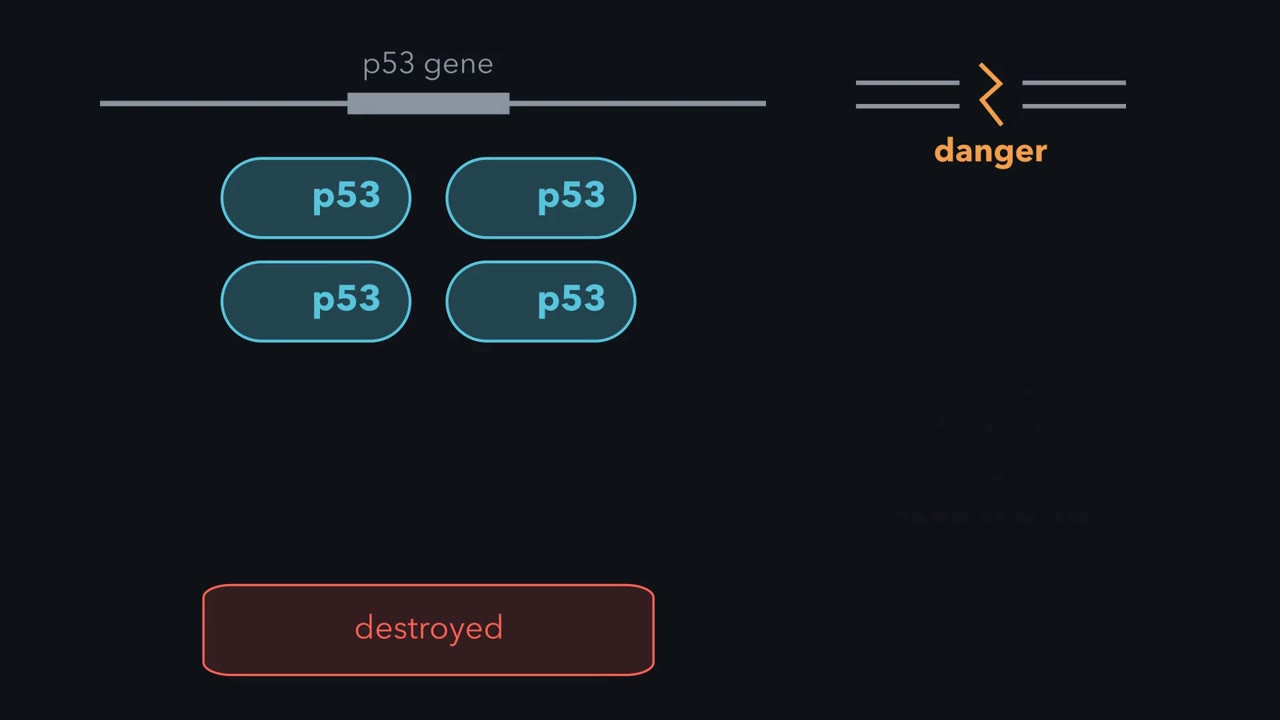
p53 made all day, half destroyed in 20 minutes; stress lifts the brake.
Cell Signaling · about 18 min · film 3:23 · 3 practice questions
Next door
- Protein quality control: Follow the Flow, Not the Pile · 4:03 · College: the core Misfolded proteins piling up in the ER is one stress that these sensors detect and answer.
- DNA repair: How DNA Chooses a Repair Route · 3:38 · College: the core DNA damage frees p53, which pauses the cell while repair enzymes fix the break.
- Programmed cell death: Why Control Comes Before the Cut · 3:22 If stress lasts too long, the same sensors switch from repair to killing the cell.
More films from this lesson
Continue in the lesson: Stress Signals: p38 and JNK, p53, Unfolded Proteins and Oxidants →
Free, with captions and a transcript. The lesson has the full text, the questions and the sources.
How this film was made. Narration: an AI narrator voice (Kokoro, af_heart) reading narration written from this lesson's text. Animation: AI-generated in code (Manim) by Claude, a schematic with no drawn molecular structures. Captions come from the narration script. See something wrong? Report it.