Films · Genetics and Molecular Biology
How DNA Chooses a Repair Route
Read the transcript of “How DNA Chooses a Repair Route”
Film transcript: How DNA Chooses a Repair Route
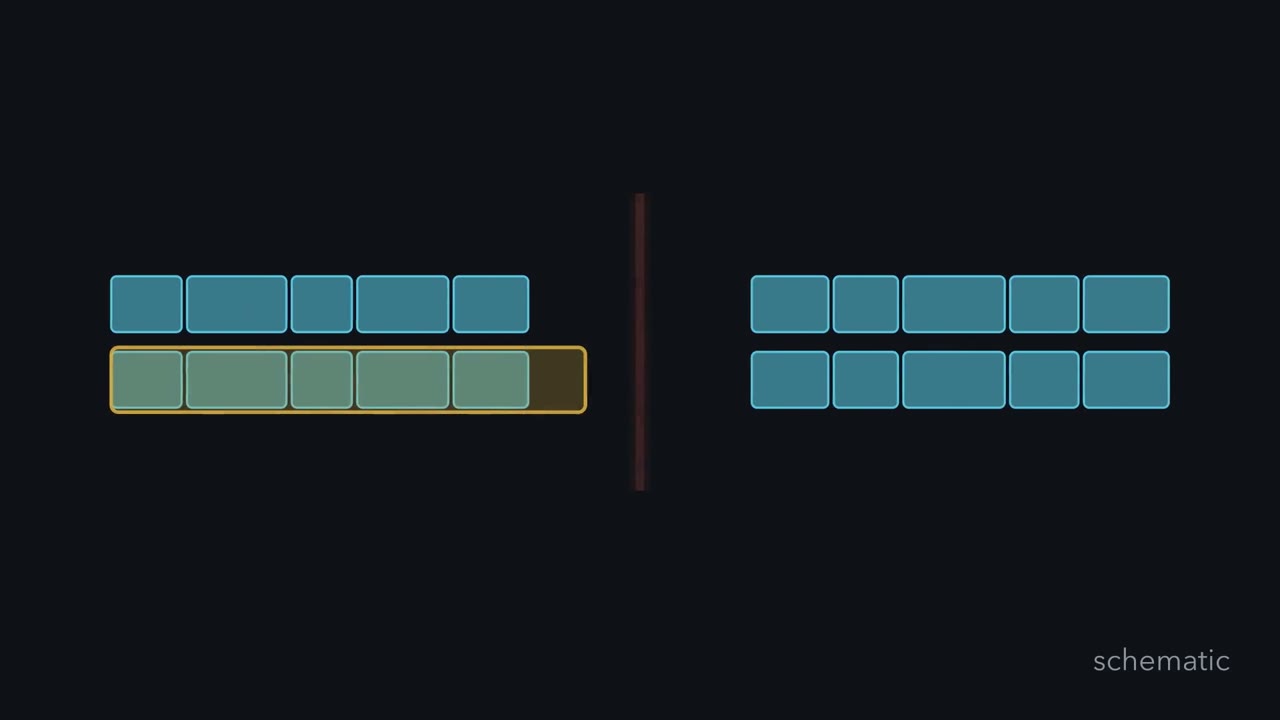
One DNA letter is wrong among billions. How can a cell repair the right spot without rewriting good DNA? Watch these two blue rows. They carry paired information. A red mark changes one block on the upper row, while the lower row stays intact. The problem's shape determines the first move.
Repair outcomes depend on what is damaged and what intact information remains. Sometimes the original base is still recognizable beneath an added chemical group. Direct reversal removes that change in place. The backbone stays uncut, and no partner strand serves as a template. This route fits only damage with chemistry an enzyme can directly undo. A small damaged base needs a different move. Base excision repair removes one block from the upper row. The lower row guides a replacement into that position, and the strand is sealed. One damaged block becomes one restored green block. Most surrounding DNA remains untouched.
Repair machinery works locally, preserving the surrounding sequence. Ultraviolet damage can join neighboring bases and bend the row. Nucleotide excision repair responds to the distorted stretch. Two cuts lift out a short patch instead of one base. The intact row guides several replacements across the gap. The same partner supplies information.
Lesion chemistry and distortion choose the pathway, which sets how much is removed. Nucleotide excision repair responds to the distorted stretch. Now both letters are ordinary, yet they pair incorrectly. Neither looks damaged. If the strands carry no history, which base should repair replace? Choose the upper block or the lower block.
The mismatch alone cannot answer. Repair needs another clue identifying the newly made strand. During replication, the template existed before the error. Signals that tell new DNA from old direct removal past the mismatch. The template then guides a corrected patch. Here, trustworthy information includes strand identity, not just the partner's letters. That extra label solves the ambiguity. Carry the same picture through the choices. A reversibly damaged base is restored in place. A small lesion loses one base. A bulky distortion loses a patch. A mismatch loses part of the strand identified as new. Each route limits its work to the problem it recognizes.
The excision routes copy the intact partner to restore the strand. If repair misses a lesion, replication may turn damage into a stable sequence change. Repair can also change sequence when information is missing. That is why finding damage is only half the problem. The cell must also know what information remains trustworthy. Follow that question whenever you choose a repair route.
If ultraviolet light joins two neighboring bases in your skin-cell DNA, how can the cell restore the original sequence?
Continue in the lesson: DNA Repair and Recombination →
3:38 · Free, with captions and a transcript. The lesson has the full text, the questions and the sources.
More films from this lesson
How this film was made. Narration: written from this lesson's text and read by an AI narrator voice (Kokoro, af_heart). Animation: AI-generated in code (Manim) by Claude, a schematic with no drawn molecular structures. Captions come from the narration script. See something wrong? Report it.