Films · Developmental Neuroscience
Timing Is the Address
Read the transcript of “Timing Is the Address”
Film transcript: Timing Is the Address
A newborn ferret's eyes have not opened yet. Even so, its retina is firing. Its ganglion cells fire bursts that sweep across the tissue as waves. Nothing is being seen. Why send this to the brain? The brain is still wiring itself. Molecules have drawn only a rough first map. In the thalamus, the two eyes' axons at first overlap. Later they separate. Two cells side by side in one eye sit at almost the same point on the gradients. So does a cell at the matching point in the other eye, though molecular cues also differ somewhat between the eyes. It still has to end up in a different territory, and the cues alone do not finish the job. Timing can sort them.
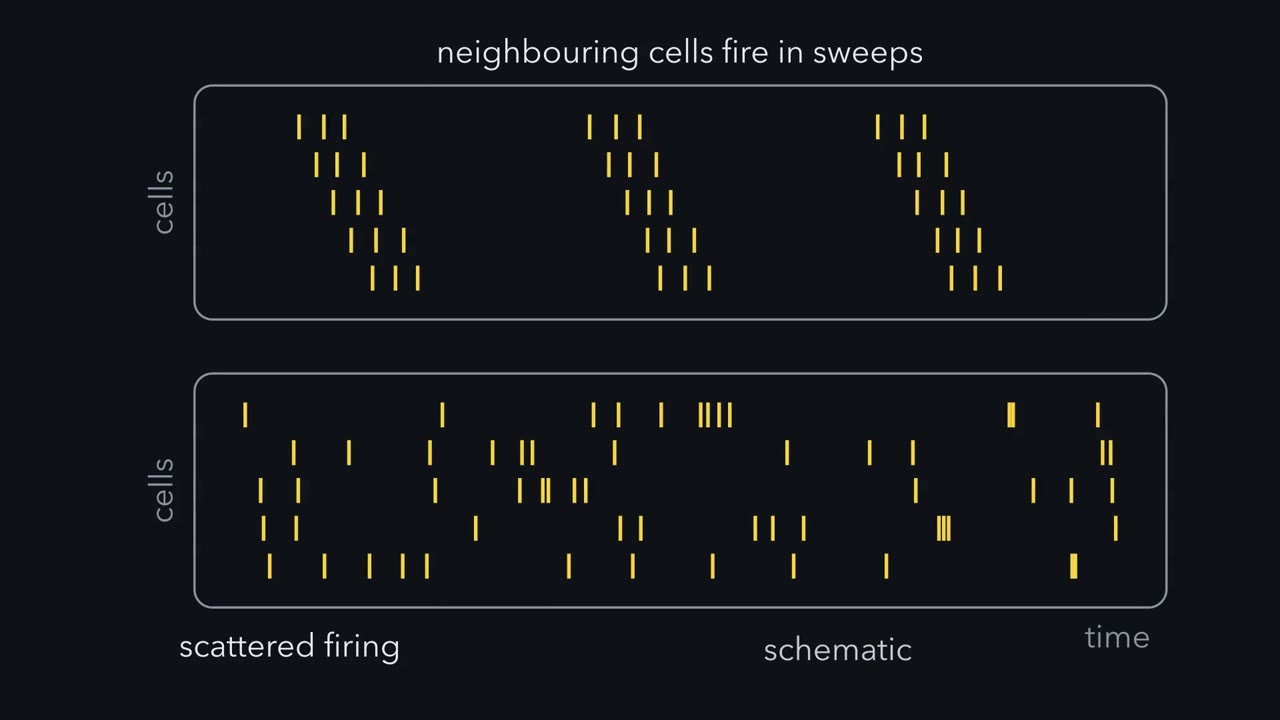
Watch a wave cross the retina at about 100 micrometres a second. Two cells this close fire almost together. Their bursts overlap almost completely. A cell a millimetre farther along the wave's path fires ten seconds later. Their bursts do not overlap. Now predict. What about a cell at the same point in the other eye?
Its waves are not timed to this eye's, so it matches only by chance, a few percent of the time. But waves start in many places and run in varying directions. So position is carried not by one cell's timing, but by how closely two cells' firing matches, over many waves. How could a target cell use that match? In 1949, the psychologist Donald Hebb proposed a rule. In paraphrase: when cell A repeatedly takes part in firing cell B, A becomes more effective at firing B. Take one thalamic cell with inputs from both eyes, each firing in its own waves. Predict: what happens to the right eye's inputs?
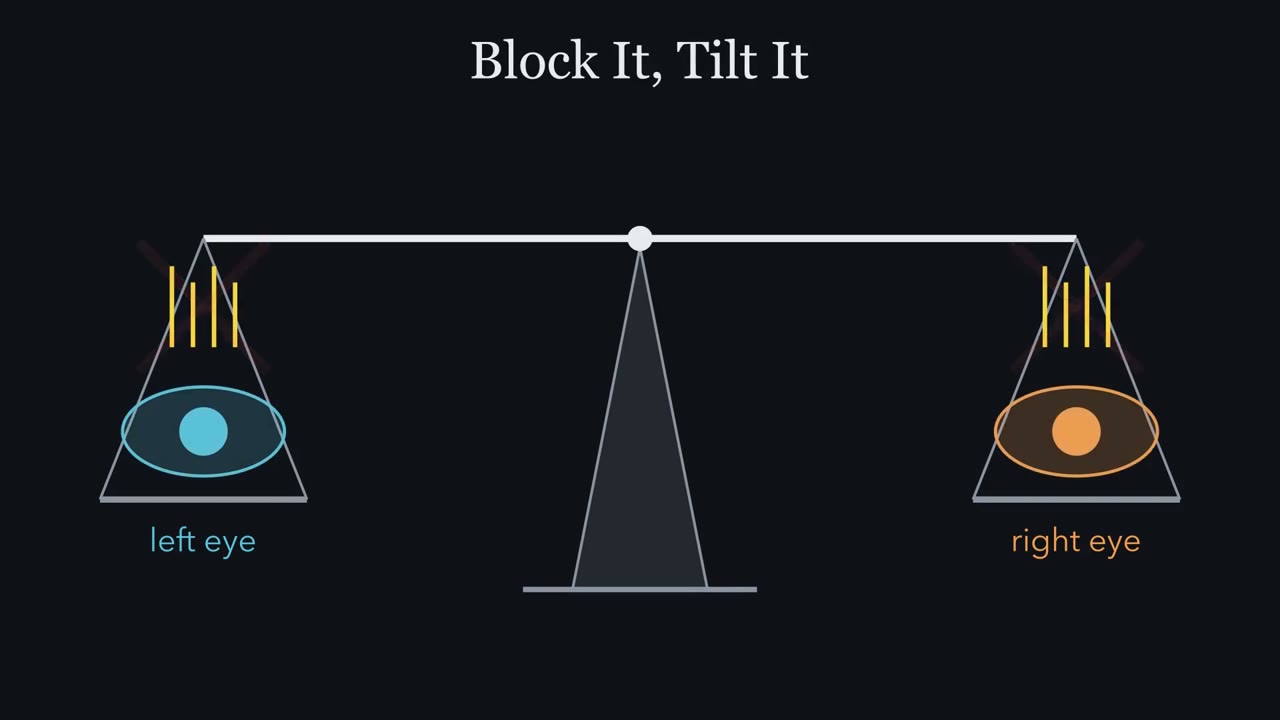
If they are strong enough to fire the cell at their own times, they strengthen too. Hebb's rule only strengthens, so the cell stays binocular. Segregation needs a second half: competition. Picture the inputs sharing a fixed budget. Each round, both eyes grow, then the same amount is taken back from each. The eye that starts slightly ahead gains more than it gives back. So it pulls further ahead. In this toy model, the other eye's inputs are pushed out of that cell. Rescale both eyes in proportion instead, and the split never changes. The kind of sharing matters. Takeaway: timing is the address. A cell keeps inputs that fire in step with its strong inputs, and they crowd out the rest.
Weeks before vision begins, the retina already fires in waves. What are they for?
Continue in the lesson: Activity Before Experience: Spontaneous Retinal Waves →
3:02 · Free, with captions and a transcript. The lesson has the full text, the questions and the sources.
More films from this lesson
How this film was made. Narration: an AI narrator voice (Kokoro, af_heart) reading narration written from this lesson's text. Animation: AI-generated in code (Manim) by Claude, a schematic with no drawn molecular structures. Captions come from the narration script. See something wrong? Report it.