Reading a Night
Read the transcript of “Reading a Night”
Film transcript: Reading a Night
Sleep pressure is highest when you fall asleep, and it drains all night. What does a recording show? Sleep is read from brain waves, eye movements and chin muscle tone. The night is cut into 30-second windows. Slower, larger brain waves mean many cortical neurons are active, then silent, in step. That happens as NREM sleep deepens. In stage N3, the deepest, large slow waves take up at least a fifth of the window. In REM sleep, the brain waves can look much like waking. The eyes and the muscles tell them apart. So where in the night will most of the deepest sleep fall?
Early, when pressure is highest. REM sleep grows toward morning, with the clock and with time already asleep. How does the brain flip? In one model, sleep-active neurons and wake-promoting groups inhibit each other. Whichever side is ahead silences the other. So the brain flips quickly, instead of drifting. Once sleep wins, pressure must drain well below where sleep began before waking can win again. That memory is one way to picture the gap between the two levels. Orexin neurons are thought to hold the switch on the wake side, like a finger holding a light switch up. In narcolepsy type 1, these neurons are severely reduced, and waking becomes unstable. Muscle tone can also fail while the person stays conscious.
Keep this. Deep sleep mainly follows the pressure. REM grows with the clock and with time asleep. A switch with a memory may explain the gap that keeps sleep in one block.
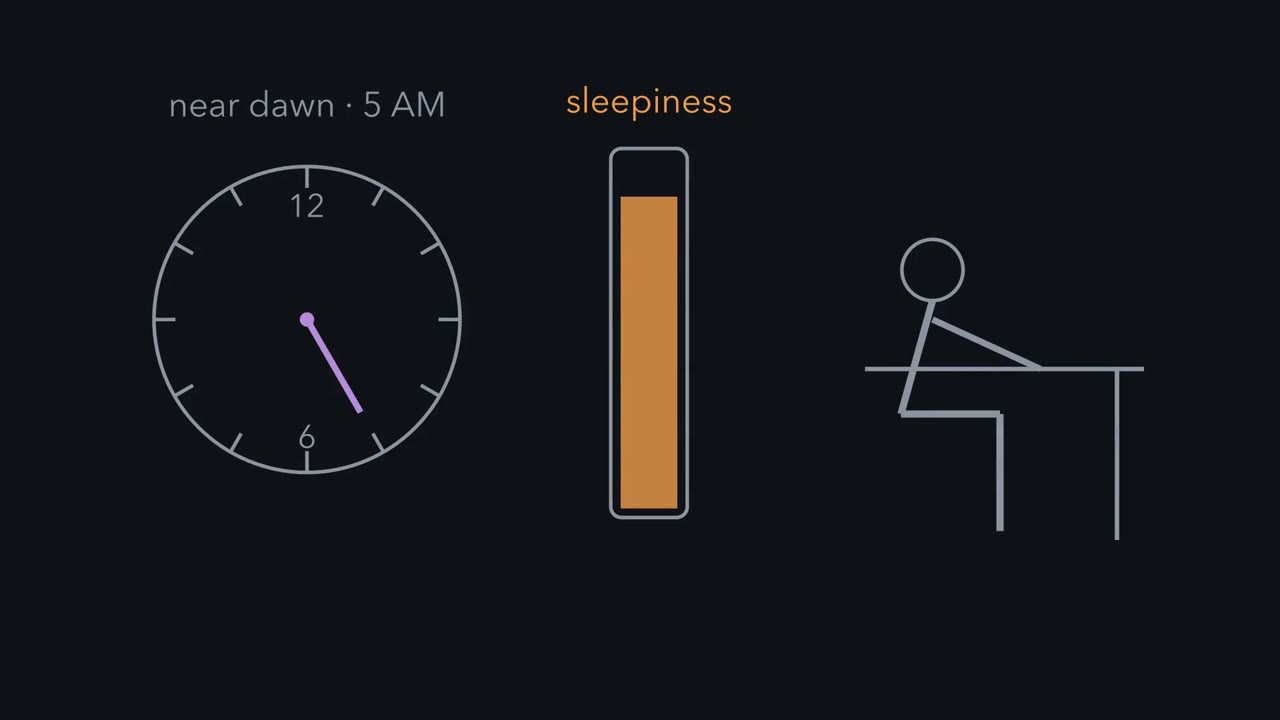
Stay up all night and you feel worst near dawn, then better by the afternoon, still without sleep. How can more time awake make you less sleepy?
Continue in the lesson: Circadian Rhythms and Sleep →
1:56 · Free, with captions and a transcript. The lesson has the full text, the questions and the sources.
More films from this lesson
How this film was made. Narration: an AI narrator voice (Kokoro, af_heart) reading narration written from this lesson's text. Animation: AI-generated in code (Manim) by Claude, a schematic with no drawn molecular structures. Captions come from the narration script. See something wrong? Report it.