Streaks and Pixels
Read the transcript of “Streaks and Pixels”
Film transcript: Streaks and Pixels
Put a grid of electrodes on the retina. Do you get a grid of dots? The Argus II tried it. A camera drove 60 electrodes on the inner surface of the retina. But ganglion cell axons run across that inner surface, toward the optic disk. Predict. Axons from elsewhere run under one electrode. What does the person see when it fires?
Often not a dot. Four implant users drew elongated or distorted shapes. Each passing axon carries signals from a ganglion cell that reports a different part of the visual field. Recruit cells along a bundle, and a stretch of visual locations can be activated at once, which can produce a streak. A model of axon pathways accounted for the shapes. It is a model-supported explanation, not a recording. The current reaches neurons whose place on the map is somewhere else. So move the electrode away from the axons, and keep each field small. The PRIMA chip does both. Near-infrared light powers its pixels. Each pixel stimulates bipolar cells, and a local return electrode confines its field.
Acuity is scored in logMAR. 0 is 20/20. 1.0 is 20/200. Higher is worse. Predict. Each pixel is 100 micrometres across. If its field stays within the pixel, what acuity could it give? The conversion is on screen. The pixel limit is near 1.32 logMAR, about 20/420.
In the PRIMAvera trial, mean acuity at the implant's own resolution was 1.32 logMAR. The measured mean sits near the pixel limit. Eyes differ in size, so treat it as agreement, not a precise prediction. For the Argus II, an ideal grid would give about 20/2400. Yet its best reported grating acuity was about 20/1260. So this is an estimate, not a hard limit. Two cautions. A zoomed score adds a magnifier, not pixels. And serious device- or procedure-related events came with the benefit. Optogenetics changes the cells instead. Ganglion cells are made to express a light-gated channel, ChrimsonR. Goggles supply the bright amber light, and part of the encoding the retina would have done.
With the goggles, one patient located, counted and touched objects. Without them, the patient did not detect objects. Where current reaches the wrong neurons, percepts can be distorted. PRIMA's mean acuity sits near its pixel limit, as its design aims for. With optogenetics, the goggles' light decides which cells are driven.
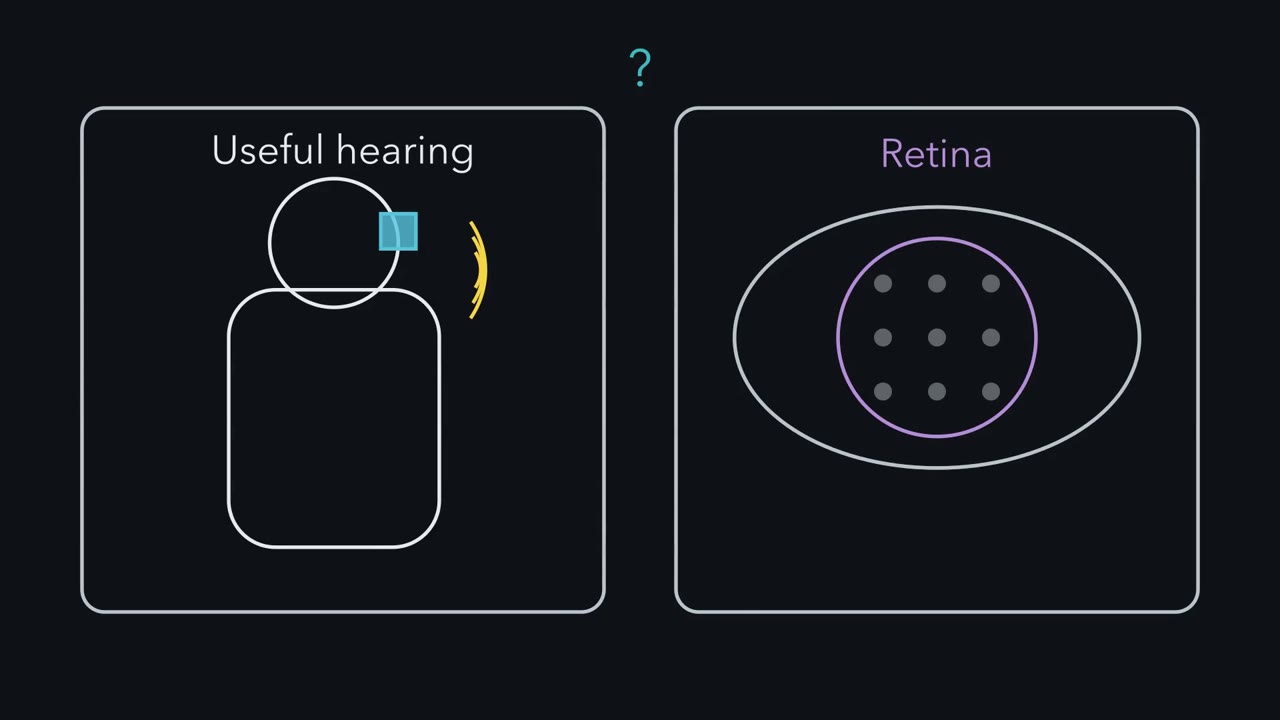
A cochlear implant skips the damaged hair cells and talks to the auditory nerve, and it gives many deaf adults useful hearing. The same idea in an epiretinal implant often gives streaks, not pixels. What decides how much detail a prosthesis can deliver?
Continue in the lesson: Restoring Senses: Implants, Prostheses and Optogenetic Vision →
3:17 · Free, with captions and a transcript. The lesson has the full text, the questions and the sources.
More films from this lesson
How this film was made. Narration: an AI narrator voice (Kokoro, af_heart) reading narration written from this lesson's text. Animation: AI-generated in code (Manim) by Claude, a schematic with no drawn molecular structures. Captions come from the narration script. See something wrong? Report it.