Contacts Are Not Channels
Read the transcript of “Contacts Are Not Channels”
Film transcript: Contacts Are Not Channels
A cochlear implant gives many adults with severe hearing loss useful hearing. The same idea in the eye often gives streaks, not pixels. Why? The implant skips damaged hair cells and excites the auditory nerve along the cochlea's map. High frequencies go to the base, low toward the apex. A contact is hardware on the array. A channel is a band of frequencies. Truly separate channels need separate groups of neurons. Predict. Take 22 contacts, spanning about 16 mm. Each contact's current spreads through fluid and bone. How many non-overlapping stretches fit along the array?
About nine, far fewer than 22. Neighbouring fields overlap and excite the same neurons. This is called channel interaction. The spread was picked to land near real data, so this illustrates the idea rather than testing it. In 18 implant users, speech recognition plateaued at 8 to 10 channels. Channel interaction is one main reason. Neural survival and how far the array reaches matter too. Here is the one idea. A prosthesis delivers detail only as far as it drives distinct groups of neurons.
So a count of contacts is not a count of channels. That has to be measured, by testing what the listener can tell apart. Test it. Some arrays are precurved, shaped to hug the inner wall, close to the nerve cell bodies in the cochlea's core. Predict. If spread sets the limit, what should a well-placed precurved array allow?
More usable channels. In an earlier cohort from the same group, those listeners kept improving past 10. The plateau group had straight arrays, or precurved arrays that crossed into the upper chamber. Those generally sat farther from the nerve.
So there is no single channel number. It depends on the listener, the placement and the test. None of this means the implant works poorly. In 96 adults, word scores rose by 40.5 percentage points. That was with the implant plus a hearing aid in the other ear. So ask how distinctly a device drives separate groups of neurons, and test what the listener can tell apart.
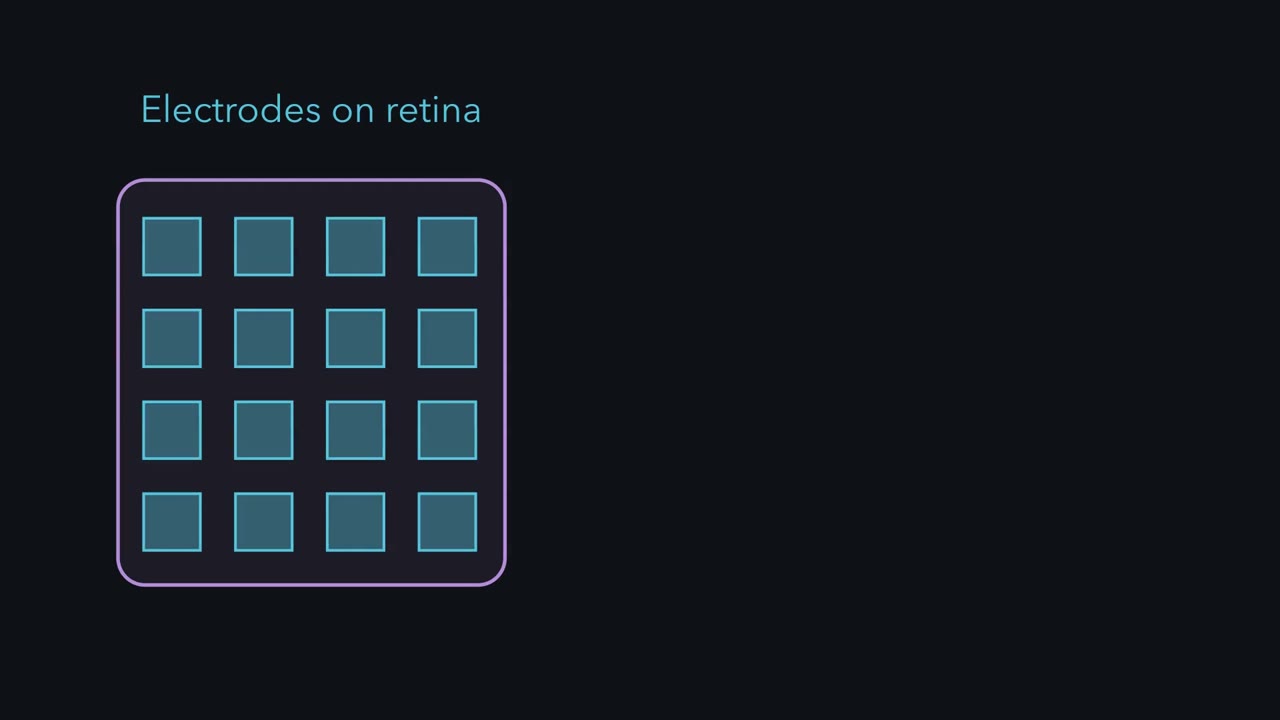
A cochlear implant skips the damaged hair cells and talks to the auditory nerve, and it gives many deaf adults useful hearing. The same idea in an epiretinal implant often gives streaks, not pixels. What decides how much detail a prosthesis can deliver?
Continue in the lesson: Restoring Senses: Implants, Prostheses and Optogenetic Vision →
2:51 · Free, with captions and a transcript. The lesson has the full text, the questions and the sources.
More films from this lesson
How this film was made. Narration: an AI narrator voice (Kokoro, af_heart) reading narration written from this lesson's text. Animation: AI-generated in code (Manim) by Claude, a schematic with no drawn molecular structures. Captions come from the narration script. See something wrong? Report it.