Films · Developmental Neuroscience
Same Cue, Opposite Answers
Read the transcript of “Same Cue, Opposite Answers”
Film transcript: Same Cue, Opposite Answers
Is repulsion a fixed property of Sema3A? Or can the growth cone change the answer? Song, Poo and colleagues grew single frog spinal neurons in a dish. A fine pipette set up a small gradient of Sema3A beside one growth cone. The growth cone turned away. Now raise cyclic GMP inside the growth cone. Same pipette, same gradient. What happens?
The growth cone turned toward the Sema3A. The gradient did not change. The reader did. Cyclic GMP is a second messenger made by guanylate cyclases. Here, its level sets the sign of the answer. A similar switch, with cyclic AMP, governs netrin. Does a living neuron use this switch? Look at the developing cortex. Sema3A is high near the pial surface, the outer surface of the brain. It repels the axons of cortical neurons downward. But the apical dendrite of the same neuron grows up, toward it. Why the difference? Soluble guanylate cyclase, an enzyme that makes cyclic GMP, sits mainly in the developing dendrite. It is needed for that attraction.
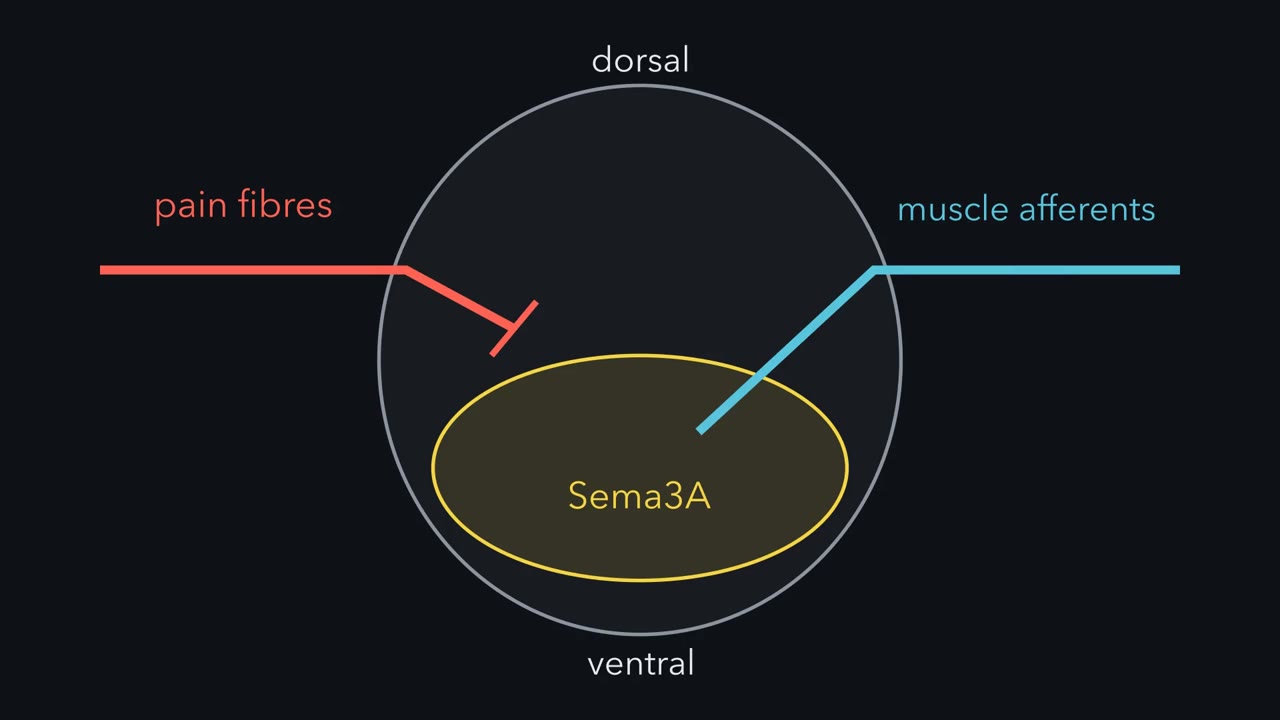
One cue, one neuron, two answers, set by where the enzyme is. Now replay the rule. The cue marks the place. The growth cone decides what it means. The pain fibre and the muscle afferent differ in how strongly they answer the cue. The axon and the dendrite differ in which way they answer. For a repelled growth cone, a pipette gradient typically gives a turn. A strong dose in a bath can give a collapse, where the preparation supports it. The takeaway: semaphorins keep axons out of wrong places. But only axons that can hear them, and only in the sense their state allows.
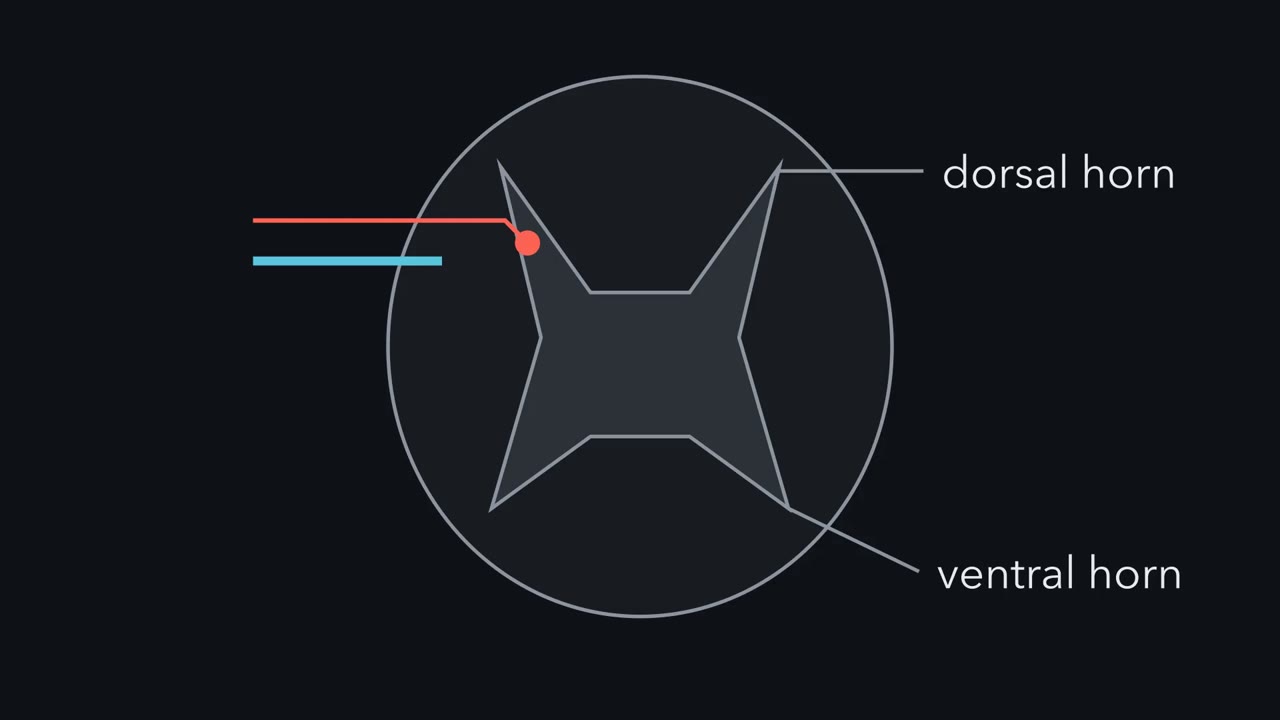
Pain fibres and muscle afferents enter the spinal cord side by side. One kind stops in the dorsal horn; the other runs on to the motor neurons. What sorts them?
Continue in the lesson: Semaphorins and Repulsion →
2:14 · Free, with captions and a transcript. The lesson has the full text, the questions and the sources.
More films from this lesson
How this film was made. Narration: an AI narrator voice (Kokoro, af_heart) reading narration written from this lesson's text. Animation: AI-generated in code (Manim) by Claude, a schematic with no drawn molecular structures. Captions come from the narration script. See something wrong? Report it.