Films · Developmental Neuroscience
One Tissue, Two Axons, One Receptor
Read the transcript of “One Tissue, Two Axons, One Receptor”
Film transcript: One Tissue, Two Axons, One Receptor
Sema3A is made in the ventral cord. Pain fibres stay out, and muscle afferents go in. Is the difference in the cue, or in the axons? Here is the test. Set a dorsal root ganglion in a collagen gel, beside a piece of ventral cord. Grow it once with nerve growth factor and once with neurotrophin-3 (NT-3). The medium largely decides which neurons grow. Where will the axons grow in each dish?
With NGF, the pain fibres grow. They grow poorly on the side facing the cord. The ring of axons, the halo, is lopsided. With NT-3, the muscle afferents grow. Their halo is nearly round. Same tissue, two answers. Messersmith, Kolodkin and colleagues found this pattern in rat explants. Cells secreting Sema3A did the same.
So how does a growth cone hear Sema3A? Two groups found the receptor independently. It was neuropilin. Neuropilin binds Sema3A tightly. But its tail inside the cell is short, with nothing like an enzyme. Where is the wire? Two more groups pointed to the plexins. These membrane proteins have a large part inside the cell. In engineered cells, neuropilin alone binds the cue, but the cell does not respond. With plexin as well, binding is tighter. Now the cells shrink and round up.
Other work tested neurons, which keep their other receptor parts. There, a neuropilin with no inner tail still let growth cones collapse. Now give sensory neurons extra plexin with its inner part cut off. They still have their own normal plexin. What happens?
The response is blocked. The broken plexin interferes with the cell's own working receptors. One likely idea: it joins neuropilin and the cue in complexes that cannot signal. A mutant that blocks the normal protein this way is called a dominant negative. So neuropilin catches, and plexin signals.
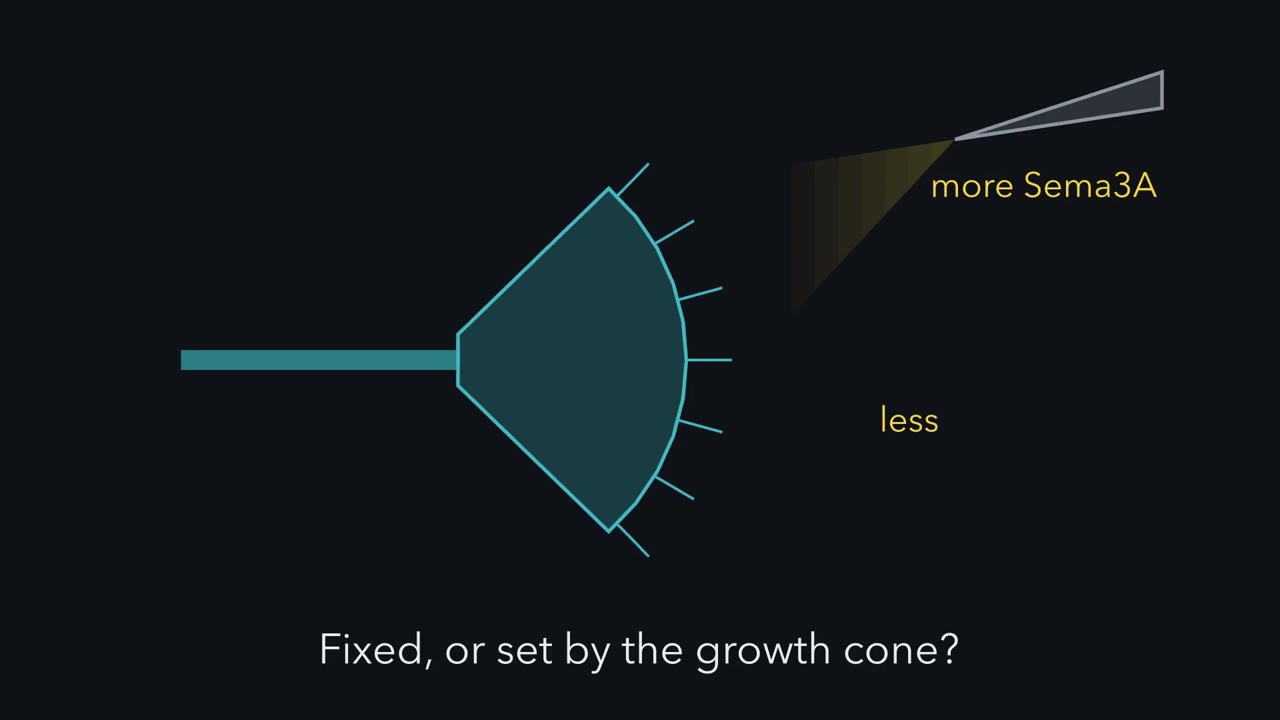
Inside, the plexin switches off a small GTPase of the Ras family. That protein helps integrins grip the surface. Other plexin pathways act on actin and microtubules. Together, the growth cone loses grip and actin. In a growth cone that Sema3A repels, where this happens shapes what you see. Typically, a gradient from one side turns it away, and a strong dose all round can fold the fan up, in preparations that support collapse.
The takeaway: for Sema3A, the working receptor is neuropilin and plexin together. No pair, no answer in these experiments.
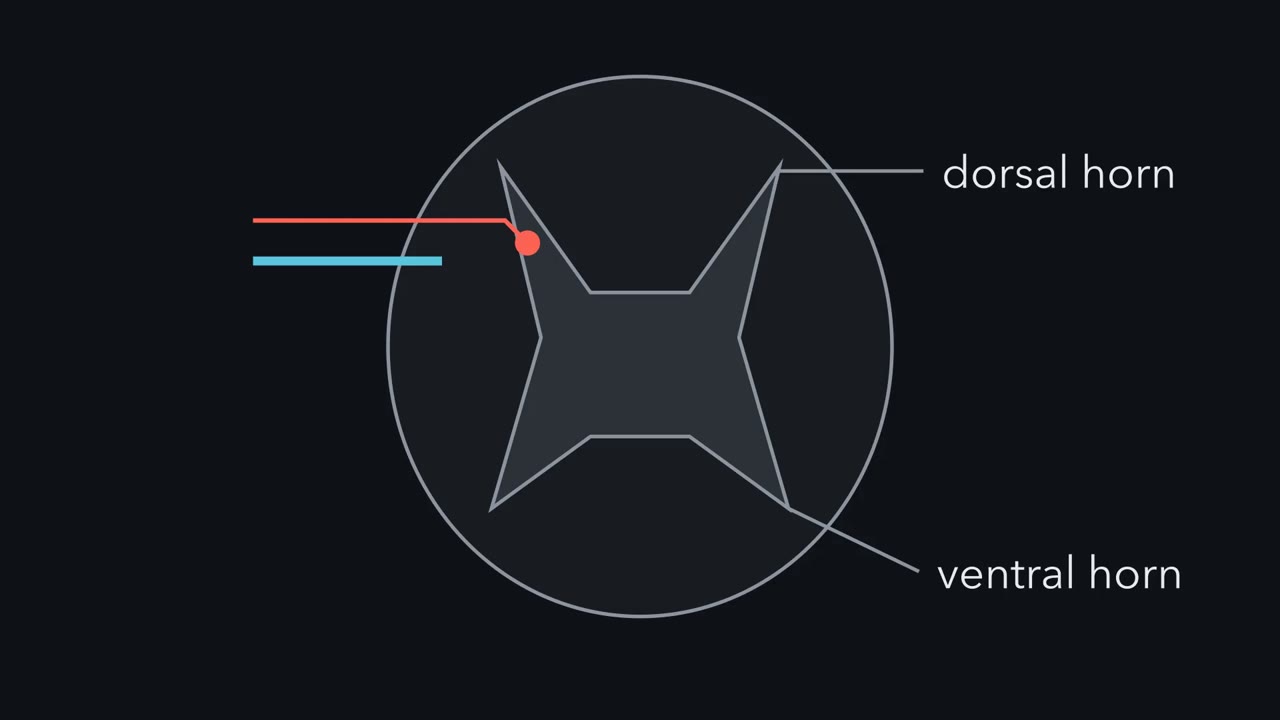
Pain fibres and muscle afferents enter the spinal cord side by side. One kind stops in the dorsal horn; the other runs on to the motor neurons. What sorts them?
Continue in the lesson: Semaphorins and Repulsion →
3:21 · Free, with captions and a transcript. The lesson has the full text, the questions and the sources.
More films from this lesson
How this film was made. Narration: an AI narrator voice (Kokoro, af_heart) reading narration written from this lesson's text. Animation: AI-generated in code (Manim) by Claude, a schematic with no drawn molecular structures. Captions come from the narration script. See something wrong? Report it.