One Type or Two? Four Ways to Count
Read the transcript of “One Type or Two? Four Ways to Count”
Film transcript: One Type or Two? Four Ways to Count
An analysis draws a group around some cells. Is it one type, or two? Recall the idea. A real type usually spaces its cells out in its own mosaic. Here is one type. Its cells keep their distance, and its arbors overlap. The coverage factor is the number of arbors over an average point. Now pour in a second type, placed independently. Colour every cell the same. Predict. Treated as one type, what happens to the spacing, and to the coverage?
The spacing usually turns patchy. A cell of one type can sit right beside a cell of the other. And the coverage adds up, so it reads higher than either type's own. So an unusually high coverage can be a sign that two types were merged. But some real types are only weakly regular. A mosaic is strong support, not a strict rule. Each census method tests a different part of the rule. Imaging grouped cells by light response, and found at least 32 types. RNA sequencing grouped cells by gene expression, and ended with 46. One cluster held two direction-selective types already known from function. Clustering alone had missed them. Another team recorded spikes and found 42 functional types.
For some cells, they also read that same cell's RNA or shape. There, three sustained ON direction-selective types shared one RNA cluster, called C10. Electron microscopy of one small patch supported at least 35 types. These are not rival answers. Each reflects a method, a preparation and a resolution. The most trustworthy types are the ones that more than one method finds. A primate needs its own census. In the macaque fovea, one red or green sensitive cone feeds its own midget bipolar cells. That private centre keeps fine spatial detail. Midget clusters made up about 85% % of sampled foveal ganglion cells. Shared ancestry with mouse cells does not mean a shared size, frequency or job.
Combine the evidence. A separate mosaic strengthens the case for a type, but it is not required.
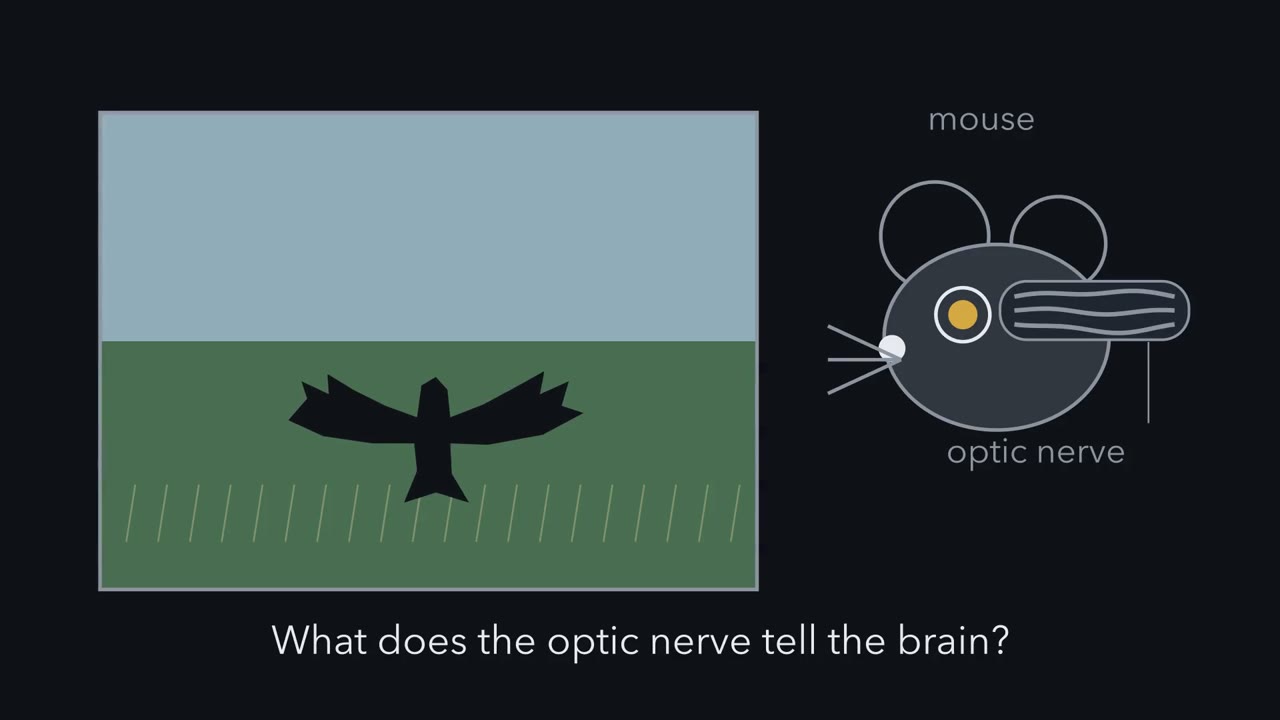
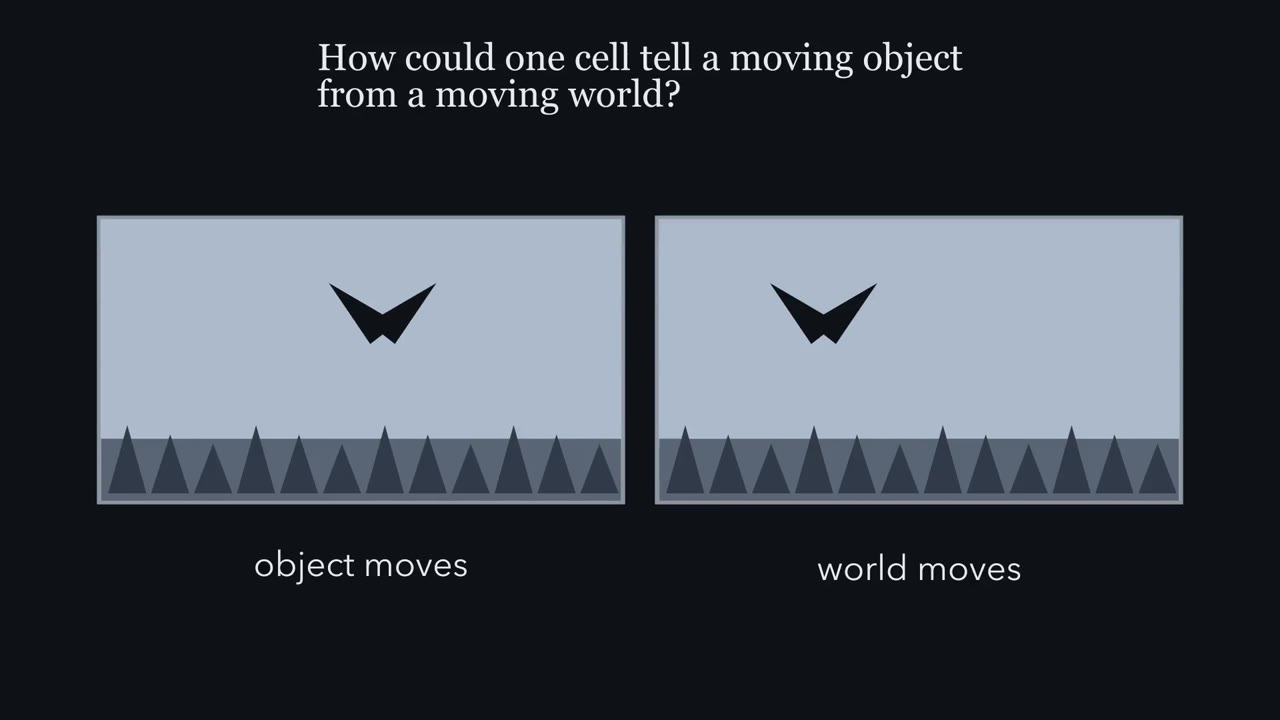
A hawk's shadow slides across a meadow. What does a mouse's optic nerve tell its brain about it? Not a picture: more than 40 kinds of ganglion cell each report the scene through their own filter.
Continue in the lesson: Parallel Channels Out of the Eye →
2:38 · Free, with captions and a transcript. The lesson has the full text, the questions and the sources.
More films from this lesson
How this film was made. Narration: an AI narrator voice (Kokoro, af_heart) reading narration written from this lesson's text. Animation: AI-generated in code (Manim) by Claude, a schematic with no drawn molecular structures. Captions come from the narration script. See something wrong? Report it.