The Cell That Ignores the World Moving
Read the transcript of “The Cell That Ignores the World Moving”
Film transcript: The Cell That Ignores the World Moving
How could one cell tell a moving object from a moving world? In 2012, Zhang and colleagues recorded from W3 cells in isolated mouse retina. Start with a spot. Brighten a small spot over the cell, and it fires. Dim the same spot, and it fires again. The cell takes excitation from the ON pathway, driven when light goes up, and from the OFF pathway. So a change of either sign excites it. The two inputs add rather than cancel. Now motion. A small textured patch moves over the cell's centre, and the background stays still. The distant surround is a wide ring far outside the centre. The cell fires many spikes. Say 40. Now the whole scene moves together.
The centre gets exactly the same stimulus. Predict. If the cell listened only to its centre, what would it do now? It would fire just as much. It does not. It falls nearly silent. Say 3 spikes. So motion far out in the surround must be silencing it. Zhang and colleagues found that this happens in two places at once. Part is presynaptic. The excitation is suppressed before it reaches the cell, so less of it arrives. Part is postsynaptic. Inhibition lands on the W3 cell itself. Older work on similar cells in other species proposed wide-field amacrine cells as the source of this kind of suppression. Where does the excitation come from? Much of it does not come straight from bipolar cells.
It arrives through the VG3 amacrine cell, an excitatory amacrine cell. So the circuit that builds the selection starts before the ganglion cell sees the signal. Two amacrine cells, two jobs. VG3 brings excitation in. Wide-field cells are the proposed brake. A W3 cell answers one question. Is something small moving differently from everything else? When the eye or head turns, the whole image slides together. The authors proposed these cells as alarm neurons for overhead predators. That is a hypothesis. The experiments used isolated retina, and no behavioural test of necessity was done. A second channel is the JAM-B cell, an OFF cell. Most labelled cells had a lopsided dendritic arbor.
These lopsided cells preferred movement from the cell body toward the dendrites. The filter is built inside the retina. The scene motion this cell ignores still travels in other channels.
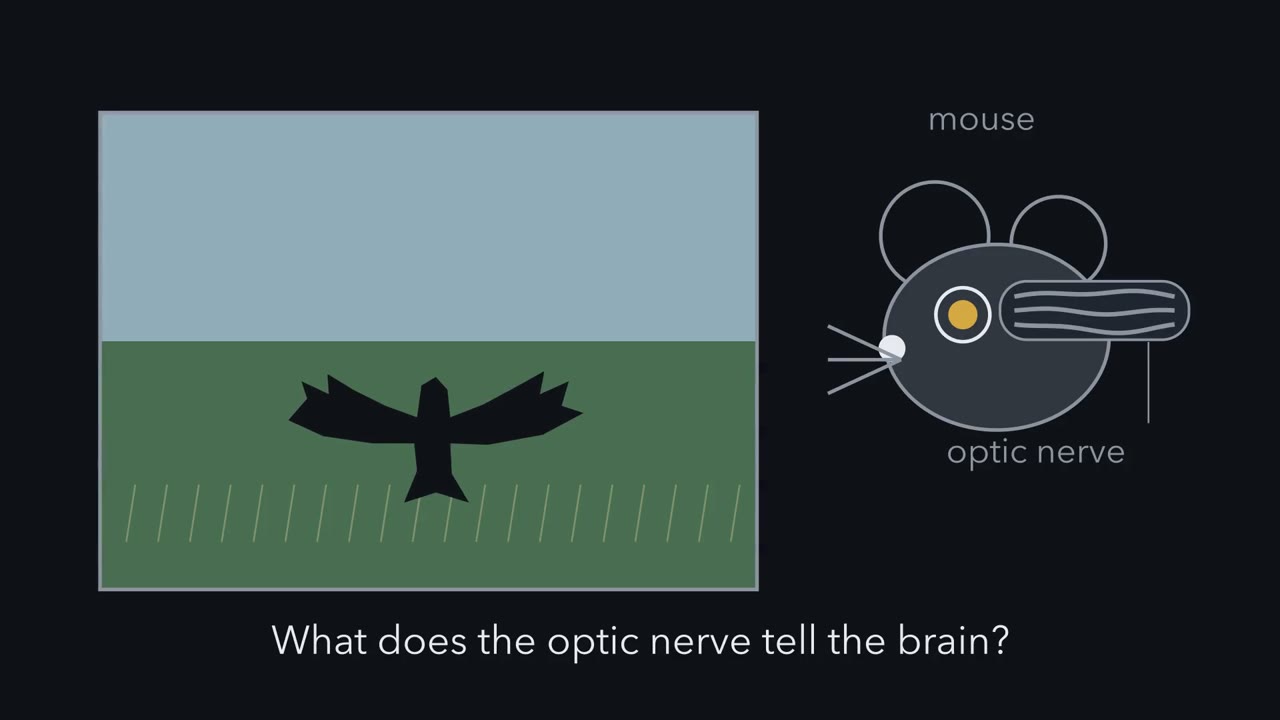
A hawk's shadow slides across a meadow. What does a mouse's optic nerve tell its brain about it? Not a picture: more than 40 kinds of ganglion cell each report the scene through their own filter.
Continue in the lesson: Parallel Channels Out of the Eye →
3:04 · Free, with captions and a transcript. The lesson has the full text, the questions and the sources.
More films from this lesson
How this film was made. Narration: an AI narrator voice (Kokoro, af_heart) reading narration written from this lesson's text. Animation: AI-generated in code (Manim) by Claude, a schematic with no drawn molecular structures. Captions come from the narration script. See something wrong? Report it.