Press play to start at .
One Band, Three Questions
From the film
- SDS-PAGE unfolds each chain and coats it with negative charge, so chains sort by size, the small ones running fastest.
- One band per kind of chain is needed but not enough: two proteins of the same size run together, and a contaminant can hide below what the stain detects.
- A band gives a size, not a name; antibodies, masses and sequence say which protein it is.
- A peptide mass fingerprint can name a known protein by matching its trypsin peptide masses against a database, without reading its sequence.
- Edman degradation reads one residue at a time from the start of the chain; tandem mass spectrometry reads sequence from the gaps between peaks.
Read the transcript of “One Band, Three Questions”
Film transcript: One Band, Three Questions
Tap a sentence to play from there.
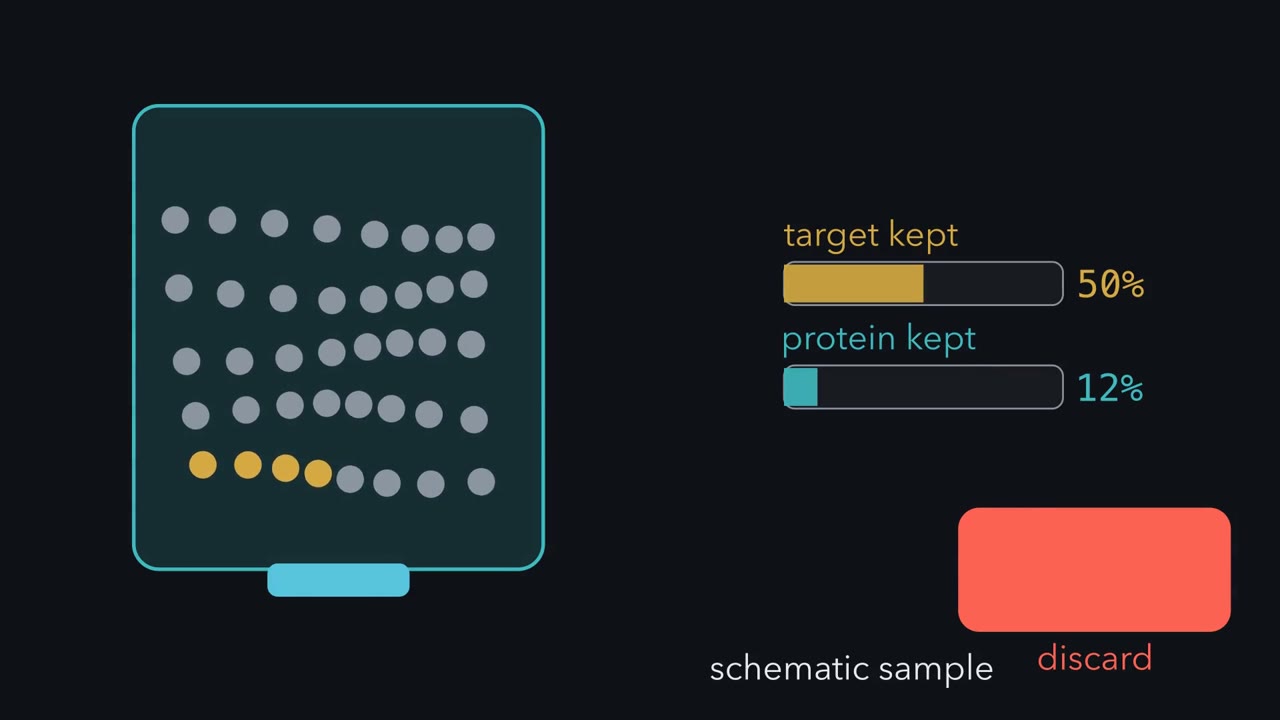
- 0:00 Last time, selective loss left a small tube rich in active target.
- 0:06 Run a sample on a gel.
- 0:08 One clean band appears.
- 0:11 Is it one protein, and which protein is it?
- 0:17 That gel is SDS-PAGE.
- 0:20 The detergent SDS unfolds each chain and coats it with negative charge.
- 0:26 Chains then sort by size alone, the small ones running fastest.
- 0:31 A ladder of marker proteins, each of known size, runs in the next lane.
- 0:37 Read the band against it, and you estimate the chain's size.
- 0:41 That is the gel's first answer.
- 0:44 Its other answer is a first look at purity.
- 0:48 One band per kind of chain is needed, but not enough.
- 0:52 Two proteins of the same size run together.
- 0:56 A contaminant can hide below what the stain detects.
- 0:59 Here is the guiding idea.
- 1:02 A band gives a size, not a name.
- 1:05 Purity and identity are separate questions.
- 1:09 Antibodies, masses and sequence say which protein it is.
- 1:13 First, antibodies.
- 1:16 Copy the gel onto a membrane, band for band.
- 1:20 Probe it with an antibody, and only the matching band lights up.
- 1:25 A validated antibody supports identity.
- 1:28 Second, mass. Trypsin cuts the protein into a predictable set of peptides.
- 1:35 A laser launches them down a flight tube.
- 1:39 Most carry one charge, so heavier ones arrive later.
- 1:43 Arrival times give each peptide's mass, to a fraction of a dalton.
- 1:49 But you never read a single amino acid.
- 1:52 Can a list of masses name the protein?
- 2:00 For a known protein, yes.
- 2:03 A computer predicts the trypsin digest of every protein in a database.
- 2:08 Few proteins give the same set of masses.
- 2:12 The list works like a fingerprint.
- 2:15 Third, sequence. Edman degradation clips the first residue off the chain, names it, and repeats. Each cycle is only about 98% % efficient.
- 2:28 So long proteins are cut into overlapping peptides and read in pieces.
- 2:33 The modern answer is tandem mass spectrometry.
- 2:38 One peptide breaks into a ladder of pieces, each one residue shorter.
- 2:43 Each gap between peaks matches one amino acid.
- 2:47 Leucine and isoleucine weigh the same, so blind spots remain.
- 2:52 Frederick Sanger spent 12 years reading the 51 amino acids of insulin by hand.
- 2:59 Today, mass spectrometry can identify a protein from its peptides in a single run.
- 3:05 So one clean band opens the question of identity.
- 3:10 It does not close it.
- 3:12 Size comes from the gel; the name comes from antibodies, masses or sequence.
Protein purification: the same idea, other levels
A level is a place to start, not a rank. If this loses you, the rung below teaches the same idea, told more simply.
Graduate · the level you chose
Finding a Signal: NGF, EGF and the Bioassay
Dilute twofold from 1:250, then divide units by protein to track purification.
Cell Signaling · about 26 min · film 1:35 · 3 practice questions
College, upper level · the level you chose
Techniques in Protein Biochemistry: Purify It, Then Prove It · this lesson
Specific activity climbs from 10 to 30,000 units/mg across a purification table.
Biochemistry · about 25 min · film 3:16 · 8 practice questions
Play the ladder · 2 films, about 5 min, from upper-level college to graduate level. Each film waits for you to press play.
Next door
- Identifying a protein: How We Know: Detecting a Signal · Graduate school and beyond After purifying a protein you still have to show which protein it is, using a gel, an antibody and its pieces.
- Nerve growth factor: A Tumor That Reaches Nerves Without Touching · 1:34 · Graduate school and beyond The survival factor for young nerve cells was found and purified by following its effect step by step.
- Enzymes: Lower the Ridge, Not the Valleys · 3:18 Tracking an enzyme through each step uses its activity as the test, because enzymes make reactions go.
- Cell fractionation: Where the Twins Disagree · 3:51 · College: the core Breaking cells open and spinning the pieces apart is often where a purification begins.
More films from this lesson
Continue in the lesson: Techniques in Protein Biochemistry: Purify It, Then Prove It →
Free, with captions and a transcript. The lesson has the full text, the questions and the sources.
How this film was made. Narration: an AI narrator voice (Kokoro, af_heart) reading narration written from this lesson's text. Animation: AI-generated in code (Manim) by Claude, a schematic with no drawn molecular structures. Captions come from the narration script. See something wrong? Report it.