Press play to start at .
One Kinase, Many Targets—and Its Brakes
From the film
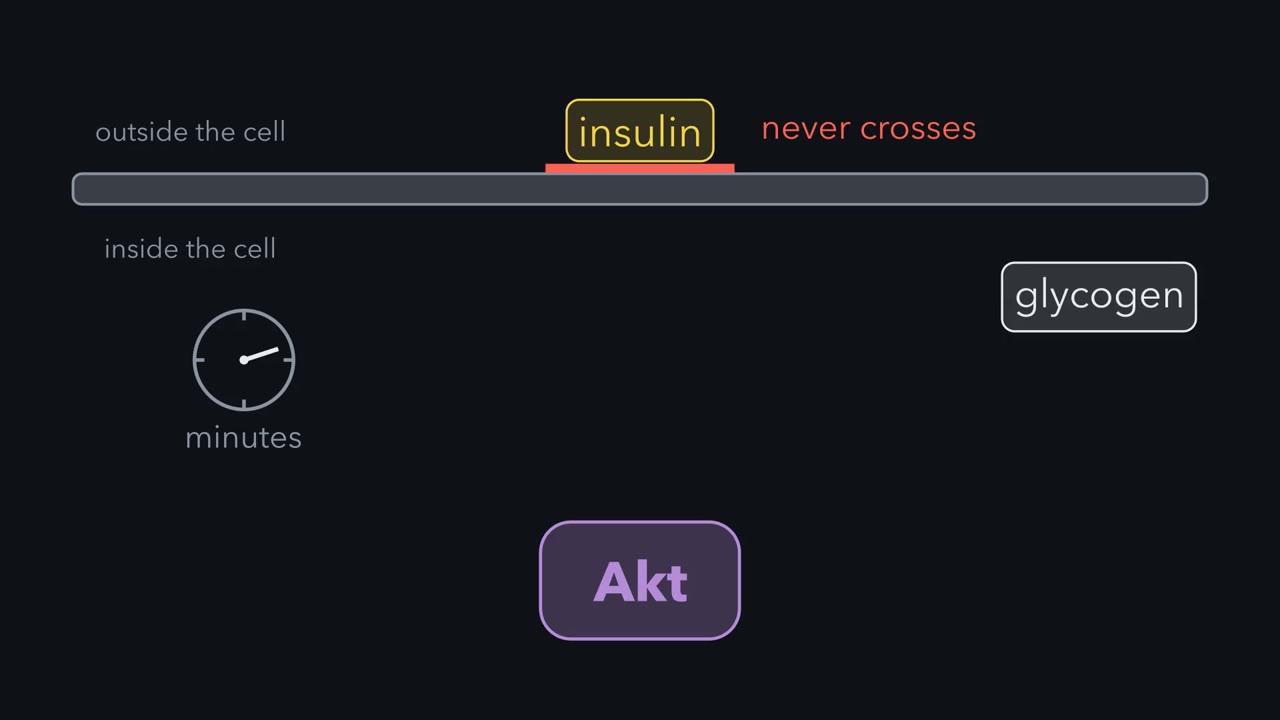
- Akt phosphorylates tissue-specific targets, while erasers and feedback limit the signal.
- In muscle, fat and liver, Akt switches off AS160, GSK3 and FOXO1 to raise glucose uptake, speed glycogen storage and slow gluconeogenic gene transcription over hours.
- PTEN strips the 3-phosphate from PIP3 back to PIP2, tyrosine and protein phosphatases reset the relay, and serine phosphorylation at some IRS-1 sites provides negative feedback.
- Activating PI 3-kinase mutations or PTEN loss lock the pathway on in tumours, whereas overdone serine feedback on IRS-1 weakens the same relay in insulin resistance.
Read the transcript of “One Kinase, Many Targets—and Its Brakes”
Film transcript: One Kinase, Many Targets—and Its Brakes
Tap a sentence to play from there.
- 0:02 The first film showed PIP3 recruiting Akt to the membrane, where two phosphates activate it. Once Akt turns on, how does one kinase drive different tissue jobs without running forever?
- 0:17 The answer combines tissue-specific targets with lipid erasers and negative feedback.
- 0:23 Start in muscle and fat cells.
- 0:26 At rest, emerald glucose transporters wait inside small vesicles.
- 0:32 A brake protein, AS160, holds those vesicles back.
- 0:37 Active Akt phosphorylates that brake and switches it off.
- 0:41 With help from other proteins, vesicles then fuse with the surface, letting glucose stream in.
- 0:48 Next, watch glycogen storage inside muscle and liver.
- 0:53 An enzyme called GSK3 normally phosphorylates glycogen synthase and keeps it slow.
- 1:00 Active Akt phosphorylates GSK3 and shuts it down.
- 1:04 With that brake gone, glycogen synthase speeds up and builds storage chains.
- 1:10 Now zoom into a liver nucleus.
- 1:14 Between meals, FOXO1 sits on DNA, driving genes that build new glucose.
- 1:20 Active Akt phosphorylates FOXO1.
- 1:24 Partner proteins then help move it out and hold it in the cytosol.
- 1:28 Over hours, those glucose-making genes quiet down.
- 1:33 Notice the shared pattern across all three jobs.
- 1:37 Akt switches each target protein off.
- 1:40 Removing a brake turns uptake and storage up; removing a driver turns glucose-making genes down. Keep this second rule.
- 1:50 Akt phosphorylates tissue-specific targets, while erasers and feedback limit the signal.
- 1:56 Every signal needs an off switch.
- 1:59 Tyrosine phosphatases reset the receptor and docking protein.
- 2:05 Mint-green PTEN strips the 3-phosphate from PIP3, restoring slate PIP2.
- 2:12 With its address gone, Akt leaves and loses both phosphates.
- 2:17 Downstream kinases also mark IRS-1 on serines, making it a poorer landing pad for PI 3-kinase.
- 2:25 Test the pattern on one target.
- 2:29 Suppose AS160 is mutated so Akt can no longer phosphorylate it.
- 2:34 When insulin arrives, what happens to glucose uptake in a fat cell?
- 2:44 Fewer vesicles reach the surface, so uptake rises much less, though Akt itself is active. Now push the whole relay both ways.
- 2:55 Lose the eraser PTEN, or mutate PI 3-kinase, and growth signals lock on in tumours.
- 3:02 Overdo serine feedback, and insulin resistance weakens the same relay.
- 3:07 One kinase directs muscle, fat, liver, and growing cells because each tissue supplies its own targets.
- 3:15 Lose an eraser and the signal locks on.
- 3:19 Overdrive feedback and the cell responds weakly to insulin.
- 3:24 Healthy signaling pairs active Akt with reliable erasers and negative feedback.
PI3K and Akt: the same idea, other levels
A level is a place to start, not a rank. If this loses you, the rung below teaches the same idea, told more simply.
Graduate · the level you chose
PI 3-Kinase, Akt and Insulin · this lesson
IRS-1 recruits PI 3-kinase, PIP3 holds Akt, PDK1 switches it on; PTEN ends it.
Cell Signaling · about 15 min · film 3:21 · 3 practice questions
Next door
- Blood sugar control: How the body switches fuels · 2:32 · College: going further Insulin lowers blood glucose through this relay, and insulin resistance is a break in it.
- mTOR: mTORC1: Two Signals at the Lysosome · 3:33 Akt passes the growth message on to mTORC1, which decides whether the cell builds.
- Cancer: How a Normal Switch Sticks On · 3:10 This pathway is switched on too much in many tumours, so cells survive and grow when they should not.
More films from this lesson
Continue in the lesson: PI 3-Kinase, Akt and Insulin →
Free, with captions and a transcript. The lesson has the full text, the questions and the sources.
How this film was made. Narration: an AI narrator voice (Kokoro, af_heart) reading narration written from this lesson's text. Animation: AI-generated in code (Manim) by Claude, a schematic with no drawn molecular structures. Captions come from the narration script. See something wrong? Report it.